Painful Sex in Perimenopause: What Helps, and for How Long?
Pain with sex may continue if its cause isn’t addressed, but the right next step depends on whether it feels like surface friction or deeper pelvic pain.
There isn’t a reliable timetable for painful sex in perimenopause. When dryness related to hormonal changes is involved, symptoms may persist without treatment, but pain can also come from pelvic-floor tension, skin or inflammatory conditions, or other pelvic causes. Lubricants and vaginal moisturizers may help dryness; ongoing, deep, or unexplained pain deserves evaluation rather than waiting for menopause to end. 3 4
There’s no predictable finish line
Painful sex can start or become more noticeable during perimenopause, especially as vaginal dryness and irritation become more common. But there’s no dependable timeline for when pain will improve. A review of perimenopause research notes that vaginal symptoms may not go away without treatment; that doesn’t mean every case has the same cause or course. 3
Hormone-related dryness is one possibility, not the whole explanation. Reduced vaginal fluid can make penetration uncomfortable, and dryness can occur alongside pain for other reasons, including not being sufficiently aroused. Pelvic-floor muscle tension, irritation or skin conditions, and other pelvic problems can also contribute. More than one cause may be present at once. 1 4
Start with where and when it hurts
Pain at the vaginal opening, or a burning or sore feeling as penetration begins, points toward a different set of possibilities than pain felt deeper in the pelvis. Note whether discomfort happens only with penetration or also at other times, and whether you have dryness, itching, urinary symptoms, unusual discharge, or bleeding. These details help distinguish possible causes; they don’t diagnose one on their own. 1 4
Deep pain is a reason to look beyond vaginal dryness. A clinician may assess the vulva and vaginal opening, vaginal tissues, and pelvic-floor muscles, and consider a broader pelvic evaluation if the pattern suggests a deeper cause. Pain during sex can have causes unrelated to menopause, and a menopause-related treatment won’t necessarily address them. 4
For example, pain deep in the pelvis that comes with painful periods or pain when having a bowel movement can be relevant to a broader evaluation. In a study of women ages 18-44 who underwent pelvic surgery, deep pain with intercourse and pain with bowel elimination were more common among those with surgically identified endometriosis than among women without it. That surgical sample cannot tell you what’s causing pain in an individual, but it illustrates why deep pain shouldn’t automatically be assumed to be dryness. 5
Match the option to the likely cause
If dryness or friction seems to be part of the problem, a lubricant used for sex can reduce friction, while a vaginal moisturizer is intended to ease ongoing dryness. These are different uses, and neither is a treatment for every cause of painful sex. 1
If dryness and irritation continue, ask whether clinically significant genitourinary symptoms of menopause could be involved. The North American Menopause Society recommends considering low-dose vaginal estrogen for bothersome symptoms that haven’t improved with over-the-counter therapies, when systemic hormone therapy isn’t otherwise indicated. It’s a targeted option for vaginal symptoms, not a general treatment for deep pelvic pain or pelvic-floor tension; whether it suits you depends on your situation. 6 2
If an assessment finds pelvic-floor tenderness, guarding, or difficulty with penetration, pelvic-floor physical therapy may be considered. Evidence specific to menopause-related pelvic-floor problems is limited, so recommendations draw cautiously on research about other kinds of painful sex and pelvic pain. 4
When to get the pain checked
Arrange an evaluation if pain persists, keeps returning, or is affecting your sex life despite trying measures aimed at dryness. Seek assessment sooner for bleeding after sex, unusual vaginal discharge, or soreness and itching that don’t settle. These symptoms can have causes that need a different response than menopause-related dryness. 1
A useful way to describe the problem is: “It hurts at the opening,” “It feels deep,” or “It burns or aches even when I’m not having sex.” Add when it began and any accompanying symptoms. That description can help focus the evaluation on the right area and possible cause, rather than treating every kind of pain as low estrogen.
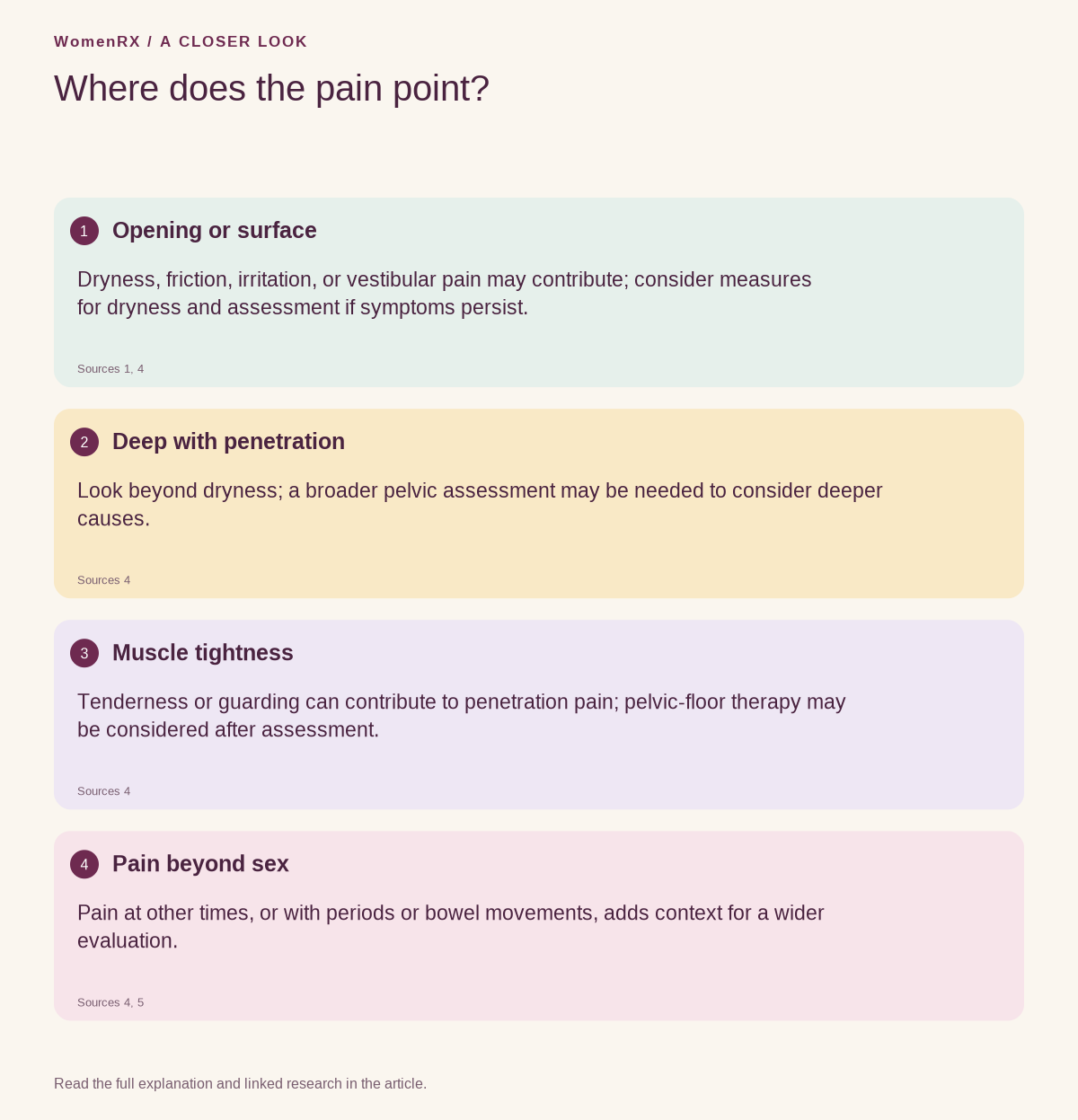
Where does the pain point?
Opening or surface: Dryness, friction, irritation, or vestibular pain may contribute; consider measures for dryness and assessment if symptoms persist.14
Deep with penetration: Look beyond dryness; a broader pelvic assessment may be needed to consider deeper causes.4
Muscle tightness: Tenderness or guarding can contribute to penetration pain; pelvic-floor therapy may be considered after assessment.4
Pain beyond sex: Pain at other times, or with periods or bowel movements, adds context for a wider evaluation.45
Read the figure as text
Pain location and timing can help identify which possibilities to discuss and whether dryness-focused measures are likely to be enough.- Opening or surface: Dryness, friction, irritation, or vestibular pain may contribute; consider measures for dryness and assessment if symptoms persist.14
- Deep with penetration: Look beyond dryness; a broader pelvic assessment may be needed to consider deeper causes.4
- Muscle tightness: Tenderness or guarding can contribute to penetration pain; pelvic-floor therapy may be considered after assessment.4
- Pain beyond sex: Pain at other times, or with periods or bowel movements, adds context for a wider evaluation.45
More questions, answered
Would vaginal estrogen help pain that feels deep?
Vaginal estrogen is aimed at vaginal dryness and irritation related to menopause. Deep pain can have other causes, so it may need a broader evaluation rather than assuming that local treatment will resolve it. 2 4
Sources you can check
- Vaginal dryness - NHSAccessed 2026-09-25Return to first citation
- About vaginal oestrogen - NHSAccessed 2026-09-25Return to first citation
- Perimenopause: From Research to Practice.Santoro N. · Journal of women's health (2002) · 2016Return to first citation
- Assessment and management of dyspareunia in peri- and postmenopausal women: A phenotype-based gynecologic approach.Broul M, Vančo M, Banýrová J, Hujová A. · International journal of gynaecology and obstetrics: the official organ of the International Federation of Gynaecology and Obstetrics · 2026Return to first citation
- Pain typology and incident endometriosis.Schliep KC, Mumford SL, Peterson CM, Chen Z, Johnstone EB, Sharp HT, Stanford JB, Hammoud AO, Sun L, Buck Louis GM. · Human reproduction (Oxford, England) · 2015Return to first citation
- The 2022 hormone therapy position statement of The North American Menopause Society.“The 2022 Hormone Therapy Position Statement of The North American Menopause Society” Advisory Panel. · Menopause (New York, N.Y.) · 2022Return to first citation