Vaginal Dryness in Perimenopause: How Long It May Last and What Helps
Menopause-related vaginal dryness can continue after periods stop, but options range from symptom-time lubrication to treatments for persistent discomfort.
There’s no dependable countdown for perimenopause-related vaginal dryness. It may continue after your final period, and it may not fade on its own. Lubricants are used around sex; moisturizers are meant to help with dryness beyond sex. If symptoms persist, affect daily life, or come with unusual discharge or bleeding, get them assessed and discuss options that fit your symptoms and preferences. 1 6
There’s no set end date
Vaginal dryness can become more noticeable later in the menopause transition, but it doesn’t affect everyone in the same way. In a cross-sectional study of women aged 40 to 69, vaginal dryness was more strongly associated with late perimenopause than with premenopause. The study asked about symptoms in the previous four weeks, so it doesn’t tell us how many months or years dryness lasts for an individual. 5
For some women, symptoms continue after their periods stop. A review of perimenopause describes vaginal dryness and pain during sex as symptoms that may not go away without treatment, unlike hot flashes, which can ease over time. That’s a reason not to assume you simply have to wait it out, not a prediction that everyone will have persistent symptoms. 6
Lower estrogen can contribute to changes in vaginal fluid. But dryness isn’t automatically caused by perimenopause: it can also be related to not being aroused during sex, certain cancer treatments, or conditions such as diabetes or Sjögren’s syndrome. 1 If the cause isn’t clear, or symptoms are new or changing, an assessment can help consider other explanations too.
Choose by what you want relief from
Lubricant is for the moment. A water-based lubricant can be used before sex. It’s meant to help with comfort during sexual activity, rather than to provide ongoing relief between encounters. 1
A vaginal moisturizer is for dryness beyond sex. It’s used inside the vagina to help keep it moist. Lubricant and moisturizer aren’t interchangeable: one is used around sex, while the other is intended to address dryness more generally. 1
If these options don’t provide enough relief, a clinician can discuss treatments for persistent menopause-related symptoms. The North American Menopause Society recommends considering low-dose vaginal estrogen or other therapies, including vaginal dehydroepiandrosterone (DHEA), for bothersome genitourinary symptoms that haven’t improved with over-the-counter options when systemic hormone therapy isn’t otherwise indicated. The right choice depends on your symptoms, medical history, and preferences. 4
Vaginal estrogen is local treatment. It’s intended to treat symptoms such as vaginal dryness and irritation, not hot flashes or sleep problems. Little of the medicine gets into the rest of the body, so its risk profile differs from systemic hormone therapy; individual suitability still matters. It can take time to work fully, and symptoms may return if treatment is stopped. 2 3
When persistent symptoms deserve attention
Consider an assessment if dryness lasts for a few weeks and self-care hasn’t helped, or if it’s affecting your daily life. Unusual discharge also warrants attention. Bleeding after sex, between periods, or after menopause should be checked rather than assumed to be dryness. 1
A useful way to describe the problem is whether it mainly causes discomfort during sex, bothers you at other times too, or comes with another change such as discharge or bleeding. That distinction can help focus a discussion on whether lubrication, a moisturizer, assessment for another cause, or a treatment for ongoing menopause-related symptoms best fits your situation.
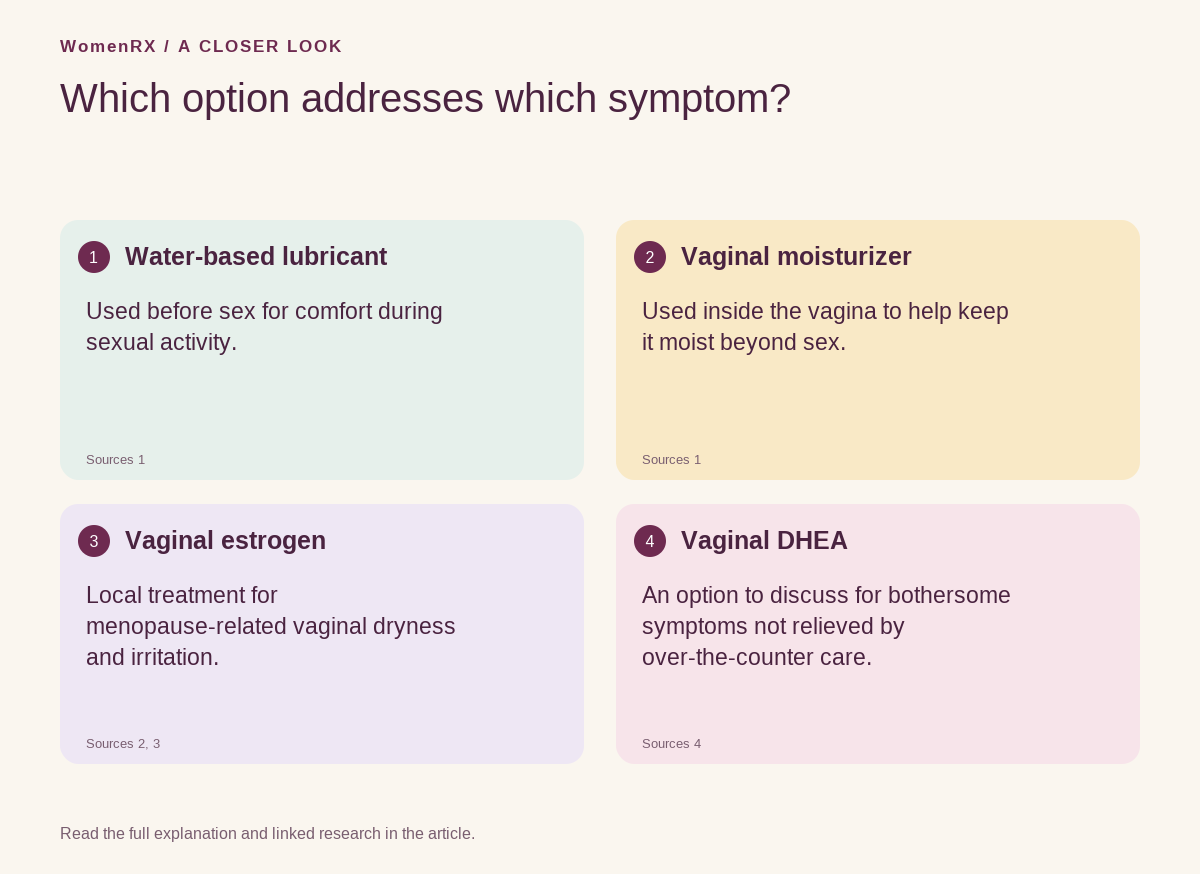
Which option addresses which symptom?
Water-based lubricant: Used before sex for comfort during sexual activity.1
Vaginal moisturizer: Used inside the vagina to help keep it moist beyond sex.1
Vaginal estrogen: Local treatment for menopause-related vaginal dryness and irritation.23
Vaginal DHEA: An option to discuss for bothersome symptoms not relieved by over-the-counter care.4
Read the figure as text
These options differ by whether relief is for sex-related discomfort, dryness at other times, or persistent menopause-related symptoms.- Water-based lubricant: Used before sex for comfort during sexual activity.1
- Vaginal moisturizer: Used inside the vagina to help keep it moist beyond sex.1
- Vaginal estrogen: Local treatment for menopause-related vaginal dryness and irritation.23
- Vaginal DHEA: An option to discuss for bothersome symptoms not relieved by over-the-counter care.4
Sources you can check
- Vaginal dryness - NHSAccessed 2026-09-25Return to first citation
- About vaginal oestrogen - NHSAccessed 2026-09-25Return to first citation
- Common questions about vaginal oestrogen - NHSAccessed 2026-09-25Return to first citation
- The 2022 hormone therapy position statement of The North American Menopause Society.“The 2022 Hormone Therapy Position Statement of The North American Menopause Society” Advisory Panel. · Menopause (New York, N.Y.) · 2022Return to first citation
- Prevalence and severity of symptoms across the menopause transition: cross-sectional findings from the Australian Women's Midlife Years (AMY) Study.Islam RM, Bond M, Ghalebeigi A, Wang Y, Walker-Bone K, Davis SR. · The lancet. Diabetes & endocrinology · 2025Return to first citation
- Perimenopause: From Research to Practice.Santoro N. · Journal of women's health (2002) · 2016Return to first citation