Nonhormonal Relief for Menopause-Related Vaginal Dryness
Moisturizers are used for vaginal dryness itself; lubricants are used before sexual activity, so the right choice depends on when you want relief.
For dryness during everyday life, a vaginal moisturizer is designed to be used inside the vagina to keep it moist. A lubricant is used before sexual activity and can be applied in and around the vagina. These products can ease symptoms, but they don’t explain every cause of soreness or pain. Persistent symptoms, unusual discharge, or bleeding after menopause deserve an examination. 1 4
Choose by when you need relief
Menopause can reduce vaginal fluid and leave the genital area dry, sore, itchy, or uncomfortable during sex. These symptoms can be part of genitourinary syndrome of menopause, which can also involve urinary symptoms. 1 4
A useful first distinction is timing: a vaginal moisturizer is used for dryness itself, while a lubricant is used before sexual activity. They have different jobs, so one isn’t automatically a substitute for the other. 1
Moisturizers: for dryness beyond sex
Vaginal moisturizers are put inside the vagina to keep it moist. That makes them an option to consider if dryness bothers you during the day, not only during sex. They may also be useful if you aren’t sexually active but want relief from dryness. 1 2
The evidence suggests moisturizers may improve dryness, but certainty is low. A 2024 systematic review found only four randomized trials of vaginal moisturizers among the studies it evaluated. The studies varied, and the review could not combine their results in a meta-analysis. It doesn’t establish one type or ingredient as best. 2
Lubricants: for sexual activity
Lubricants are used before sex. NHS guidance describes water-based lubricants and says they can be applied in and around the vagina, or to a partner’s penis, fingers, or a sex toy. If discomfort happens during sexual activity, this is the product category to consider for that situation. 1
You don’t need to use a lubricant just because you’re using a moisturizer, or a moisturizer just because you’re using a lubricant. Pick based on the symptom and when it occurs. If sex remains painful despite trying a lubricant, don’t assume dryness is the only explanation. 1 4
What these products can, and can’t, do
Moisturizers and lubricants are intended to provide symptom relief. They are not a guarantee that all menopause-related tissue changes will reverse, and neither product treats every possible cause of genital discomfort. A small open-label study of one hyaluronic-acid moisturizer reported improvement in symptoms among 45 postmenopausal participants who completed the study, but it doesn’t show that every product works the same way or that its results apply to everyone. 2 3 4
If you try a product, follow its package directions. For washing around the vagina, NHS guidance recommends unperfumed soaps and washes. 1
When dryness may not be the whole story
Menopause is one possible cause of dryness, but low fluid during sex can also relate to not being aroused. Other conditions, including diabetes and Sjögren’s syndrome, can be associated with dryness too. Itching, soreness, unusual discharge, urinary changes, or pain that doesn’t improve can point to a problem that needs more than a moisturizer or lubricant. 1
Arrange an examination if symptoms have lasted a few weeks and products you’ve tried aren’t helping, or if dryness is affecting daily life. Unusual discharge should also be checked. Any bleeding after menopause, including bleeding after sex, deserves medical attention rather than being treated as dryness alone. 1
If discomfort during sex continues, a clinician can assess whether other factors, such as pelvic-floor tension, may be involved. The goal is to match the treatment to what’s causing your symptoms, not just to keep trying products that aren’t helping. 4
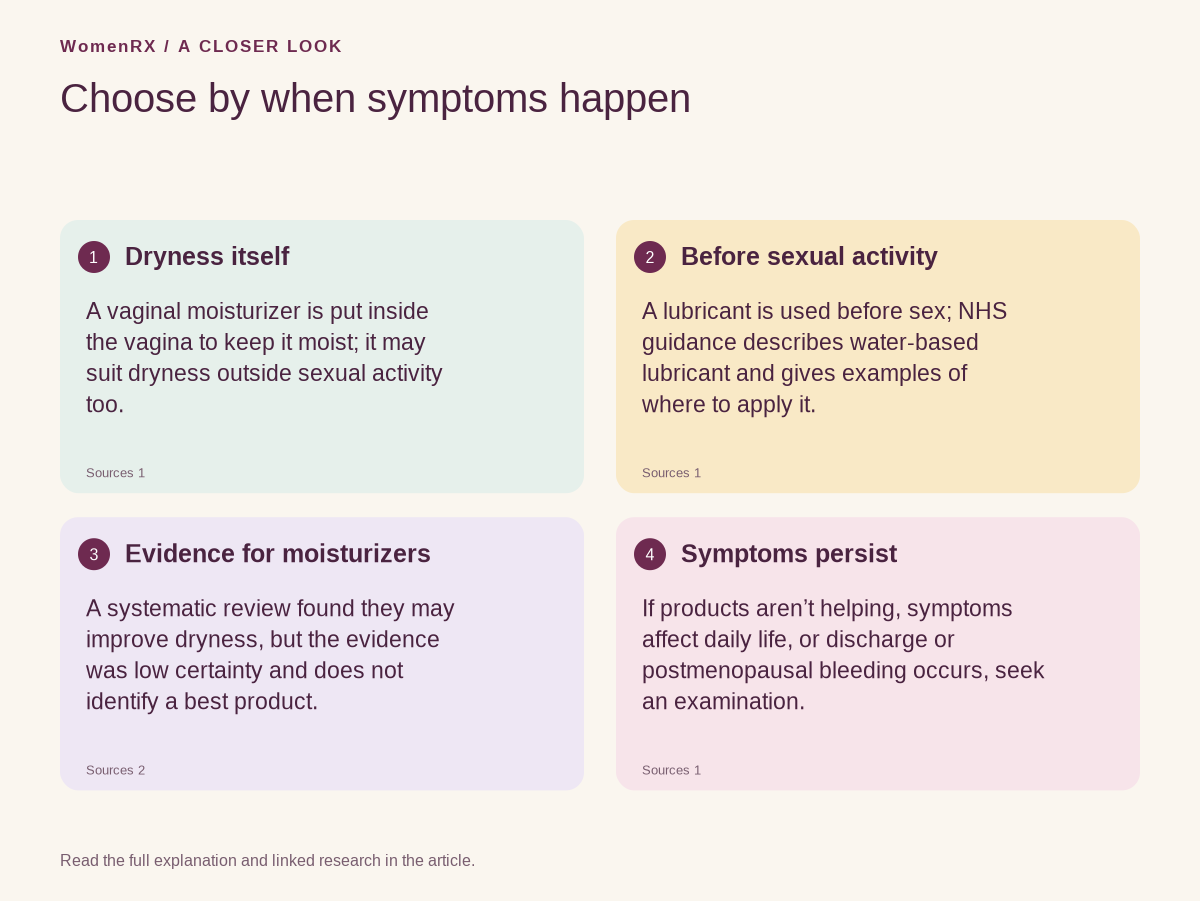
Choose by when symptoms happen
Dryness itself: A vaginal moisturizer is put inside the vagina to keep it moist; it may suit dryness outside sexual activity too.1
Before sexual activity: A lubricant is used before sex; NHS guidance describes water-based lubricant and gives examples of where to apply it.1
Evidence for moisturizers: A systematic review found they may improve dryness, but the evidence was low certainty and does not identify a best product.2
Symptoms persist: If products aren’t helping, symptoms affect daily life, or discharge or postmenopausal bleeding occurs, seek an examination.1
Read the figure as text
Moisturizers and lubricants serve different purposes. This comparison separates everyday dryness from symptoms around sexual activity.- Dryness itself: A vaginal moisturizer is put inside the vagina to keep it moist; it may suit dryness outside sexual activity too.1
- Before sexual activity: A lubricant is used before sex; NHS guidance describes water-based lubricant and gives examples of where to apply it.1
- Evidence for moisturizers: A systematic review found they may improve dryness, but the evidence was low certainty and does not identify a best product.2
- Symptoms persist: If products aren’t helping, symptoms affect daily life, or discharge or postmenopausal bleeding occurs, seek an examination.1
More questions, answered
Can I use a vaginal moisturizer if I’m not sexually active?
Yes. Vaginal moisturizers are used for vaginal dryness itself; sexual activity isn’t required. Follow the product’s directions. 1
When should I get persistent dryness checked?
Arrange an examination if symptoms last a few weeks despite trying products, affect daily life, or come with unusual discharge. Bleeding after menopause should also be checked. 1
Sources you can check
- Vaginal dryness - NHSAccessed 2026-09-25Return to first citation
- Hormonal Treatments and Vaginal Moisturizers for Genitourinary Syndrome of Menopause : A Systematic Review.Danan ER, Sowerby C, Ullman KE, Ensrud K, Forte ML, Zerzan N, Anthony M, Kalinowski C, Abdi HI, Friedman JK, Landsteiner A, Greer N, Nardos R, Fok C, Dahm P, Butler M, Wilt TJ, Die... · Annals of internal medicine · 2024Return to first citation
- Managing Vulvovaginal Atrophy, in Postmenopausal Women, Without Hormones: Efficacy of a Hyaluronic Acid Vaginal Moisturizer.Falcão MAP, Pereira CPM, de Castro TL, Brunetti JDV, Cunha AS, Taira AM, Kummer AM. · Healthcare (Basel, Switzerland) · 2026Return to first citation
- Clinical Practice Guidelines for Managing Genitourinary Symptoms Associated With Menopause.Christmas M, Huguenin A, Iyer S. · Clinical obstetrics and gynecology · 2024Return to first citation