Nonhormonal Relief for Vaginal Menopause Symptoms
A moisturizer is for ongoing dryness, while a lubricant is for reducing friction during sexual activity.
For ongoing vaginal dryness, try a vaginal moisturizer; for sex, use a lubricant at the time. They serve different purposes, and neither should be assumed to work like hormone therapy, which the North American Menopause Society identifies as the most effective treatment for genitourinary menopause symptoms. If over-the-counter options don’t help, other treatments may be worth discussing. 1 2
Match the product to the moment
Vaginal dryness, irritation, and pain with sex can continue after menopause as estrogen levels fall. If you’d rather avoid vaginal estrogen, two over-the-counter options are worth distinguishing: moisturizers are meant to ease symptoms between sexual activity, while lubricants are used during sexual activity to reduce friction. A review of these products describes them as options for symptom relief, but notes that their ingredients and formulations vary widely. 1
A moisturizer is for ongoing dryness. Use it according to its label for symptom control. It isn’t just for sex, and a lubricant used only during sex may not address dryness at other times. 1
A lubricant is for sexual activity. Use it when friction or discomfort is a concern. It can help with comfort during sex, but that doesn’t mean it will relieve dryness the rest of the week. 1
These products relieve symptoms; they aren’t equivalent to vaginal estrogen. The North American Menopause Society identifies hormone therapy as the most effective treatment for genitourinary symptoms of menopause and recommends considering other treatments when over-the-counter options haven’t relieved bothersome symptoms. 2
Compare ingredients, not just labels
“Moisturizer” and “lubricant” describe intended use, but products can differ in their ingredients and how closely their properties resemble vaginal secretions. A review advises choosing products with pH and osmolality as close as possible to those of vaginal secretions. It also cautions that some formulations may have detrimental effects, so a “natural” label alone doesn’t establish safety or effectiveness. 1
Hyaluronic acid is used in some nonhormonal local products. A paper discussing care for women with cancer-related genitourinary symptoms describes local approaches such as hyaluronic acid as moderately limited in efficacy. That assessment comes from a cancer-care context and doesn’t establish whether hyaluronic acid works better than other moisturizers or lubricants for women more broadly. 4
A practical way to compare products is to ask: Is this intended for dryness outside sexual activity or for sex? Does the label explain how to use it? If it doesn’t help, or it causes irritation, is there a different formulation to consider? Those questions are more useful than assuming that a particular ingredient or “natural” claim guarantees a result.
If dryness isn’t the whole problem
If you have cancer-related menopause symptoms and sex is painful, lubricant isn’t the only option to discuss. A review focused on women with cancer lists pelvic floor physical therapy, dilator therapy, and counseling among tailored approaches. It doesn’t establish which approach is best for every woman with menopause-related pain. 5
Vaginal laser treatment is sometimes presented as another alternative, but the evidence doesn’t show that it adds benefit over a sham procedure in a studied group of breast cancer survivors. In a randomized trial, both groups received nonhormonal moisturizers and vaginal vibrator stimulation; after six months, laser treatment did not produce significantly greater improvement than sham treatment in sexual function or other assessed outcomes. The result applies to that study population and doesn’t prove what would happen in every group of women. 3
If a moisturizer and lubricant aren’t enough, describe which symptoms persist and what you’ve tried. For persistent, bothersome symptoms, guideline-supported options include low-dose vaginal estrogen and other prescription treatments. Those treatments aren’t simply interchangeable with nonhormonal products, so be clear that you prefer to avoid estrogen and ask which options fit your situation. 2
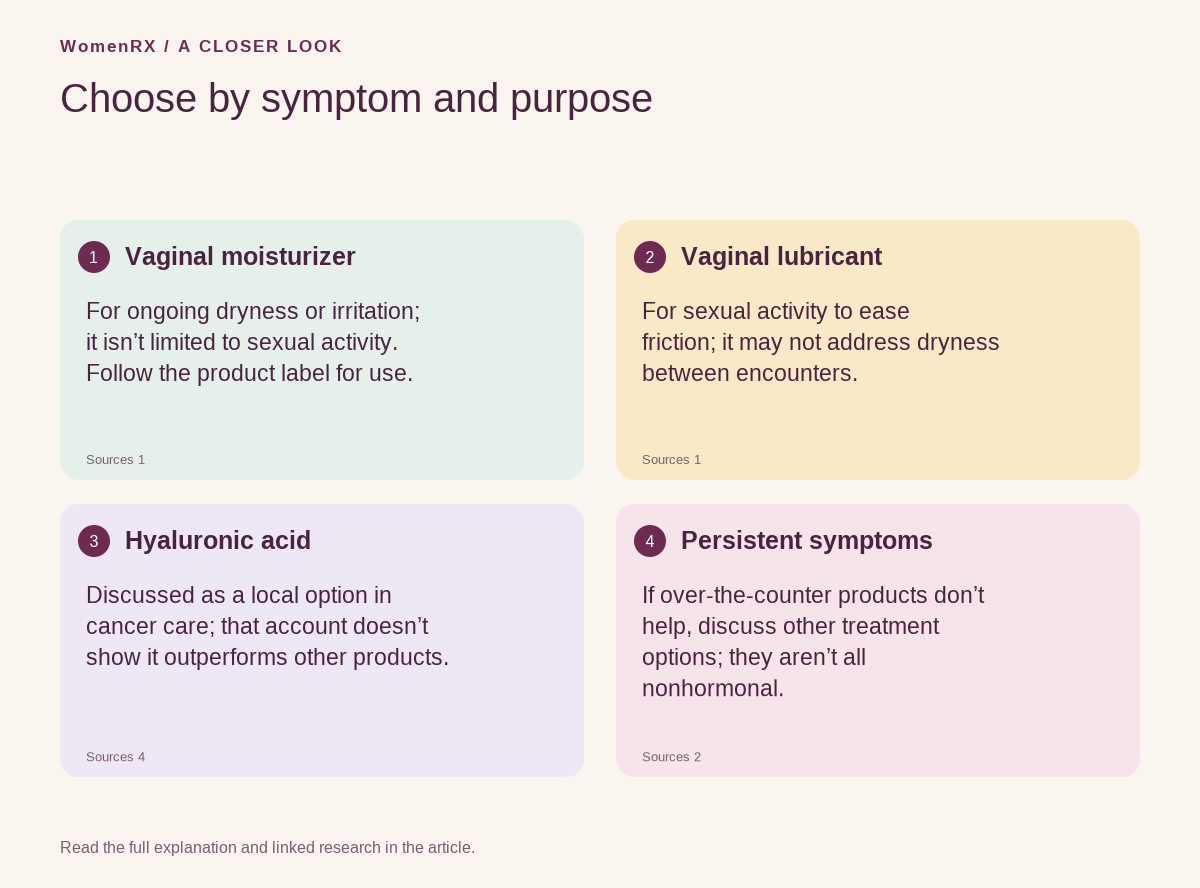
Choose by symptom and purpose
Vaginal moisturizer: For ongoing dryness or irritation; it isn’t limited to sexual activity. Follow the product label for use.1
Vaginal lubricant: For sexual activity to ease friction; it may not address dryness between encounters.1
Hyaluronic acid: Discussed as a local option in cancer care; that account doesn’t show it outperforms other products.4
Persistent symptoms: If over-the-counter products don’t help, discuss other treatment options; they aren’t all nonhormonal.2
Read the figure as text
These options differ in when they’re used, what the evidence can support, and when it may be time to discuss other care.- Vaginal moisturizer: For ongoing dryness or irritation; it isn’t limited to sexual activity. Follow the product label for use.1
- Vaginal lubricant: For sexual activity to ease friction; it may not address dryness between encounters.1
- Hyaluronic acid: Discussed as a local option in cancer care; that account doesn’t show it outperforms other products.4
- Persistent symptoms: If over-the-counter products don’t help, discuss other treatment options; they aren’t all nonhormonal.2
More questions, answered
Can I use a moisturizer and lubricant?
They have different intended uses: moisturizers are for ongoing symptom control, and lubricants are for sexual activity. A review says they can be used even when topical or systemic menopause hormone therapy is also being used. 1
Does a product labeled natural mean it’s safer or more effective?
No. Product composition varies, and some formulations may have detrimental effects. A review recommends considering how closely a product’s pH and osmolality resemble vaginal secretions rather than relying on a natural label. 1
Sources you can check
- Vaginal lubricants and moisturizers: a review into use, efficacy, and safety.Potter N, Panay N. · Climacteric : the journal of the International Menopause Society · 2021Return to first citation
- The 2022 hormone therapy position statement of The North American Menopause Society.“The 2022 Hormone Therapy Position Statement of The North American Menopause Society” Advisory Panel. · Menopause (New York, N.Y.) · 2022Return to first citation
- Effect of Fractional Carbon Dioxide vs Sham Laser on Sexual Function in Survivors of Breast Cancer Receiving Aromatase Inhibitors for Genitourinary Syndrome of Menopause: The LIGHT Randomized Clinical Trial.Mension E, Alonso I, Anglès-Acedo S, Ros C, Otero J, Villarino Á, Farré R, Saco A, Vega N, Castrejón N, Ordi J, Rakislova N, Tortajada M, Matas I, Gómez S, Ribera L, Castelo-Branco... · JAMA network open · 2023Return to first citation
- Efficacy of a Diode Vaginal Laser in the Treatment of the Genitourinary Syndrome of Menopause.Barba M, Cola A, De Vicari D, Costa C, Castelli AP, Volontè S, Fruscio R, Frigerio M. · Bioengineering (Basel, Switzerland) · 2023Return to first citation
- Management of genitourinary syndrome of menopause in female cancer patients: a focus on vaginal hormonal therapy.Crean-Tate KK, Faubion SS, Pederson HJ, Vencill JA, Batur P. · American journal of obstetrics and gynecology · 2020Return to first citation