Vaginal Moisturizers: How to Choose and Use Them
A moisturizer can help with ongoing dryness, while a water-based lubricant is an option before sex; the cause of your symptoms matters too.
A vaginal moisturizer helps keep the vagina moist beyond sex; a water-based lubricant is an option before sex. 1 Choose a product labeled for vaginal use and follow its directions. If it causes new irritation, stop using it. If dryness persists despite a few weeks of self-care, affects daily life, or comes with unusual discharge or bleeding after sex, between periods, or after menopause, seek a review. 1
First, match the product to the moment
A vaginal moisturizer is meant to ease dryness between sexual activity. A water-based lubricant is an option before sex. They’re not interchangeable: a moisturizer may be used inside the vagina to keep it moist, while lubricant is applied before sex. Follow the product’s directions for where and how to use it. 1
If dryness is mainly a problem during sex, a water-based lubricant before sex may suit that situation. If it bothers you at other times too, a moisturizer may be worth trying. Some people may use both for different situations.
What to compare on the label
Start with the intended use: choose a product specifically labeled for vaginal use if you plan to insert it. Check whether the directions say to apply it inside the vagina or around it, and follow those directions rather than assuming all products are used the same way. Check the ingredient list too, especially if you’re comparing a product with one that irritated you. An ingredient name alone doesn’t tell you whether a product will suit you.
Hyaluronic acid and polycarbophil are two non-hormonal moisturizer ingredients studied for vaginal dryness. In a randomized trial of 53 women in the menopausal transition, both gels were associated with improvement over 30 days, and polycarbophil was found not inferior to hyaluronic acid. That’s a reason not to assume that hyaluronic acid is automatically the better choice; the study compared two products, not either product with no treatment. 4
Use an unperfumed soap or wash around the vulva rather than scented products. 1
What a moisturizer can, and can’t, tell you
Some trials report improvements, but the evidence isn’t uniformly positive. In a 12-week randomized trial of 302 postmenopausal women with moderate-to-severe vulvovaginal symptoms, the average reduction in the most bothersome symptom was similar with moisturizer and placebo: 1.2 points versus 1.3 on a 0-to-3 severity scale. The moisturizer did not provide a statistically significant benefit over placebo in that study. 5
Other trials have found improvements on some measures. For example, a randomized study of 100 postmenopausal women with breast cancer who had completed oncological treatment, excluding endocrine therapy from that completion requirement, compared moisturizer used regularly with lubricant used during sex. The moisturizer group had better scores on several vaginal and vulvar health measures at 8 and 16 weeks. The different findings don’t establish that every moisturizer works for every cause of dryness; the studies involved different people and comparisons. 3 5
Dryness can have different causes
Menopause and some cancer treatments can change hormone levels and reduce vaginal fluid. Dryness can also be related to not being aroused during sex or to conditions such as diabetes or Sjögren’s syndrome. A moisturizer may ease symptoms, but it doesn’t identify or treat every underlying cause. 1
Postpartum and breastfeeding are different contexts from menopause. If dryness starts after birth or while breastfeeding, mention that timing when you seek advice; evidence from postmenopausal trials doesn’t establish the cause or best treatment in those circumstances.
If symptoms continue despite trying a product, treatment options depend on the cause. For hormone-related dryness, hormonal treatments may be an option for some people, but they aren’t suitable for everyone. If you’ve had breast cancer or take an aromatase inhibitor, don’t assume a moisturizer is the only option or that menopause studies settle the decision: a small randomized trial in 23 breast cancer survivors taking aromatase inhibitors found greater improvement in dryness and pain with vaginal estrogen than with non-hormonal moisturizer, but larger studies and longer follow-up are needed to clarify long-term safety and effectiveness. 1 2
When to have the symptoms reviewed
If a moisturizer causes new burning or irritation, stop using it rather than pushing through. If the irritation doesn’t settle, have it reviewed instead of trying to cover it with another product.
Seek a review if dryness has lasted a few weeks and self-care hasn’t helped, if it’s affecting daily life, or if you have unusual discharge. Bleeding after sex, between periods, or after menopause also warrants assessment. These symptoms can point to something other than simple dryness, so changing moisturizer brands may not be the most useful next step. 1
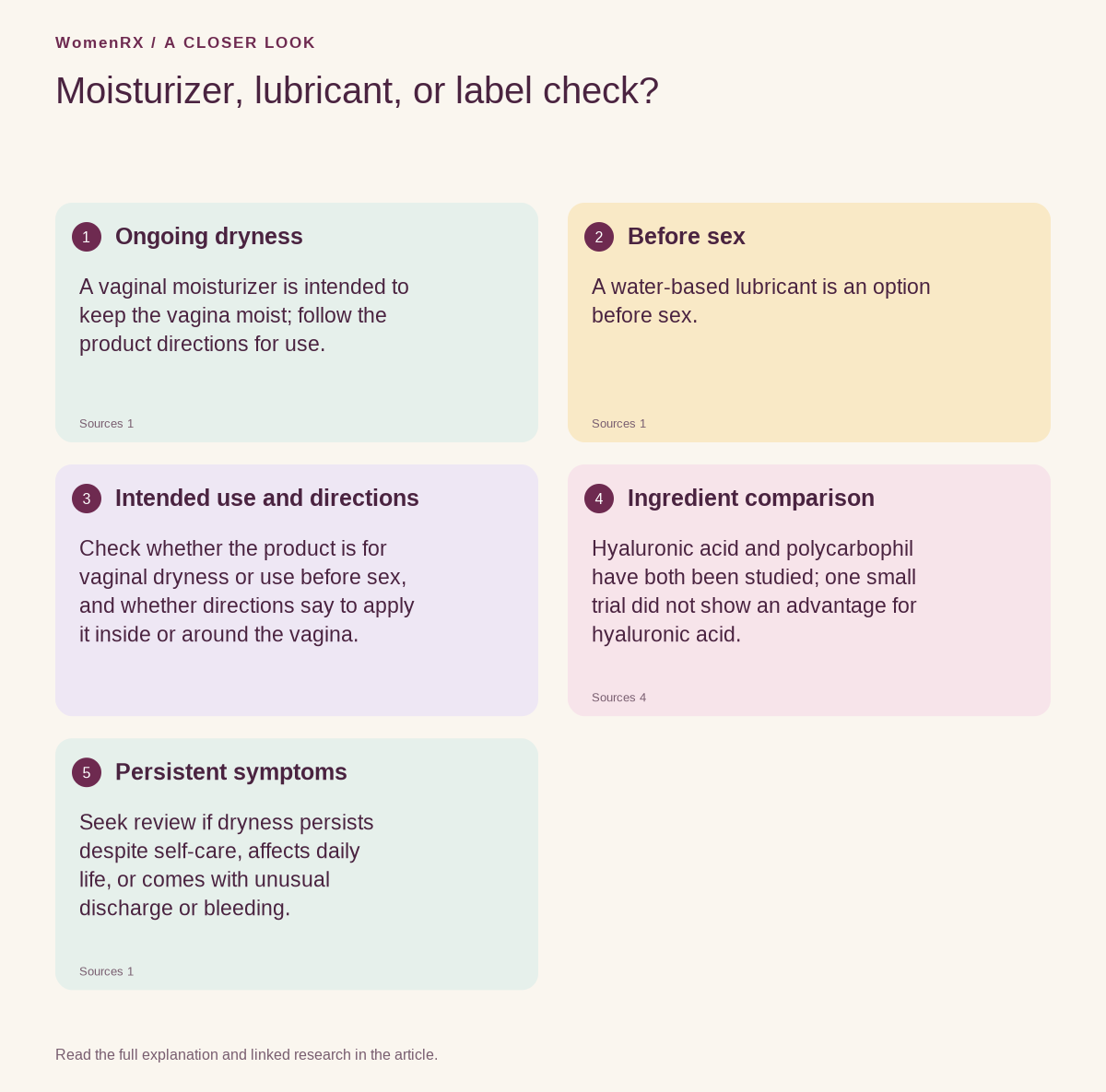
Moisturizer, lubricant, or label check?
Ongoing dryness: A vaginal moisturizer is intended to keep the vagina moist; follow the product directions for use.1
Before sex: A water-based lubricant is an option before sex.1
Intended use and directions: Check whether the product is for vaginal dryness or use before sex, and whether directions say to apply it inside or around the vagina.
Ingredient comparison: Hyaluronic acid and polycarbophil have both been studied; one small trial did not show an advantage for hyaluronic acid.4
Persistent symptoms: Seek review if dryness persists despite self-care, affects daily life, or comes with unusual discharge or bleeding.1
Read the figure as text
Compare the product’s purpose and what to check before use; a product choice won’t identify the cause of persistent dryness.- Ongoing dryness: A vaginal moisturizer is intended to keep the vagina moist; follow the product directions for use.1
- Before sex: A water-based lubricant is an option before sex.1
- Intended use and directions: Check whether the product is for vaginal dryness or use before sex, and whether directions say to apply it inside or around the vagina.
- Ingredient comparison: Hyaluronic acid and polycarbophil have both been studied; one small trial did not show an advantage for hyaluronic acid.4
- Persistent symptoms: Seek review if dryness persists despite self-care, affects daily life, or comes with unusual discharge or bleeding.1
More questions, answered
Can I use a vaginal moisturizer instead of lubricant before sex?
They have different jobs: moisturizer helps keep the vagina moist, while a water-based lubricant is an option before sex. Follow the directions on your product; a lubricant may be more useful if discomfort happens mainly during sex. 1
Is hyaluronic acid the best ingredient for vaginal dryness?
Not based on this comparison. In a randomized trial of women in the menopausal transition, hyaluronic acid gel was not shown to provide an advantage over polycarbophil gel. That study doesn’t establish which product works best for every person or cause of dryness. 4
Sources you can check
- Vaginal dryness - NHSAccessed 2026-09-25Return to first citation
- VEMORA: Vaginal Estrogen versus non-hormonal MOisturizer in women Receiving Aromatase inhibitors: a randomized, controlled trial.Niravath P, Rimawi M, Sun K, Mai H, Puri A, Vyas A, Nangia J, Brock A, Foreman C, Adnan H, Shafer M, Anand A, Moges A, Al Najjar E, Mathur S, Antosh D, High R, Zaid T, Chang J, Osb... · Breast cancer research and treatment · 2026Return to first citation
- Effect of a non-hormonal vaginal moisturizer on vaginal and vulvar health in postmenopausal women with breast cancer: A randomized clinical trial.Martin BC, VItorino CN, Souza R, Medolago N, Nahas GP, Carvalho-Pessoa E, Vespoli HL, Nahas EAP. · Maturitas · 2026Return to first citation
- Polycarbophil vaginal moisturizing gel versus hyaluronic acid gel in women affected by vaginal dryness in late menopausal transition: A prospective randomized trial.Cagnacci A, Barattini DF, Casolati E, Pecoroni A, Mangrella M, Patrascu LC. · European journal of obstetrics, gynecology, and reproductive biology · 2022Return to first citation
- Efficacy of Vaginal Estradiol or Vaginal Moisturizer vs Placebo for Treating Postmenopausal Vulvovaginal Symptoms: A Randomized Clinical Trial.Mitchell CM, Reed SD, Diem S, Larson JC, Newton KM, Ensrud KE, LaCroix AZ, Caan B, Guthrie KA. · JAMA internal medicine · 2018Return to first citation