Vaginal Lubricant or Moisturizer? Choose by When Dryness Happens
A lubricant helps with friction during sexual activity; a vaginal moisturizer is for dryness that bothers you at other times, too.
If sex feels dry or uncomfortable, a lubricant is designed to reduce friction during sexual activity. If dryness also bothers you between encounters, a vaginal moisturizer serves a different purpose: ongoing hydration. You can use both if both situations apply. 14 Check the label for vaginal use and directions, and look for explicit compatibility information if you use condoms. Don’t assume one formula suits everyone.
Two products, two jobs
A lubricant reduces friction during sexual activity. It’s the more direct choice when dryness shows up mainly with touch or penetration. A vaginal moisturizer is used outside sexual activity to help with dryness between encounters. The choice isn’t necessarily either-or: someone who feels dry during the day and uncomfortable during sex may have a use for both. 14
This distinction also helps you judge whether a product is doing the job you bought it for. A moisturizer may improve day-to-day comfort but not provide enough slip during sex. A lubricant can make sex more comfortable without addressing dryness you notice the next morning. These products are intended to address dryness or friction, not desire, which can be affected by other factors. 24
What a label can, and can’t, tell you
First, check whether the package calls the product a personal lubricant or a vaginal moisturizer, and read its directions for use. Pay attention to when the directions say to use it: a lubricant is for sexual activity, while a moisturizer is used consistently outside it. Those details are more useful than a promise that it’s “rejuvenating” or right for every stage of life. Water-based lubricants are one option for sex; silicone-based lubricants have also been studied in women experiencing vaginal dryness. The studies don’t establish that one base is best for every woman. 1467
For a practical label check, start with intended use and frequency: is it labeled for vaginal use, and do its directions fit when you need relief? Then scan the ingredient list for anything you already know bothers you. If you use condoms, look for explicit compatibility information for your condom type on the product and condom packaging. The lubricant studies discussed here did not test every condom-and-product combination. 67 Don’t infer compatibility from “water-based,” “silicone-based,” or “gentle.”
You may see hyaluronic acid on a moisturizer label. It’s an ingredient used in vaginal moisturizers, not proof that a particular product will work better for you. 3 A review of menopause-related vaginal symptoms found no clear superiority of one lubricant or moisturizer product over another in the trials and analyses it discussed. 4
Researchers also measure a lubricant’s pH and osmolality. These describe properties of the formula, not a personal comfort rating. In a four-week, open-label randomized study of 174 women with mild-to-moderate dryness and pain with sex, all five tested water-based lubricants were well tolerated, including formulas made to meet pH and osmolality guidance and one with higher values. That finding applies to those tested products; it doesn’t mean every formula will feel comfortable on sensitive tissue. 7
If a product feels irritating, that matters more to your next purchase than a broad “gentle” claim. And if dryness comes with soreness or itching, don’t assume choosing another lubricant will explain the symptoms. 1
Why the timing of dryness matters
While breastfeeding: Postpartum hormonal changes can be part of the picture. In a cross-sectional survey of 113 Australian women, respondents reported vaginal dryness and pain with sex among other symptoms. The survey shows these concerns occur during lactation; it doesn’t tell us which over-the-counter product works best. If dryness is limited to sex, a lubricant fits that use. If you notice it at other times, a moisturizer may fit better. 54
During perimenopause: When dryness appears, its timing alone can’t identify the cause. Dryness can also occur when you’re not aroused during sex, with some health conditions, or during cancer treatment. Notice whether the problem is mainly friction during sex or a more persistent dry, sore feeling. That distinction helps you choose a product without assuming every symptom has the same explanation. 14
After menopause: Lower-estrogen changes can affect vaginal and urinary comfort as well as sex. Lubricants and moisturizers are nonhormonal options for mild symptoms. If they aren’t doing enough, there are other treatments for menopause-related vaginal symptoms to discuss with a clinician; buying a succession of similar products isn’t your only option. 14
When a product switch isn’t enough
Arrange an assessment if dryness has lasted a few weeks despite things you’ve tried, or if it’s affecting daily life. Unusual vaginal discharge or bleeding after sex, between periods, or after menopause also deserves assessment rather than another product experiment. These symptoms don’t all have the same cause, and a lubricant can’t tell you which one is responsible. 1
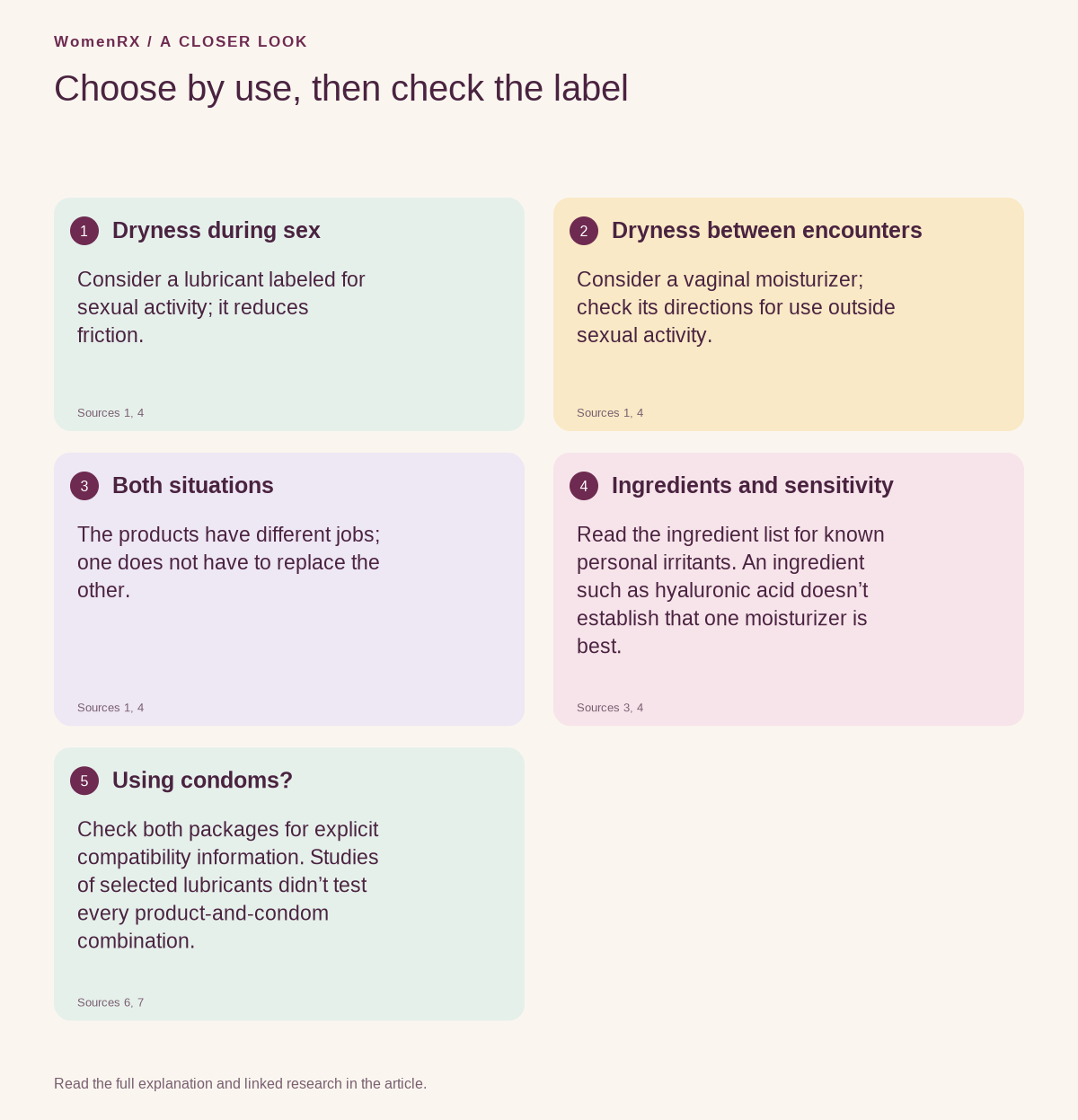
Choose by use, then check the label
Dryness during sex: Consider a lubricant labeled for sexual activity; it reduces friction.14
Dryness between encounters: Consider a vaginal moisturizer; check its directions for use outside sexual activity.14
Both situations: The products have different jobs; one does not have to replace the other.14
Ingredients and sensitivity: Read the ingredient list for known personal irritants. An ingredient such as hyaluronic acid doesn’t establish that one moisturizer is best.34
Using condoms?: Check both packages for explicit compatibility information. Studies of selected lubricants didn’t test every product-and-condom combination.67
Read the figure as text
Match the product to when dryness happens, then check its directions and whether the packaging answers your compatibility question.- Dryness during sex: Consider a lubricant labeled for sexual activity; it reduces friction.14
- Dryness between encounters: Consider a vaginal moisturizer; check its directions for use outside sexual activity.14
- Both situations: The products have different jobs; one does not have to replace the other.14
- Ingredients and sensitivity: Read the ingredient list for known personal irritants. An ingredient such as hyaluronic acid doesn’t establish that one moisturizer is best.34
- Using condoms?: Check both packages for explicit compatibility information. Studies of selected lubricants didn’t test every product-and-condom combination.67
More questions, answered
Can I use a moisturizer and a lubricant?
Yes. They serve different moments: a moisturizer for dryness outside sex and a lubricant to reduce friction during sexual activity. Using one doesn’t rule out using the other. 14
Does a lubricant help with low desire?
It may make sex more comfortable if friction is the problem, but lubrication and desire aren’t the same thing. Medicines, health conditions, and concerns about pregnancy are among the factors that can affect sexual health. 24
Sources you can check
- Vaginal dryness - NHSAccessed 2026-09-25Return to first citation
- Sexual Health | MedlinePlusAccessed 2026-09-25Return to first citation
- French multicentre randomised phase III trial evaluating the efficacy and safety of vaginal radiofrequency in the management of vulvovaginal atrophy and dryness in patients treated for breast cancer (RF-Vaginale): trial protocol.Demetz J, Vanseymortier M, Martin C, Ben Oune F, Alloy N, Leguillette C, Penel N, Chauvet MP, Le Deley MC. · BMJ open · 2026Return to first citation
- Case-Based Perspectives on the Management of Genitourinary Syndrome of Menopause.Cyriac J, Sood R. · Clinics and practice · 2026Return to first citation
- Postpartum health-seeking behaviours, awareness and experiences of Genitourinary Syndrome of Lactation.Santos E, Bradfield Strydom M, Perelmuter S, Schloss J. · Midwifery · 2026Return to first citation
- A randomized trial on the safety and efficacy of sensate water-based and silicone-based personal lubricants for relief of intimate discomfort associated with vaginal dryness.Krychman M, Hemmady K, Su L, Hood S, Gaifieva S, Palacios S. · The journal of sexual medicine · 2025Return to first citation
- A randomized trial on the effectiveness and safety of 5 water-based personal lubricants.Palacios S, Hood S, Abakah-Phillips T, Savania N, Krychman M. · The journal of sexual medicine · 2023Return to first citation