Vaginal Dryness Treatments: Moisturizer or Estrogen?
Moisturizers can ease ongoing dryness, while vaginal estrogen targets menopause-related changes; the right choice depends on the cause and your symptoms.
A vaginal moisturizer is meant to ease ongoing dryness; lubricant reduces friction during sex. For dryness linked to menopause, low-dose vaginal estrogen is another option. In studies of menopause-related symptoms, estrogen helped more when women had two or more symptoms, while moisturizers worked similarly for one or minor symptoms. Persistent symptoms or bleeding deserve evaluation rather than more product trials. 147
First, match the product to the problem
A lubricant and a moisturizer do different jobs. Lubricant is used around sexual activity to reduce friction. A vaginal moisturizer is used regularly to ease dryness beyond sex. Neither is the same as vaginal estrogen, which treats local vaginal symptoms associated with menopause-related tissue changes. 12
Dryness isn’t always caused by menopause. Changes in hormone levels during cancer treatment, not feeling aroused during sex, and some health conditions can also be involved. So a product that helps one person may not address another person’s underlying cause. 1
| Option | What it’s for | What to consider |
|---|---|---|
| Lubricant | Reducing friction during sex | It’s for activity-related comfort, not ongoing dryness. 1 |
| Vaginal moisturizer | Easing dryness between sexual activity | Nonhormonal products may suit mild menopause-related symptoms; products can differ, and one small trial doesn’t establish a universal best ingredient. 67 |
| Vaginal estrogen | Treating dryness and irritation associated with menopause | A local treatment available in different forms; whether it fits your circumstances is a clinical decision. 24 |
What the evidence says about moisturizers
Nonhormonal moisturizers can be a reasonable place to start when symptoms are mild or when you prefer not to use estrogen. A systematic review found that women with one or minor menopause-related vaginal symptom had similar symptom resolution with moisturizer or vaginal estrogen. When women had two or more symptoms, estrogen improved symptoms more. That finding can help frame the tradeoff, but it doesn’t mean every person with multiple symptoms should use estrogen. 7
There isn’t enough evidence to name one moisturizer as the best. In a randomized trial, 53 women aged 45 to 55 in the menopausal transition used either a polycarbophil gel or a hyaluronic acid gel for 30 days. Both groups improved, and the study found polycarbophil was not less effective than hyaluronic acid. It was a small, short trial in a specific group, so it can’t show that these products work equally well for everyone or that one type is best overall. 6
If you’re comparing products, think about the symptom you want to relieve and whether the product is a moisturizer or a lubricant. If a nonhormonal moisturizer isn’t helping, persistent symptoms are a reason to reconsider the cause and options rather than assume you need a different brand. 14
When vaginal estrogen may be worth discussing
Menopause-related estrogen loss can lead to vaginal dryness and irritation. Vaginal estrogen delivers treatment locally and is used for those symptoms; it doesn’t treat other menopause symptoms such as hot flashes or sleep problems. It comes in forms such as creams, tablets, gels, or rings, though the options appropriate and available to you depend on your care setting. 2
The North American Menopause Society recommends considering low-dose vaginal estrogen or other therapies for bothersome genitourinary symptoms of menopause that haven’t improved with over-the-counter treatments, for women without an indication for systemic hormone therapy. A systematic review also found vaginal estrogen improved dryness and pain with sex compared with placebo; the reviewed estrogen preparations generally had similar efficacy. 47
Vaginal estrogen may take time to work fully. If symptoms continue, or if you have a personal history that makes estrogen use a more complicated decision, ask the prescriber how that history affects your options. A small randomized trial in breast cancer survivors taking aromatase inhibitors found greater improvement in dryness and pain with vaginal estrogen than with moisturizer over 24 weeks, but it enrolled only 23 people and cannot establish long-term safety. That situation calls for an individualized discussion, not a blanket yes or no. 235
Dryness outside menopause needs its own explanation
If you’re breastfeeding or recently gave birth, don’t assume a treatment shown to help menopause-related dryness is automatically the right treatment for you. A lubricant addresses friction during sex, and a moisturizer is an option for ongoing dryness, whatever prompted you to look for relief. The evidence comparing moisturizers with vaginal estrogen, though, concerns menopause-related symptoms, not postpartum or breastfeeding care. If dryness began around childbirth, ask what might be causing it and which options fit your circumstances rather than choosing estrogen on the basis of menopause studies. 1247
It’s also worth having persistent symptoms assessed if a moisturizer or lubricant isn’t helping. Seek evaluation for unusual discharge, bleeding after sex, bleeding between periods, or bleeding after menopause. Dryness that affects daily life is also a reason to get help, not something you have to simply put up with. 1
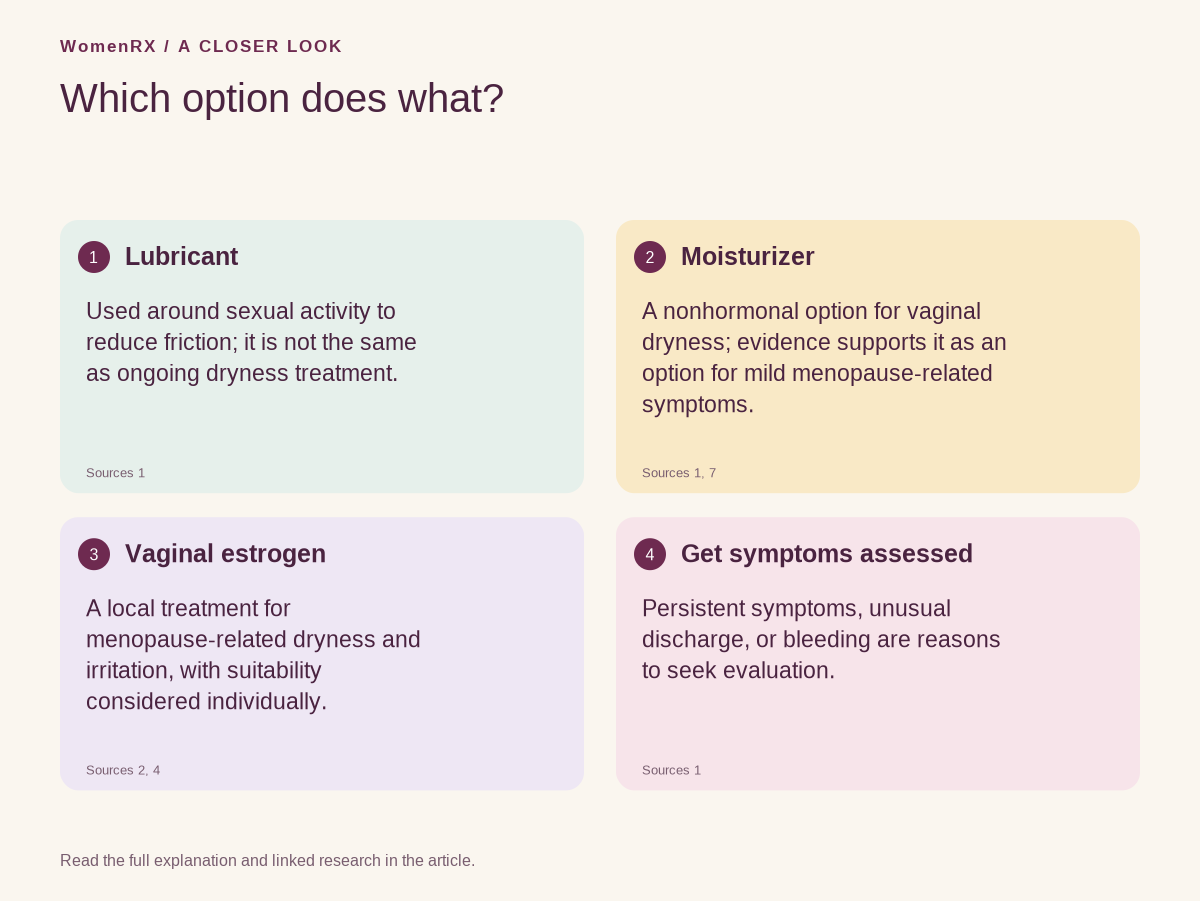
Which option does what?
Lubricant: Used around sexual activity to reduce friction; it is not the same as ongoing dryness treatment.1
Moisturizer: A nonhormonal option for vaginal dryness; evidence supports it as an option for mild menopause-related symptoms.17
Vaginal estrogen: A local treatment for menopause-related dryness and irritation, with suitability considered individually.24
Get symptoms assessed: Persistent symptoms, unusual discharge, or bleeding are reasons to seek evaluation.1
Read the figure as text
These categories address different needs: friction during sex, dryness between sexual activity, or menopause-related local symptoms.- Lubricant: Used around sexual activity to reduce friction; it is not the same as ongoing dryness treatment.1
- Moisturizer: A nonhormonal option for vaginal dryness; evidence supports it as an option for mild menopause-related symptoms.17
- Vaginal estrogen: A local treatment for menopause-related dryness and irritation, with suitability considered individually.24
- Get symptoms assessed: Persistent symptoms, unusual discharge, or bleeding are reasons to seek evaluation.1
More questions, answered
Will vaginal estrogen help hot flashes too?
No. Vaginal estrogen is used for local symptoms such as menopause-related vaginal dryness and irritation; it doesn’t treat hot flashes or other menopause symptoms such as sleep problems. 2
Does hyaluronic acid work better than other moisturizers?
A small trial doesn’t establish that. One 30-day trial in women in the menopausal transition found a polycarbophil gel was not less effective than a hyaluronic acid gel. That result doesn’t settle which product works best for an individual. 6
Sources you can check
- Vaginal dryness - NHSAccessed 2026-09-25Return to first citation
- About vaginal oestrogen - NHSAccessed 2026-09-25Return to first citation
- Common questions about vaginal oestrogen - NHSAccessed 2026-09-25Return to first citation
- The 2022 hormone therapy position statement of The North American Menopause Society.“The 2022 Hormone Therapy Position Statement of The North American Menopause Society” Advisory Panel. · Menopause (New York, N.Y.) · 2022Return to first citation
- VEMORA: Vaginal Estrogen versus non-hormonal MOisturizer in women Receiving Aromatase inhibitors: a randomized, controlled trial.Niravath P, Rimawi M, Sun K, Mai H, Puri A, Vyas A, Nangia J, Brock A, Foreman C, Adnan H, Shafer M, Anand A, Moges A, Al Najjar E, Mathur S, Antosh D, High R, Zaid T, Chang J, Osb... · Breast cancer research and treatment · 2026Return to first citation
- Polycarbophil vaginal moisturizing gel versus hyaluronic acid gel in women affected by vaginal dryness in late menopausal transition: A prospective randomized trial.Cagnacci A, Barattini DF, Casolati E, Pecoroni A, Mangrella M, Patrascu LC. · European journal of obstetrics, gynecology, and reproductive biology · 2022Return to first citation
- Vaginal estrogen for genitourinary syndrome of menopause: a systematic review.Rahn DD, Carberry C, Sanses TV, Mamik MM, Ward RM, Meriwether KV, Olivera CK, Abed H, Balk EM, Murphy M, Society of Gynecologic Surgeons Systematic Review Group. · Obstetrics and gynecology · 2014Return to first citation