Vaginal Moisturizer or Lubricant: Which Fits the Problem?
Use a moisturizer for dryness between sexual activity and a lubricant to reduce friction during sex; some people may want both.
A vaginal moisturizer is meant to ease dryness between sexual activity, while lubricant is used during sex to reduce friction and discomfort. If dryness is ongoing, a moisturizer may fit the everyday problem; if discomfort mainly happens with penetration, a lubricant may help. You can use both for different purposes, but neither identifies or treats every possible cause of pain. 1 3
Match the product to when discomfort happens
If you feel dry or uncomfortable at times other than sex, a vaginal moisturizer is designed for ongoing comfort. It’s used inside the vagina to help with vaginal dryness. Follow the product’s directions for when and how to use it. 1 3
A lubricant is for the moment friction is a problem. Apply it before sexual activity to help reduce rubbing and discomfort during sex. The NHS recommends water-based lubricants as one option. 1
These are different jobs, not competing treatments. For example, someone who feels dry throughout the week and also has friction during sex might choose a moisturizer for the ongoing dryness and lubricant for sex. Using both for those separate purposes is a reasonable approach; one doesn’t automatically replace the other. 3
What the research can, and can’t, tell you
The distinction is useful, but research doesn’t show that one type is best for everyone. In a 16-week randomized trial of postmenopausal women with breast cancer who reported dryness or painful sex, one group used a non-hormonal moisturizer regularly and the other used lubricant during sex. Several vaginal and vulvar health measures improved more in the moisturizer group, but vaginal maturation index scores did not differ significantly between groups. The study compared two different use patterns in a specific group of women, so it can’t establish that moisturizer works better for everyone or for every cause of pain. 2
A review describes lubricants as short-term help during sexual activity and moisturizers as products intended for day-to-day dryness. It also notes that products differ in composition. 3
Dryness isn’t limited to menopause. Hormonal changes around menopause can reduce vaginal fluid, and dryness can also be associated with not being aroused, perfumed washes or douches, and some health conditions. A review also describes dryness in younger women in situations such as lactation or use of anti-estrogen medicines. A moisturizer or lubricant may help with comfort, but it doesn’t explain why dryness started. 1 3
A practical label check
Before choosing, ask:
- Is it made for the job I have? Look for a product labeled as a vaginal moisturizer if you want ongoing dryness relief, or a personal lubricant if you want help with friction during sex.
- What’s in it? Read the ingredient list, especially if you know you’re sensitive to an ingredient. Products can feel different, and there isn’t one formulation that’s right for everyone. 3 4
- Does it give formulation details? A review recommends considering pH and osmolality because products vary on these measures. If those values are provided, they still can’t guarantee that a product will feel comfortable for you. 3
- Could something else be irritating the area? Perfumed soaps, washes, or douches can contribute to dryness or irritation; avoiding them may help. 1
When dryness deserves a closer look
If dryness continues for weeks despite trying self-care, affects daily life, or comes with unusual discharge, arrange an evaluation. Bleeding after sex, between periods, or after menopause also warrants medical attention. Pain during sex can be related to dryness and friction, but a moisturizer or lubricant may not address every cause. 1 3
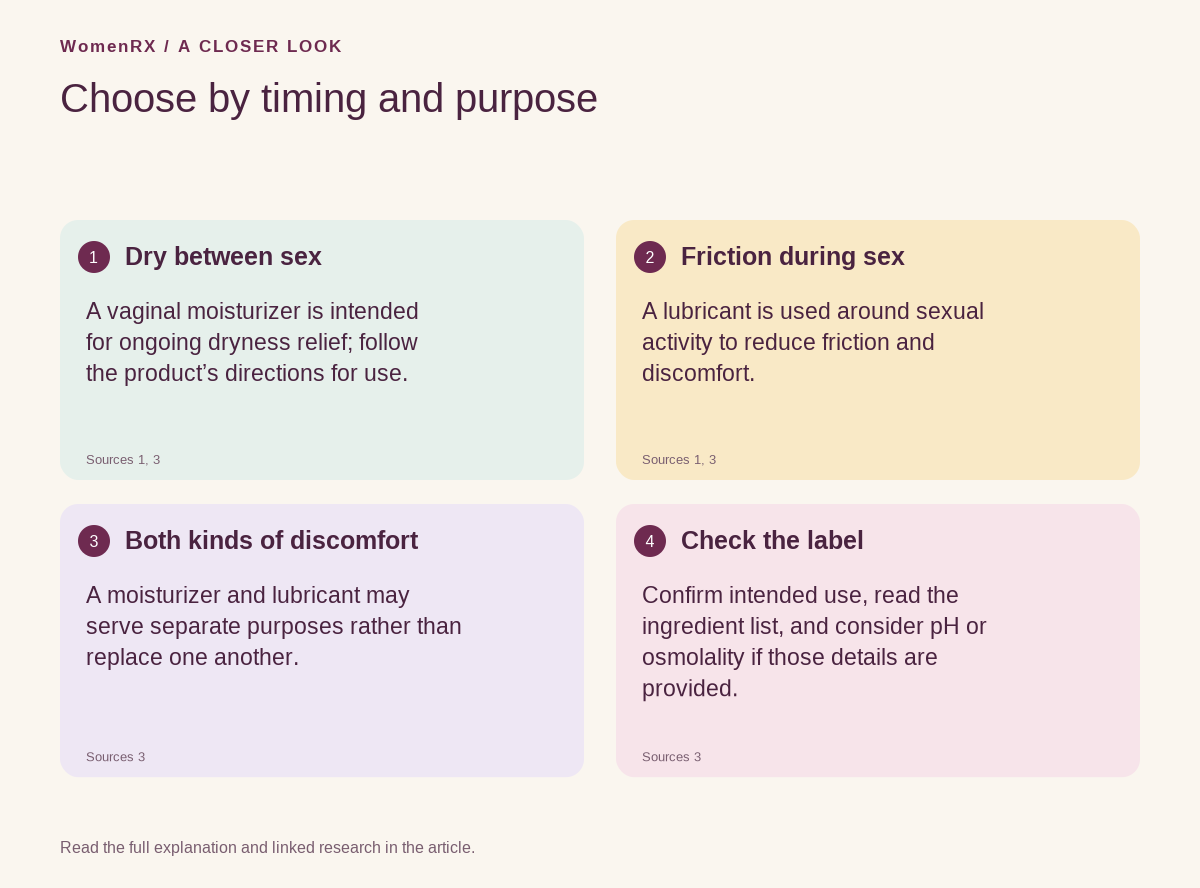
Choose by timing and purpose
Dry between sex: A vaginal moisturizer is intended for ongoing dryness relief; follow the product’s directions for use.13
Friction during sex: A lubricant is used around sexual activity to reduce friction and discomfort.13
Both kinds of discomfort: A moisturizer and lubricant may serve separate purposes rather than replace one another.3
Check the label: Confirm intended use, read the ingredient list, and consider pH or osmolality if those details are provided.3
Read the figure as text
The key difference is when you need relief: everyday dryness points toward a moisturizer, while friction during sex points toward a lubricant.- Dry between sex: A vaginal moisturizer is intended for ongoing dryness relief; follow the product’s directions for use.13
- Friction during sex: A lubricant is used around sexual activity to reduce friction and discomfort.13
- Both kinds of discomfort: A moisturizer and lubricant may serve separate purposes rather than replace one another.3
- Check the label: Confirm intended use, read the ingredient list, and consider pH or osmolality if those details are provided.3
More questions, answered
Can I use a moisturizer and lubricant together?
They serve different purposes: a moisturizer is intended for ongoing dryness, while lubricant is used during sex to reduce friction. Using each for its intended purpose may make sense if you have both kinds of discomfort. 1 3
Does painful sex always mean I need lubricant?
No. Lubricant may help when friction or dryness contributes to pain, but it won’t address every possible cause. If dryness lasts for weeks despite self-care, affects daily life, or comes with unusual discharge, seek an evaluation. Bleeding after sex, between periods, or after menopause is also a reason to seek medical attention. 1 3
Sources you can check
- Vaginal dryness - NHSAccessed 2026-09-25Return to first citation
- Effect of a non-hormonal vaginal moisturizer on vaginal and vulvar health in postmenopausal women with breast cancer: A randomized clinical trial.Martin BC, VItorino CN, Souza R, Medolago N, Nahas GP, Carvalho-Pessoa E, Vespoli HL, Nahas EAP. · Maturitas · 2026Return to first citation
- Treating vulvovaginal atrophy/genitourinary syndrome of menopause: how important is vaginal lubricant and moisturizer composition?Edwards D, Panay N. · Climacteric : the journal of the International Menopause Society · 2016Return to first citation
- Quantitative perceptual differences among over-the-counter vaginal products using a standardized methodology: implications for microbicide development.Mahan ED, Morrow KM, Hayes JE. · Contraception · 2011Return to first citation