Vaginal Dryness: Causes and What Can Help
Dryness can be linked to lower estrogen, irritation, sexual arousal, or other health factors, so the best first step depends on when it started and what else you’re noticing.
Vaginal dryness isn’t caused by menopause alone. Lower estrogen can contribute during and after menopause, and after childbirth, especially while breastfeeding; some cancer treatments and other medicines or endocrine treatments can also play a role. Irritating washes, certain health conditions, and not being aroused during sex are other possibilities. A vaginal moisturizer may help everyday dryness, while lubricant can reduce friction during sex. Persistent symptoms, unusual discharge, or bleeding deserve evaluation. 1 4 6
Start with the pattern, not your age
Dryness can mean soreness, itching, or irritation in and around the vagina. It may be noticeable all day, during sex, or both. These details can point toward different explanations, but symptoms alone don’t confirm a cause. Menopause-related tissue changes can resemble other vulvovaginal conditions, so an exam may be useful when the cause isn’t clear or symptoms persist. 1 6
A hormone shift is one possibility, not the only one. Falling estrogen during and after menopause can contribute to dryness and irritation. Similar low-estrogen changes can happen after delivery and continue during breastfeeding. Cancer treatments, including some hormonal treatments, chemotherapy, radiation, or surgery, and other pharmacological or endocrine treatments can also be associated with vulvovaginal symptoms. 1 2 4 6
Other possibilities include not being sufficiently aroused before or during sex, conditions such as diabetes or Sjögren’s syndrome, and irritation from perfumed soaps, washes, or douches. If dryness began after a treatment or a new health change, that timing is useful context to share with a clinician. 1
Match the first step to the situation
If dryness mainly affects sex: A lubricant used before sex can reduce friction in the moment. A vaginal moisturizer is different: it’s used inside the vagina to help with dryness beyond sex. Some people may find one more useful than the other, depending on when symptoms occur. Choose products intended for vaginal use; creams or moisturizers made for other parts of the body can irritate the area. 1
If irritation may be part of it: Stop perfumed washes, soaps, and douches around the vagina. Use an unperfumed wash externally, and avoid putting non-vaginal lotions or creams inside. These changes can remove a possible irritant, but they won’t treat every cause of dryness. 1
If symptoms started after childbirth: Dryness, burning, or itching can occur after delivery and may continue during lactation. A randomized, open-label study of 85 postpartum women found better short-term sexual-function scores in the group using a vaginal hyaluronic-acid gel than in the expectant-management group. That’s promising for this particular setting, but it’s one study of one product, not proof that every postpartum product works or is right for every person. 4
If symptoms fit menopause-related changes: Vaginal estrogen is a local treatment that can help dryness and irritation related to menopause. It comes in forms inserted into the vagina; a clinician can discuss whether it fits your symptoms and personal history. It addresses vaginal symptoms, not other menopause symptoms such as hot flashes or sleep problems. 2 3
Nonhormonal options and vaginal estrogen aren’t interchangeable in every situation. In one open-label trial of 144 women described as postmenopausal, vaginal hyaluronic-acid gel and estriol cream both improved reported dryness over the study period; estriol had a greater effect on vaginal pH. The results don’t establish that the products work equally well for every cause of dryness, or for people who were excluded from the study, including pregnant and breastfeeding women. 5
Know when self-care isn’t enough
Arrange an evaluation if dryness lasts for a few weeks despite self-care, affects daily life, or comes with unusual discharge. Bleeding after sex, between periods, or after menopause should also be checked rather than treated as dryness alone. Repeated urinary tract infections can occur alongside vaginal dryness, but they’re another reason to discuss the full pattern rather than assume one explanation. 1
The useful question is not just “Which product should I try?” It’s “What changed, when did it change, and are there other symptoms?” That can help distinguish friction or irritation from a hormone-related change or a condition that needs its own treatment. A clinician may use your history and an examination, and sometimes additional tests, to assess the tissue and rule out other causes. 6
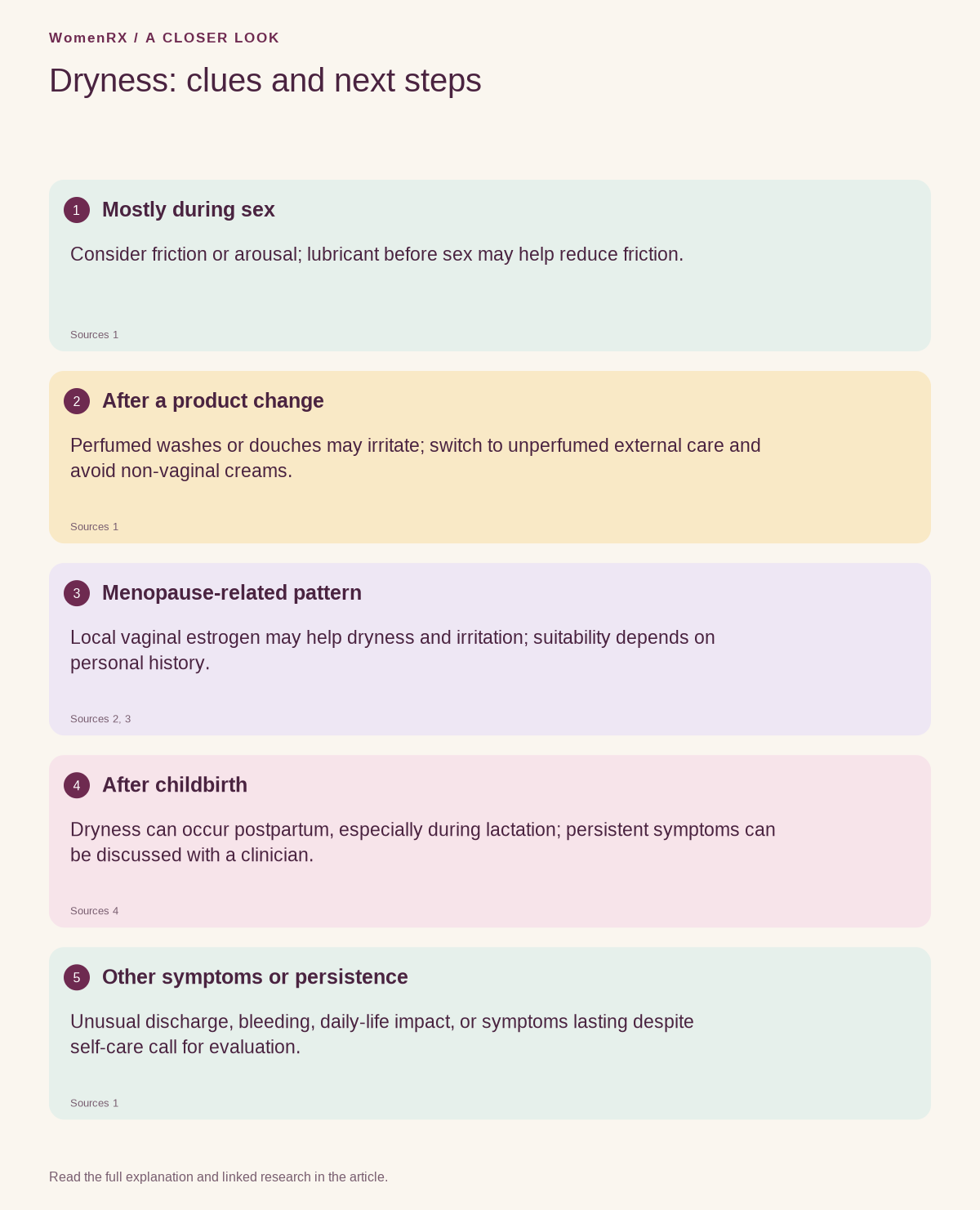
Dryness: clues and next steps
Mostly during sex: Consider friction or arousal; lubricant before sex may help reduce friction.1
After a product change: Perfumed washes or douches may irritate; switch to unperfumed external care and avoid non-vaginal creams.1
Menopause-related pattern: Local vaginal estrogen may help dryness and irritation; suitability depends on personal history.23
After childbirth: Dryness can occur postpartum, especially during lactation; persistent symptoms can be discussed with a clinician.4
Other symptoms or persistence: Unusual discharge, bleeding, daily-life impact, or symptoms lasting despite self-care call for evaluation.1
Read the figure as text
Use timing and accompanying symptoms as clues for choosing a first step; they don’t diagnose the cause.- Mostly during sex: Consider friction or arousal; lubricant before sex may help reduce friction.1
- After a product change: Perfumed washes or douches may irritate; switch to unperfumed external care and avoid non-vaginal creams.1
- Menopause-related pattern: Local vaginal estrogen may help dryness and irritation; suitability depends on personal history.23
- After childbirth: Dryness can occur postpartum, especially during lactation; persistent symptoms can be discussed with a clinician.4
- Other symptoms or persistence: Unusual discharge, bleeding, daily-life impact, or symptoms lasting despite self-care call for evaluation.1
More questions, answered
Is a vaginal moisturizer the same as lubricant?
No. A lubricant is used around sex to reduce friction. A vaginal moisturizer is used inside the vagina to help with dryness more generally. Use products made for vaginal use. 1
Does vaginal estrogen treat all menopause symptoms?
No. Vaginal estrogen can help menopause-related vaginal dryness and irritation, but it does not treat symptoms such as hot flashes or sleep problems. 2
Sources you can check
- Vaginal dryness - NHSAccessed 2026-09-25Return to first citation
- About vaginal oestrogen - NHSAccessed 2026-09-25Return to first citation
- Common questions about vaginal oestrogen - NHSAccessed 2026-09-25Return to first citation
- Efficacy and safety of prolonged-release hyaluronic acid derivative vaginal application in the postpartum period: a prospective randomised clinical trial.Gustavino C, Sala P, Cusini N, Gravina B, Ronzini C, Marcolin D, Vellone VG, Paudice M, Nappi R, Nappi R, Costantini S, Ferrero S, Barra F. · Annals of medicine · 2021Return to first citation
- Is vaginal hyaluronic acid as effective as vaginal estriol for vaginal dryness relief?Stute P. · Archives of gynecology and obstetrics · 2013Return to first citation
- Clinical manifestations and evaluation of postmenopausal vulvovaginal atrophy.Pérez-López FR, Vieira-Baptista P, Phillips N, Cohen-Sacher B, Fialho SCAV, Stockdale CK. · Gynecological endocrinology : the official journal of the International Society of Gynecological Endocrinology · 2021Return to first citation