Choosing a Lubricant for Perimenopause-Related Dryness
The right lubricant can make friction during sex more comfortable, but dryness that persists between encounters may call for a different approach.
If sex feels dry or friction makes it uncomfortable, a water-based vaginal lubricant is a practical place to start. If you use condoms, avoid oil-based lubricant because it can damage them. Choose for your own comfort rather than a “best” base, and look beyond lubricant if dryness or pain continues, affects daily life, or comes with bleeding or unusual discharge. 16
Start with what you want the product to do
A lubricant adds slipperiness during sex. That can help when the uncomfortable part is friction, whether dryness has appeared during perimenopause or you simply need more lubrication on a particular day. Vaginal dryness can also be linked to medications, irritating washes, or not feeling aroused during sex, so it isn’t always a sign of menopause. 1
You don’t have to find a supposedly perfect formula before trying anything. A water-based vaginal lubricant is a straightforward starting point recommended in guidance for dryness. You can use it where friction occurs, including around the vaginal opening. How a product feels matters: if one feels unpleasant or doesn’t give you enough comfort, it may not be the right choice for you. 1
Read the label for fit, not a winning ingredient
Water-based: This is a useful first choice, particularly if you use condoms: menopause guidance recommends water-based products and warns against oil-based lubricant with condoms. In a four-week, open-label study of women ages 18 to 65 with mild-to-moderate dryness and pain during sex, participants reported improvement with each of five water-based products tested. The study didn’t show that water-based lubricant is better than other bases, or identify one best product for perimenopause. 65
Silicone-based: It’s another type you may see on the shelf, but don’t assume that the word silicone guarantees longer-lasting comfort or a better result. One four-week trial studied a warming silicone-based lubricant and a tingling water-based lubricant in women ages 18 to 65 with dryness. Both groups improved, but the different sensory ingredients mean the trial can’t tell us what difference the bases alone made.
Oil-based: This is the clearest compatibility decision in the guidance: don’t use an oil-based lubricant with condoms, because it can damage them. 6
The rest of the label matters to your comfort, too. If the vulva already feels sore or itchy, a plain product may be more appealing than one marketed to tingle or warm. That’s a preference, not a proven rule that every sensory lubricant is irritating: the two sensory formulas in the short trial were generally well tolerated by its participants. Also consider what touches the area outside of sex. Perfumed soaps, washes, and douches can contribute to vaginal dryness, and creams or lotions not made for vaginal use can cause irritation or infection. 41
When dryness needs more than slip during sex
If you feel dry or irritated at other times, a vaginal moisturizer serves a different purpose: it’s used for ongoing moisture, rather than only when friction happens during sex. In a 16-week randomized trial involving postmenopausal women with breast cancer who had completed oncological treatment other than endocrine therapy, a moisturizer improved several vaginal and vulvar health measures more than lubricant used during intercourse. That finding helps explain why the products aren’t interchangeable, but it doesn’t establish which moisturizer is best for a woman in perimenopause. 13
Menopause-associated changes can also involve the vaginal and vulvar tissues, not just the amount of lubrication available during sex. Guidance includes nonhormonal moisturizers or lubricants as options and recommends discussing vaginal estrogen for genitourinary symptoms associated with menopause; these approaches can be used together. If lubricant helps briefly but discomfort keeps returning, it’s reasonable to ask whether treatment for ongoing tissue symptoms would make more sense than repeatedly changing lubricant brands. 7
Notice when pain is telling you something else
Friction is only one possible reason sex hurts. For example, pain alongside itching, unusual discharge, or soreness may call for a look at irritation or another cause rather than a thicker lubricant. Hormone changes, some medicines, perfumed products, and underlying conditions can all play a part in dryness. 1
Arrange a medical assessment if dryness has lasted a few weeks despite what you’ve tried, affects daily life, or comes with unusual discharge. Bleeding after sex, between periods, or after menopause also deserves assessment. Those details change the next step: the goal is to find the cause of the discomfort, not simply to make penetration possible. 1
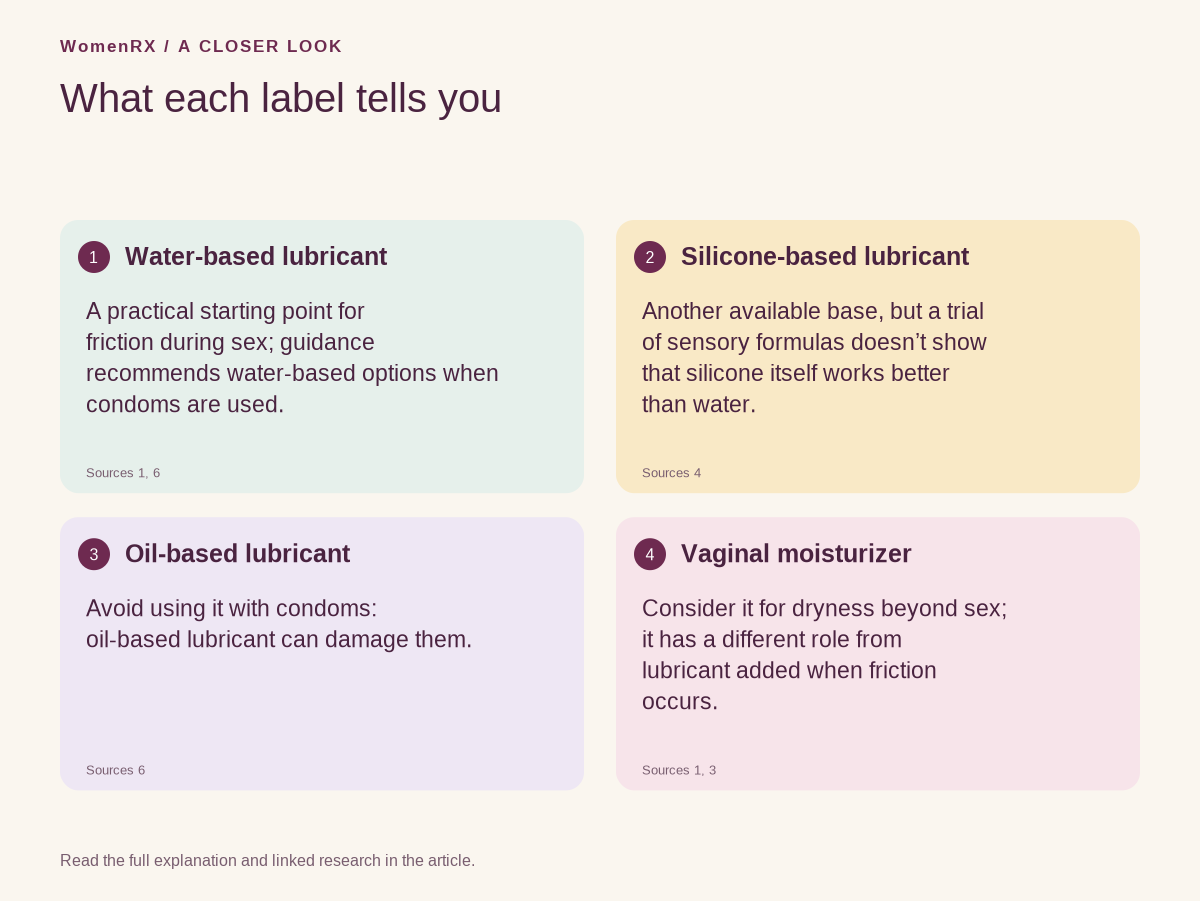
What each label tells you
Water-based lubricant: A practical starting point for friction during sex; guidance recommends water-based options when condoms are used.16
Silicone-based lubricant: Another available base, but a trial of sensory formulas doesn’t show that silicone itself works better than water.4
Oil-based lubricant: Avoid using it with condoms: oil-based lubricant can damage them.6
Vaginal moisturizer: Consider it for dryness beyond sex; it has a different role from lubricant added when friction occurs.13
Read the figure as text
Compare products by what they’re for and what you need to check, rather than treating any base as a proven winner.- Water-based lubricant: A practical starting point for friction during sex; guidance recommends water-based options when condoms are used.16
- Silicone-based lubricant: Another available base, but a trial of sensory formulas doesn’t show that silicone itself works better than water.4
- Oil-based lubricant: Avoid using it with condoms: oil-based lubricant can damage them.6
- Vaginal moisturizer: Consider it for dryness beyond sex; it has a different role from lubricant added when friction occurs.13
More questions, answered
Does adding hyaluronic acid make a lubricant the best choice?
Not on current comparative evidence. In a three-month uncontrolled study, women using one water-based lubricant with hyaluronic acid reported less dryness and pain during sex. Without a comparison group, the study can’t show that hyaluronic acid was responsible or that this formula works better than other lubricants. 2
Sources you can check
- Vaginal dryness - NHSAccessed 2026-09-25Return to first citation
- Prospective, multicenter, uncontrolled study on the effectiveness and safety of a hyaluronic acid water-based vaginal lubricant in alleviating vaginal dryness and dyspareunia.Sánchez-Prieto M, Pingarrón C, Bergamaschi L, Bermúdez JC, Subiris González J, Sánchez Sánchez R, Poyo Torcal S, Gómez M, Ruiz Pérez ML, Castillo Martínez M, Peña Penedo ME, Sánche... · Gynecological endocrinology : the official journal of the International Society of Gynecological Endocrinology · 2024Return to first citation
- Effect of a non-hormonal vaginal moisturizer on vaginal and vulvar health in postmenopausal women with breast cancer: A randomized clinical trial.Martin BC, VItorino CN, Souza R, Medolago N, Nahas GP, Carvalho-Pessoa E, Vespoli HL, Nahas EAP. · Maturitas · 2026Return to first citation
- A randomized trial on the safety and efficacy of sensate water-based and silicone-based personal lubricants for relief of intimate discomfort associated with vaginal dryness.Krychman M, Hemmady K, Su L, Hood S, Gaifieva S, Palacios S. · The journal of sexual medicine · 2025Return to first citation
- A randomized trial on the effectiveness and safety of 5 water-based personal lubricants.Palacios S, Hood S, Abakah-Phillips T, Savania N, Krychman M. · The journal of sexual medicine · 2023Return to first citation
- Things you can do to help menopause and perimenopause symptoms - NHSAccessed 2026-09-25Return to first citation
- Recommendations | Menopause: identification and management | Guidance | NICEAccessed 2026-09-25Return to first citation