Choosing a Lubricant or Moisturizer for Menopause Dryness
Lubricant eases friction during sexual activity; a vaginal moisturizer is used regularly for dryness between sexual activity.
For discomfort during sex or other vaginal activity, try a lubricant used at the time. For dryness that bothers you day to day, a vaginal moisturizer is designed for regular use and may offer longer-lasting relief. Neither is the same as vaginal estrogen, which can address menopause-related tissue symptoms. Check product instructions and condom compatibility, and seek care for bleeding or persistent symptoms. 1 2 5
Match the product to when you feel dry
If dryness mainly makes penetration or another vaginal activity uncomfortable, start with a lubricant. It reduces friction while you’re using it. Water-based lubricants can be applied in and around the vagina, and to a partner or sex toy, before activity. Follow the product label for where and how to use it. 1
If you’re also uncomfortable when you’re not having sex, a vaginal moisturizer may fit better. It’s intended for regular use inside the vagina to ease ongoing dryness, rather than only during sex. One review describes moisturizer effects as lasting about two to three days, but products differ, so follow the schedule on the label. 1 5
These products do different jobs. A lubricant can make activity more comfortable, but it doesn’t replace estrogen or treat the underlying hormone-related tissue changes. A moisturizer adds moisture to the vaginal lining, but it isn’t vaginal estrogen either. You can use a lubricant for activity even if you use a moisturizer regularly. 2 5
What to check on the label
Choose a product intended for vaginal use, and use it as directed. If you’re sensitive to a product, stop using it and try a different formulation; there isn’t one lubricant or moisturizer that suits everyone. A review of product composition recommends considering how a product’s pH and osmolality compare with vaginal secretions, but those details may not be easy to compare on a retail label. 5
If you use condoms or a diaphragm, check the product’s compatibility information rather than assuming every vaginal product works with every barrier. Some estrogen creams and gels can damage condoms and diaphragms. That warning applies to certain hormone products, not automatically to every over-the-counter lubricant or moisturizer. 3 4
There’s no need to choose a product because it promises a particular sensation. A small four-week study tested one water-based tingling lubricant and one silicone-based warming lubricant in 66 women who completed the study; it did not compare them with a plain lubricant or establish that either type is best for menopause-related dryness. 6
When dryness may need more than an OTC product
Dryness can happen during perimenopause or after menopause as estrogen levels fall. But menopause isn’t the only possible cause: low arousal, some cancer treatments, diabetes, and Sjögren’s syndrome can also contribute. So can hormonal changes at other life stages. Dryness alone doesn’t tell you which cause applies. 1 5
If dryness keeps bothering you despite trying a lubricant or moisturizer, vaginal estrogen is a different option to discuss with a clinician. It is used locally for menopause-related vaginal dryness and irritation; it can take time to work fully. Whether it suits you depends on your situation. 2 3
Get medical advice if dryness has lasted a few weeks and self-care isn’t helping, it affects daily life, or you have unusual discharge. Bleeding after sex, between periods, or after menopause also deserves evaluation rather than being treated as dryness alone. 1
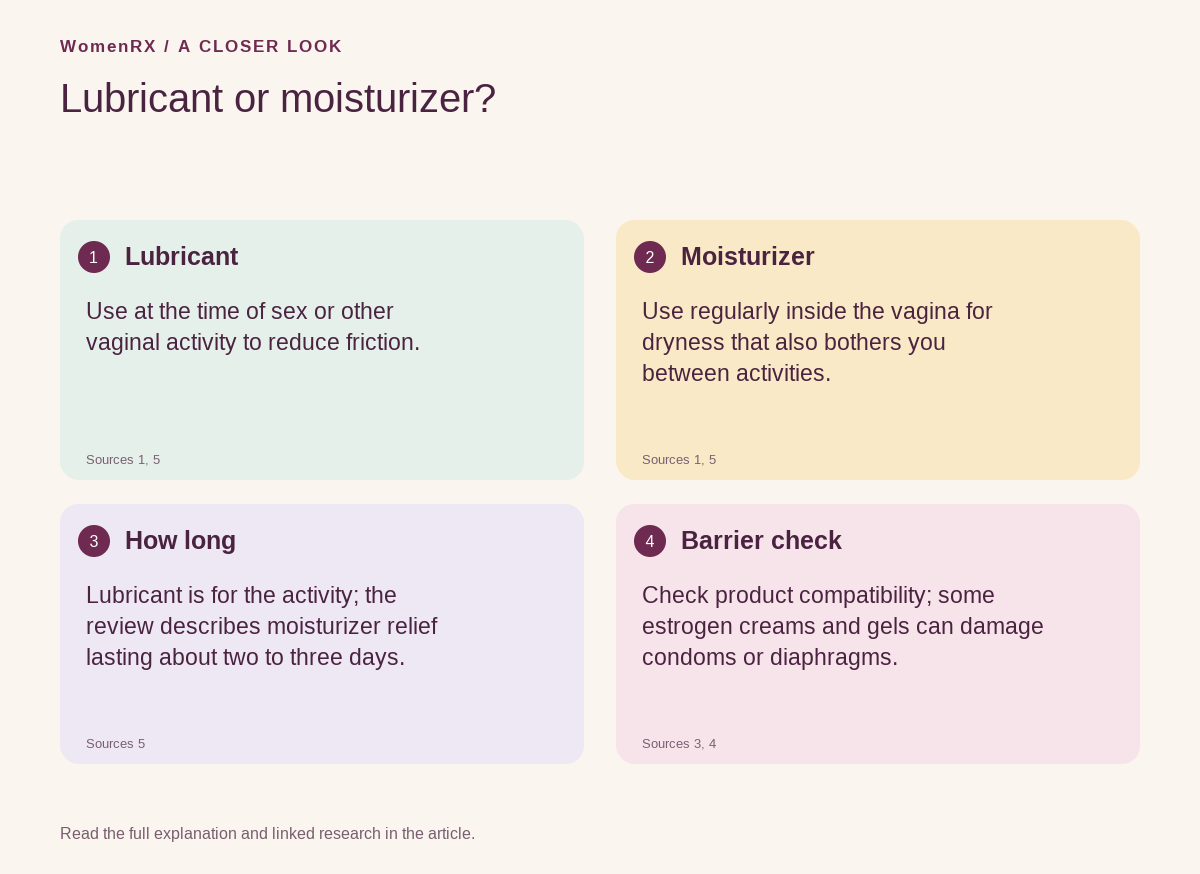
Lubricant or moisturizer?
Lubricant: Use at the time of sex or other vaginal activity to reduce friction.15
Moisturizer: Use regularly inside the vagina for dryness that also bothers you between activities.15
How long: Lubricant is for the activity; the review describes moisturizer relief lasting about two to three days.5
Barrier check: Check product compatibility; some estrogen creams and gels can damage condoms or diaphragms.34
Read the figure as text
The useful distinction is when you need relief: during activity or between activities.- Lubricant: Use at the time of sex or other vaginal activity to reduce friction.15
- Moisturizer: Use regularly inside the vagina for dryness that also bothers you between activities.15
- How long: Lubricant is for the activity; the review describes moisturizer relief lasting about two to three days.5
- Barrier check: Check product compatibility; some estrogen creams and gels can damage condoms or diaphragms.34
Sources you can check
- Vaginal dryness - NHSAccessed 2026-09-25Return to first citation
- About vaginal oestrogen - NHSAccessed 2026-09-25Return to first citation
- Common questions about vaginal oestrogen - NHSAccessed 2026-09-25Return to first citation
- How and when to use vaginal oestrogen - NHSAccessed 2026-09-25Return to first citation
- Treating vulvovaginal atrophy/genitourinary syndrome of menopause: how important is vaginal lubricant and moisturizer composition?Edwards D, Panay N. · Climacteric : the journal of the International Menopause Society · 2016Return to first citation
- A randomized trial on the safety and efficacy of sensate water-based and silicone-based personal lubricants for relief of intimate discomfort associated with vaginal dryness.Krychman M, Hemmady K, Su L, Hood S, Gaifieva S, Palacios S. · The journal of sexual medicine · 2025Return to first citation