Painful Sex After Menopause: What Might Help
Dryness is common after menopause, but where and how sex hurts can point to different conversations about relief.
A drop in estrogen can leave vaginal tissue dry and irritated, making sex painful, but menopause isn’t the only possible cause. Deeper pain may involve the pelvic floor; itching, urinary symptoms, or a sore area deserve their own assessment. You don’t need to keep having painful penetration while you work out what’s happening. Relief depends on the cause. 45
Start with where it hurts
Painful sex after menopause often gets called “dryness,” and dryness may be part of it. Declining estrogen can affect vaginal and urinary tissues, causing dryness, irritation, pain with sex, and sometimes urinary symptoms. Clinicians call this group of changes genitourinary syndrome of menopause, or GSM. But a GSM diagnosis also involves considering other causes or conditions happening alongside it. 45
The useful first distinction is whether the pain feels like rubbing or soreness at the vaginal opening, pain deeper inside, or discomfort accompanied by symptoms such as itching or urinary urgency. Those descriptions aren’t a home diagnosis. They help explain what needs attention instead of assuming one treatment will fix every kind of pain. 45
If it feels dry or sore with contact
Dryness and irritation can make contact uncomfortable. A lubricant used during sexual activity and a vaginal moisturizer used regularly serve different purposes: one helps with sex in the moment, while the other is a longer-lasting option for dryness. They’re reasonable options for mild GSM symptoms, and you can use them without committing to penetration that hurts. 24
If symptoms remain bothersome, low-dose vaginal estrogen is a treatment to discuss. It acts locally and has a stronger evidence base for GSM than other treatments assessed in the 2025 AUA/SUFU/AUGS guideline. It treats vaginal dryness and irritation, not hot flashes or sleep problems. Other treatments for bothersome GSM symptoms include vaginal DHEA and oral ospemifene; the choice depends on your symptoms, preferences, and medical history. 1456
Vaginal estrogen may take up to three months to work fully. If it isn’t helping, that’s a reason to revisit both the treatment and the possibility that something else is contributing to the pain, rather than simply enduring it. 25
If the pain is deeper, itchy, or comes with urinary symptoms
Deeper pain: Pelvic floor muscle pain is one possible contributor. In a clinical review of GSM care, deeper pain related to pelvic floor myalgia prompted discussion of muscle relaxation and, when symptoms persisted, pelvic floor physical therapy. Deeper pain alone doesn’t establish that diagnosis, so describe where you feel it and ask whether a pelvic floor assessment makes sense. 45
Itching or a tender area on the outside: GSM can cause irritation and itching, but those symptoms shouldn’t automatically be attributed to vaginal dryness. An examination can look at the vulvar skin and the painful area and help sort out whether GSM or another condition needs attention. The pattern by itself can’t distinguish a skin problem from other causes. 45
Urinary urgency, fever, local pain, or itching: These symptoms can raise concern for infection, particularly if they appear while you’re using vaginal estrogen. Menopause-related urinary symptoms can also overlap with other urinary conditions, so the next step is assessment rather than guessing that estrogen loss explains them all. 35
A cause can overlap with another. For example, treating dryness may help with friction while deeper pelvic floor pain still needs a different approach. That’s why persistent pain deserves a conversation about what you feel and an examination suited to those symptoms. 45
Make comfort the goal, not a test to pass
You can pause painful penetration and choose touch or sexual activity that feels comfortable, if you want to. External stimulation is one option; penetration isn’t required to keep intimacy in your life. 4 When you seek care, a plain description is enough: “It burns at the opening,” “It hurts deeper inside,” or “I also have itching or urinary urgency.” Mention whether you’ve tried a lubricant or moisturizer and whether it changed anything. Those details give the clinician a better starting point for examining the right area and discussing relief that fits the cause. 45
If you have a history of breast cancer, especially if you take an aromatase inhibitor, decisions about hormonal GSM treatments need a more individualized discussion that may include your oncology team. Nonhormonal comfort measures are still options to discuss. 4
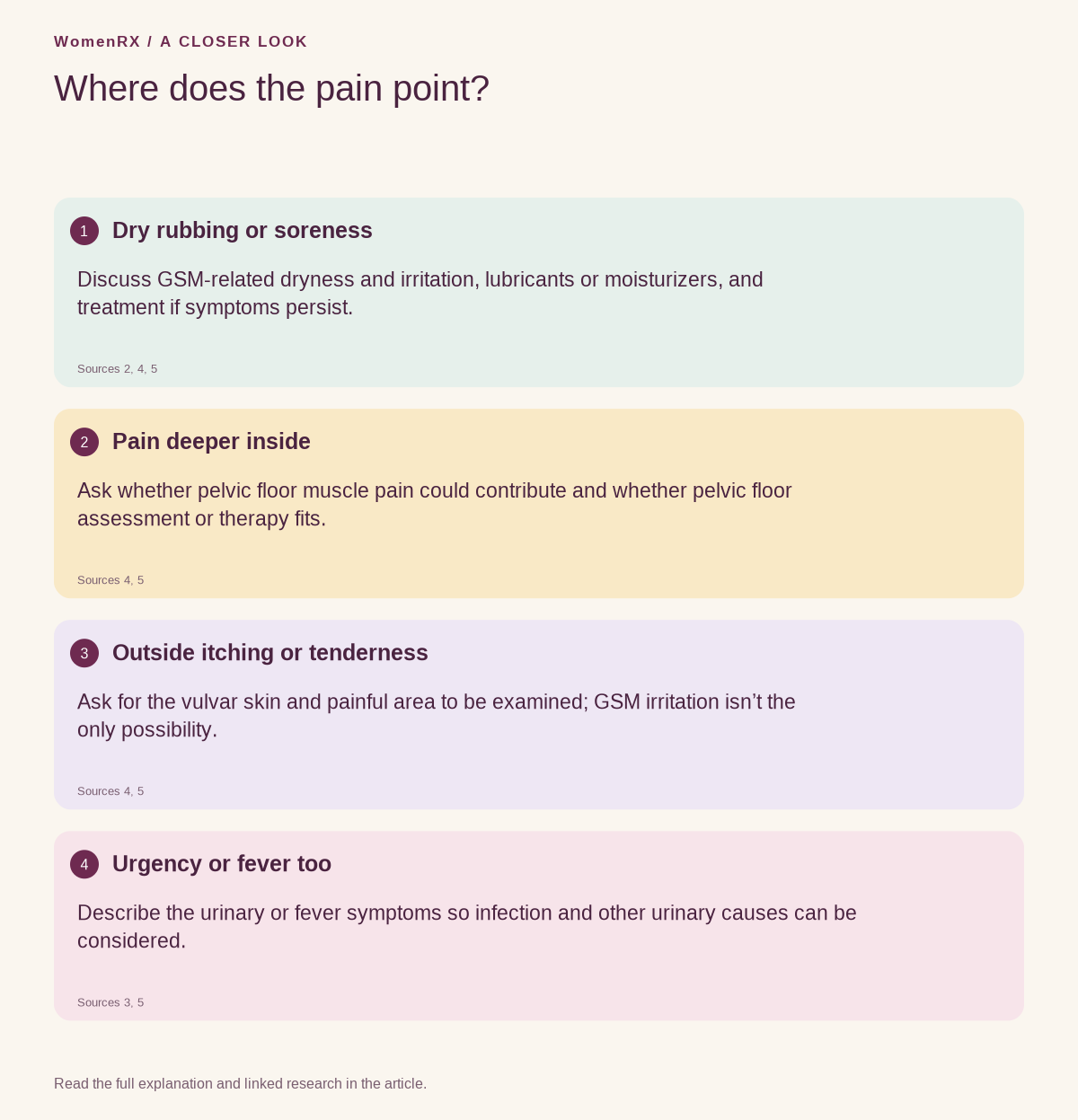
Where does the pain point?
Dry rubbing or soreness: Discuss GSM-related dryness and irritation, lubricants or moisturizers, and treatment if symptoms persist.245
Pain deeper inside: Ask whether pelvic floor muscle pain could contribute and whether pelvic floor assessment or therapy fits.45
Outside itching or tenderness: Ask for the vulvar skin and painful area to be examined; GSM irritation isn’t the only possibility.45
Urgency or fever too: Describe the urinary or fever symptoms so infection and other urinary causes can be considered.35
Read the figure as text
Start with what you notice, then use that description to guide an assessment. More than one branch can apply.- Dry rubbing or soreness: Discuss GSM-related dryness and irritation, lubricants or moisturizers, and treatment if symptoms persist.245
- Pain deeper inside: Ask whether pelvic floor muscle pain could contribute and whether pelvic floor assessment or therapy fits.45
- Outside itching or tenderness: Ask for the vulvar skin and painful area to be examined; GSM irritation isn’t the only possibility.45
- Urgency or fever too: Describe the urinary or fever symptoms so infection and other urinary causes can be considered.35
More questions, answered
Can I use vaginal estrogen if I’m already using a lubricant?
They address comfort in different ways. A lubricant can help during sex; vaginal estrogen treats menopause-related vaginal dryness and irritation over time. Your symptoms and response can guide whether to discuss using both. 124
Sources you can check
- About vaginal oestrogen - NHSAccessed 2026-09-25Return to first citation
- Common questions about vaginal oestrogen - NHSAccessed 2026-09-25Return to first citation
- Side effects of vaginal oestrogen - NHSAccessed 2026-09-25Return to first citation
- Case-Based Perspectives on the Management of Genitourinary Syndrome of Menopause.Cyriac J, Sood R. · Clinics and practice · 2026Return to first citation
- The AUA/SUFU/AUGS Guideline on Genitourinary Syndrome of Menopause.Kaufman MR, Ackerman AL, Amin KA, Coffey M, Danan E, Faubion SS, Hardart A, Goldstein I, Ippolito GM, Northington GM, Powell CR, Rubin RS, Westney OL, Wilson TS, Lee UJ. · The Journal of urology · 2025Return to first citation
- The 2022 hormone therapy position statement of The North American Menopause Society.“The 2022 Hormone Therapy Position Statement of The North American Menopause Society” Advisory Panel. · Menopause (New York, N.Y.) · 2022Return to first citation