Painful Sex After Menopause: Causes and Care Options
Dryness is one possible cause, but pain can also involve pelvic muscles, skin, inflammation, or deeper pelvic problems.
Painful sex after menopause can involve genitourinary syndrome of menopause (GSM), which may include vaginal dryness and pain with sex. 2 But GSM isn’t the only possibility: pelvic-floor tension, skin or inflammatory conditions, treatment-related factors, and deeper pelvic pain can also play a part. The location and pattern of pain help guide an evaluation and the options worth discussing. 3
Start with where and when it hurts
Pain with penetration after menopause can have more than one contributor. A helpful first distinction is whether pain is near the vaginal opening or deeper in the pelvis, and whether it occurs only with touch or penetration or also at other times. Pain felt deeper calls for a broader pelvic evaluation. These patterns offer clues, not a diagnosis. 3
Genitourinary syndrome of menopause (GSM) is a frequent contributor and can include vaginal dryness, pain with sex, and urinary symptoms. 2 But having pain does not prove that GSM is the whole explanation. Pelvic-floor, vestibular, dermatologic, inflammatory, treatment-related, and psychosocial factors may coexist. 3
What an evaluation can help sort out
A useful visit is more than a question about whether sex hurts. You can describe where the pain is, whether it feels like dryness, burning, tenderness, or pressure, and whether it happens with touch, penetration, or at other times. Mention urinary symptoms, visible skin changes, and any relevant medication or treatment changes. If stress, comfort, or relationship context feels relevant, you can mention that too; it doesn’t make the pain less real or rule out physical causes. This helps the clinician consider several possible contributors rather than assuming every symptom comes from low estrogen. 3
Depending on your symptoms and comfort, an examination may look at the vulva and vaginal opening, the vagina, and the pelvic-floor muscles. If pain seems deep or the history suggests a deeper pelvic cause, a clinician may consider a bimanual examination and, selectively, imaging. You can ask what each part of an examination is intended to assess and discuss pausing if it becomes painful. 3
Match the option to the pattern
When dryness is prominent: Lubricants during sex and vaginal moisturizers are nonprescription options to discuss. Avoiding irritants may also be part of care. If symptoms remain bothersome, options for GSM include low-dose vaginal estrogen, vaginal prasterone (also called vaginal DHEA), or oral ospemifene. These are different treatments and routes, so the choice is a discussion about your symptoms, health history, preferences, and whether you have another reason to use systemic hormone therapy. 3 1
When muscles feel tight or tender: Pelvic-floor physical therapy may be considered when an evaluation finds tenderness, guarding, or muscles that are too tense for comfortable penetration. This addresses a different possible contributor than vaginal tissue treatment. The menopause-specific evidence for pelvic-floor approaches is limited, so recommendations draw partly on broader pain conditions. 3
When skin, inflammation, or treatment factors may be involved: Ask what the examination suggests and whether a skin, inflammatory, or treatment-related issue needs its own assessment. Treating dryness alone may not address those contributors. If the pain is deep, ask whether the findings point to a need for broader pelvic evaluation. 3
When more than one factor is present: Care may need to address more than one pattern. For example, someone might discuss a GSM treatment and pelvic-floor therapy if both dryness and muscle guarding are present. That’s an example of matching care to findings, not a one-size-fits-all plan. 3
Systemic hormone therapy is not automatically the only hormonal option for bothersome GSM symptoms. The North American Menopause Society recommends considering low-dose vaginal estrogen, vaginal DHEA, or oral ospemifene for bothersome GSM symptoms not relieved by over-the-counter treatments in women without an indication for systemic hormone therapy. Hormone therapy decisions should be individualized; its risks vary with factors including type, route, timing, and whether a progestogen is used. 1
Pain with sex is worth discussing even if dryness seems like an obvious explanation. The most useful next step is to describe the pain pattern and ask which possible contributors the evaluation is checking, so treatment can fit what is actually going on.
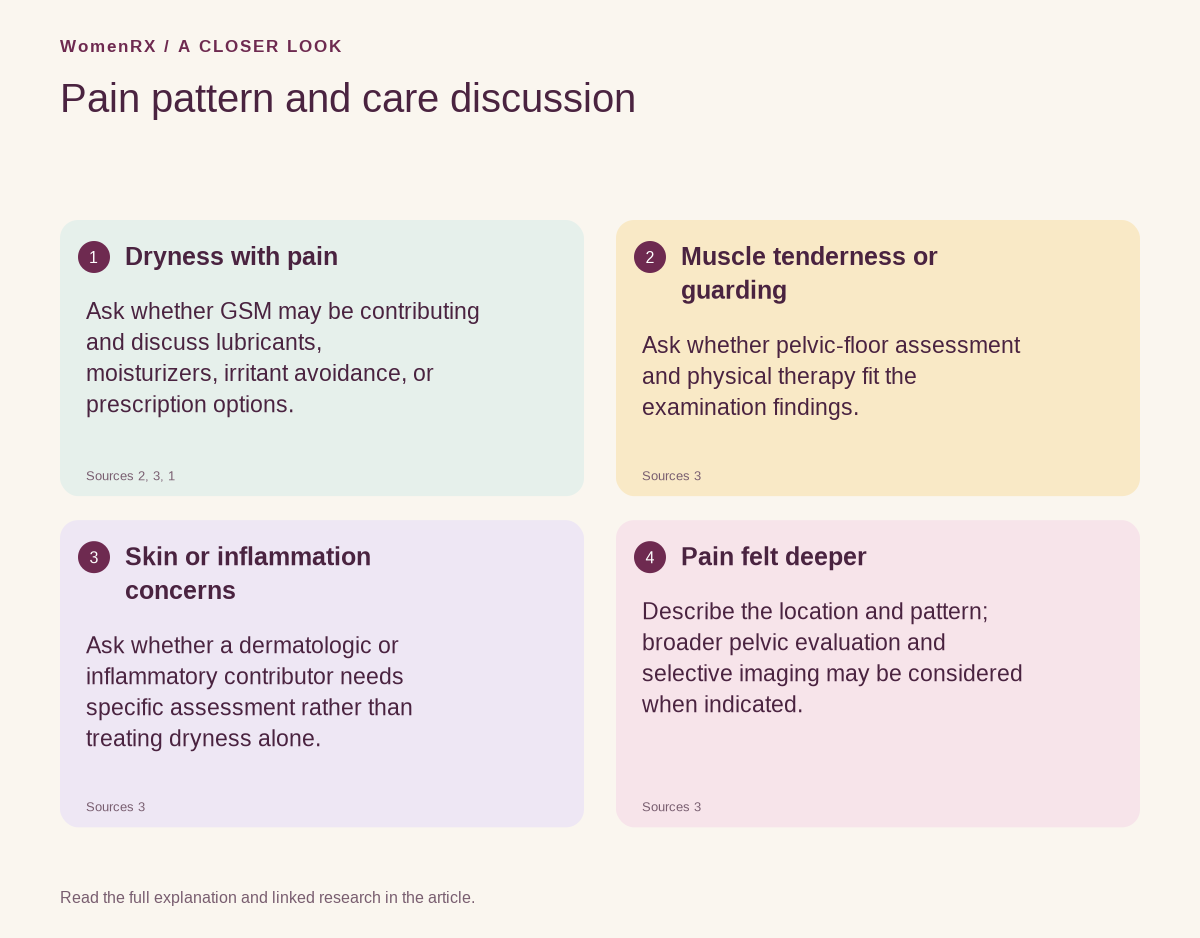
Pain pattern and care discussion
Dryness with pain: Ask whether GSM may be contributing and discuss lubricants, moisturizers, irritant avoidance, or prescription options.231
Muscle tenderness or guarding: Ask whether pelvic-floor assessment and physical therapy fit the examination findings.3
Skin or inflammation concerns: Ask whether a dermatologic or inflammatory contributor needs specific assessment rather than treating dryness alone.3
Pain felt deeper: Describe the location and pattern; broader pelvic evaluation and selective imaging may be considered when indicated.3
Read the figure as text
These patterns can help frame an evaluation; they are clues to discuss, not a way to diagnose yourself.- Dryness with pain: Ask whether GSM may be contributing and discuss lubricants, moisturizers, irritant avoidance, or prescription options.231
- Muscle tenderness or guarding: Ask whether pelvic-floor assessment and physical therapy fit the examination findings.3
- Skin or inflammation concerns: Ask whether a dermatologic or inflammatory contributor needs specific assessment rather than treating dryness alone.3
- Pain felt deeper: Describe the location and pattern; broader pelvic evaluation and selective imaging may be considered when indicated.3
More questions, answered
Does painful sex after menopause always mean vaginal dryness?
No. GSM can involve dryness and pain with sex, but pelvic-floor tenderness or guarding, skin or inflammatory conditions, treatment-related factors, and deeper pelvic causes may also contribute. More than one can be present. 2 3
Is vaginal treatment different from systemic hormone therapy?
Yes. Low-dose vaginal estrogen and vaginal DHEA are local treatments, while ospemifene is taken orally. They are options to discuss for bothersome GSM symptoms; suitability depends on your health history and treatment goals. 1
Sources you can check
- The 2022 hormone therapy position statement of The North American Menopause Society.“The 2022 Hormone Therapy Position Statement of The North American Menopause Society” Advisory Panel. · Menopause (New York, N.Y.) · 2022Return to first citation
- Vaginal Estrogen: Pearls for the Practitioner A Practical Review of Evidence, Guidelines, and Prescribing Strategies for Genitourinary Syndrome of Menopause.Perelmuter S, Srivastava M, Freedman KP, Hanfling S, Rubin RS. · Journal of women's health (2002) · 2026Return to first citation
- Assessment and management of dyspareunia in peri- and postmenopausal women: A phenotype-based gynecologic approach.Broul M, Vančo M, Banýrová J, Hujová A. · International journal of gynaecology and obstetrics: the official organ of the International Federation of Gynaecology and Obstetrics · 2026Return to first citation