Painful Sex After Menopause: What to Discuss
Where the pain happens and what comes with it can help guide an evaluation, but symptoms alone can’t identify the cause.
Pain with sex after menopause is common enough to deserve attention, not something you have to accept. Lower estrogen can contribute to dryness, tissue changes, and pain with penetration, but vulvar skin conditions and other causes can feel similar. Describe where the pain starts, whether it feels near the opening or deeper, and any urinary symptoms or skin changes so an exam can help clarify the cause. 2 3
Start with where and when it hurts
Try describing the pain in everyday terms: Does it sting or burn at the vaginal opening, or feel deeper during penetration? Does it happen with touch, with penetration, or afterward? Mention whether dryness, urinary discomfort, or a change in the vulvar skin comes along with it. These details help focus the conversation; they don’t diagnose the cause on their own.
After menopause, lower estrogen can lead to genitourinary syndrome of menopause (GSM). It may involve vaginal dryness and pain with sex, as well as urinary symptoms. Changes in the vulvovaginal tissue can also be present. 2 3
But GSM isn’t the only possibility. Vulvar skin conditions can overlap with its symptoms, and clinical evaluation may also need to consider inflammatory, infectious, or other conditions. 3 Pain that feels deeper is worth describing just as clearly. Its location is useful information, but it can’t tell you by itself what is causing the pain.
When to arrange an assessment
Consider making an appointment if pain is recurring, getting worse, or making sex uncomfortable enough that you avoid it. An assessment is also reasonable if you notice new vulvar skin changes or urinary symptoms alongside the pain. GSM and vulvar conditions can resemble one another, so a focused history and examination can help distinguish them and guide treatment. 3
There’s no need to wait until sex is impossible or to assume the discomfort is simply part of getting older. Pain can have different causes, and treatment depends on what’s behind it. 1 3
Questions that make the conversation useful
You might ask:
- “Could dryness or other menopausal tissue changes be contributing?”
- “Do you see skin changes or signs of another condition that could explain the pain?”
- “Would an examination help distinguish these possibilities?”
- “Which treatment options fit the likely cause and my health history?”
If the pain is mainly at the opening, describe exactly where you feel it and whether touch or penetration brings it on. If it feels deeper, say when that sensation starts and whether it happens every time. Also mention urinary symptoms, skin changes, and any treatments you’ve already tried. That gives the discussion more to work with than the label “painful sex.”
Treatment depends on the cause
If GSM is the likely explanation, ask what options make sense for you. The North American Menopause Society’s 2022 position statement recommends considering low-dose vaginal estrogen or other therapies, including vaginal dehydroepiandrosterone or oral ospemifene, for bothersome GSM symptoms not relieved by over-the-counter therapies when there isn’t a reason to use systemic hormone therapy. These are options to discuss, not a one-size-fits-all choice. 2
If you have had hormone-sensitive cancer, or are receiving treatment for one, bring that up before choosing a treatment. A review focused on cancer survivors describes the need for individualized decision-making with the oncology team when considering vaginal estrogen. 4 If examination suggests a vulvar skin condition or another cause instead, care can be directed toward that diagnosis rather than assuming menopause-related dryness is responsible. 3
Pain with sex is a symptom worth explaining, not a verdict on what you can expect from intimacy. A clear description of location, timing, and related symptoms can help turn the visit toward finding the cause and choosing care that fits.
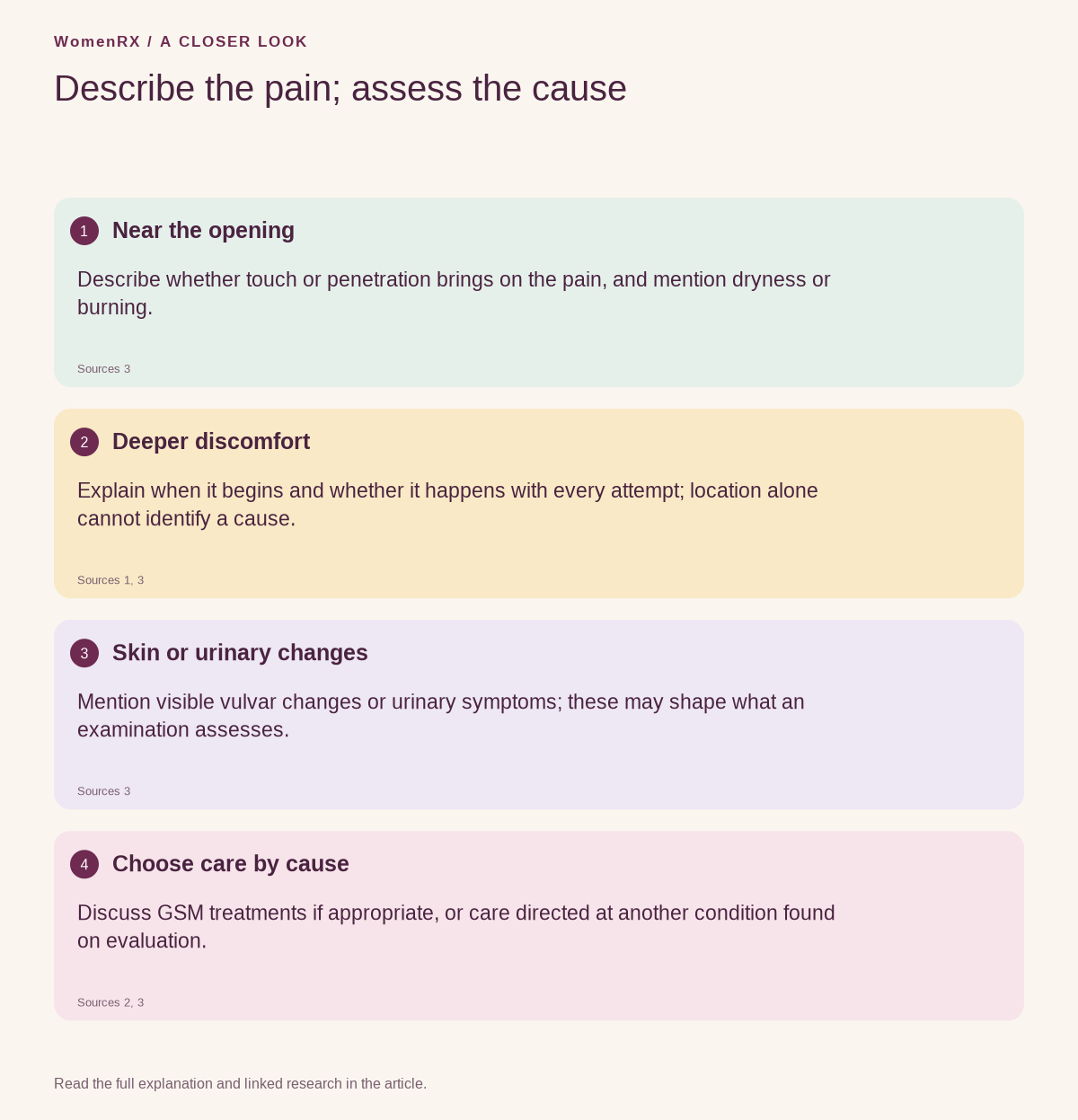
Describe the pain; assess the cause
Near the opening: Describe whether touch or penetration brings on the pain, and mention dryness or burning.3
Deeper discomfort: Explain when it begins and whether it happens with every attempt; location alone cannot identify a cause.13
Skin or urinary changes: Mention visible vulvar changes or urinary symptoms; these may shape what an examination assesses.3
Choose care by cause: Discuss GSM treatments if appropriate, or care directed at another condition found on evaluation.23
Read the figure as text
Use the pattern of pain and any related symptoms to guide what to discuss. These clues do not diagnose the cause.- Near the opening: Describe whether touch or penetration brings on the pain, and mention dryness or burning.3
- Deeper discomfort: Explain when it begins and whether it happens with every attempt; location alone cannot identify a cause.13
- Skin or urinary changes: Mention visible vulvar changes or urinary symptoms; these may shape what an examination assesses.3
- Choose care by cause: Discuss GSM treatments if appropriate, or care directed at another condition found on evaluation.23
More questions, answered
Does pain with sex after menopause always mean vaginal dryness?
No. GSM can cause dryness and pain with sex, but vulvar skin conditions and other causes can overlap with its symptoms. An assessment may help distinguish them. 3
Is vaginal estrogen the only treatment option to ask about?
No. For bothersome GSM symptoms not relieved by over-the-counter therapies, the 2022 North American Menopause Society position statement also names vaginal dehydroepiandrosterone and oral ospemifene as options. Which, if any, fits depends on your situation. 2
Sources you can check
- Pain | MedlinePlusAccessed 2026-09-25Return to first citation
- The 2022 hormone therapy position statement of The North American Menopause Society.“The 2022 Hormone Therapy Position Statement of The North American Menopause Society” Advisory Panel. · Menopause (New York, N.Y.) · 2022Return to first citation
- A Practical Management Approach to Vulvar Dermatoses and Genitourinary Syndrome of Menopause.Negris O, Ghafari-Saravi A, Mauskar MM. · Obstetrics and gynecology · 2026Return to first citation
- Genitourinary syndrome of menopause in women with cancer - a narrative review.Ryan HM, Brennan DJ. · Maturitas · 2026Return to first citation