Painful Sex After Menopause: What an Assessment Looks For
Where the pain starts and what else you notice can help distinguish menopause-related tissue changes from other possible causes.
After menopause, dryness and thinner vaginal tissue can make sex painful, but they aren’t the only possible causes. Pain at the opening, pain with deeper penetration, and pain that began after years of comfortable sex offer different clues. An assessment usually starts with your description of the pain and may include an examination of the vulvar skin and pelvic floor, adapted to what you can tolerate. 23
Where it hurts helps focus the assessment
Pain during sex is a symptom, not a diagnosis. Genitourinary syndrome of menopause, or GSM, can involve vaginal dryness and thinner tissue, along with pain during sex. Some people also have urinary symptoms, such as discomfort when urinating or urgency. But vulvar skin conditions can cause similar symptoms, so dryness alone doesn’t settle the question. 2
These distinctions give you a way to describe what’s happening:
- Pain at the opening or on the outer vulva is often called superficial pain. The assessment may focus on the vulvar skin, vaginal entrance, and tenderness in that area. 3
- Pain farther inside, especially with deeper penetration is called deep pain. Pelvic floor muscles and other pelvic conditions may need consideration, rather than dryness alone. 3
- Pain that started after a period of pain-free sex is called secondary dyspareunia. When the change happened is useful history, though it doesn’t identify the cause by itself. 3
- Pain with touch outside sex, or a visible skin change can shift attention toward the vulva. The appearance and location of skin changes matter because vulvar conditions can overlap with GSM. 23
You may recognize more than one pattern. The point isn’t to choose a diagnosis from a list. It’s to help make sure the assessment accounts for all the places you hurt and any symptoms that occur alongside the pain. 23
What you can expect at the visit
A clinician may ask where the pain is, what it feels like, when it began, and whether it happens with initial touch, deeper penetration, or at other times. Mention dryness, urinary symptoms, and any skin changes you’ve noticed. You can also mention changes in your medicines or circumstances around sex without assuming either explains the pain. Questions about the pain’s location, timing, and triggers help guide the examination. 13
The examination may start with a look at the vulva and vaginal entrance and a check for tenderness or skin changes. If a skin condition is possible, its appearance and distribution can help distinguish it from GSM. A biopsy is sometimes considered when a finding needs further evaluation; it isn’t a routine step for everyone with painful sex. 23
Depending on your symptoms, the clinician may assess the pelvic floor muscles with a single-finger internal examination. A speculum or bimanual examination may follow if it would help and you can tolerate it. You can ask what each step is meant to find out, request an explanation as it happens, or ask to pause. An assessment for pain should take the pain itself into account. 3
How the findings shape the next step
The next step depends on what the history and examination suggest. Menopause-related tissue changes, a vulvar skin condition, pelvic muscle tenderness, or another pelvic problem call for different approaches; overlapping findings may need more than one approach. When a vulvar condition remains uncertain, or symptoms don’t respond as expected, referral to a clinician with vulvar expertise may be appropriate. 23
If GSM appears to be the cause, treatment can address those symptoms specifically. For bothersome GSM symptoms that haven’t improved with over-the-counter therapies, the North American Menopause Society lists low-dose vaginal estrogen and other options, including vaginal dehydroepiandrosterone and oral ospemifene, for women who don’t have an indication for systemic hormone therapy. That guidance applies to GSM, not to every cause of painful sex. 4
You don’t need to arrive knowing whether this is GSM. “It stings at the opening,” “It hurts deeper inside,” or “This is new for me” is enough to begin a more focused conversation.
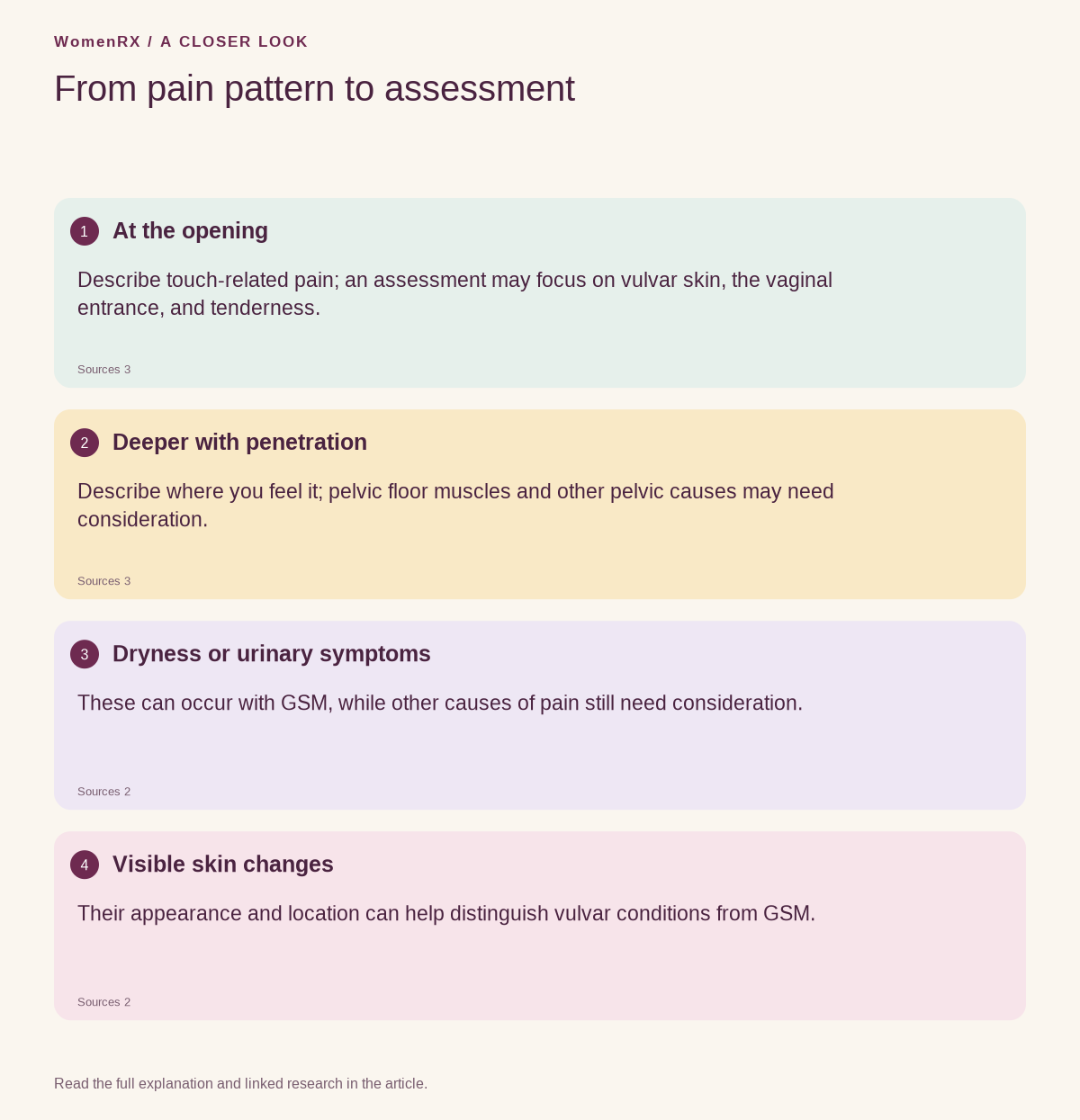
From pain pattern to assessment
At the opening: Describe touch-related pain; an assessment may focus on vulvar skin, the vaginal entrance, and tenderness.3
Deeper with penetration: Describe where you feel it; pelvic floor muscles and other pelvic causes may need consideration.3
Dryness or urinary symptoms: These can occur with GSM, while other causes of pain still need consideration.2
Visible skin changes: Their appearance and location can help distinguish vulvar conditions from GSM.2
Read the figure as text
A symptom can point toward what to examine next, but no single pattern establishes a diagnosis.- At the opening: Describe touch-related pain; an assessment may focus on vulvar skin, the vaginal entrance, and tenderness.3
- Deeper with penetration: Describe where you feel it; pelvic floor muscles and other pelvic causes may need consideration.3
- Dryness or urinary symptoms: These can occur with GSM, while other causes of pain still need consideration.2
- Visible skin changes: Their appearance and location can help distinguish vulvar conditions from GSM.2
More questions, answered
Can I ask to change or stop the examination?
Yes. A clinical review of sexual pain describes explaining examination steps and proceeding with further internal examination if it’s tolerated. You can ask what a step is for, request a pause, or say you don’t want to continue. 3
Sources you can check
- Pain | MedlinePlusAccessed 2026-09-25Return to first citation
- A Practical Management Approach to Vulvar Dermatoses and Genitourinary Syndrome of Menopause.Negris O, Ghafari-Saravi A, Mauskar MM. · Obstetrics and gynecology · 2026Return to first citation
- Evaluation and Treatment of Female Sexual Pain: A Clinical Review.Sorensen J, Bautista KE, Lamvu G, Feranec J. · Cureus · 2018Return to first citation
- The 2022 hormone therapy position statement of The North American Menopause Society.“The 2022 Hormone Therapy Position Statement of The North American Menopause Society” Advisory Panel. · Menopause (New York, N.Y.) · 2022Return to first citation