GSM Can Affect More Than Vaginal Comfort
Menopause-related changes can involve genital, sexual, and urinary symptoms, but those symptoms can have other causes too.
Genitourinary syndrome of menopause (GSM) describes symptoms and tissue changes linked to lower hormone levels during the menopausal transition. It can involve vaginal or vulvar dryness and discomfort, pain with sex, or urinary symptoms such as urgency or burning. Not everyone has symptoms in every area, and symptoms alone can’t confirm GSM: evaluation considers your situation and checks for other causes. 2 3 4
One process, several symptom areas
GSM is the name for symptoms and physical changes in the genital and urinary tract associated with declining estrogen and androgen levels during the menopausal transition. It can begin around perimenopause or occur after menopause; symptoms may involve one area without involving all the others. 2
The name is broader than older terms such as “vaginal atrophy” because the experience isn’t limited to the vagina. Symptoms can affect the vulva, vagina, sexual comfort, and urinary function. 2 4
What the pattern can look like
Vulvar or vaginal symptoms: dryness and discomfort are common ways GSM may be experienced. On examination, a clinician may see changes such as paler, thinner tissue or a loss of the vagina’s usual folds. These findings can support the assessment, but they aren’t required for a GSM diagnosis. 2 3
Sexual symptoms: vaginal dryness or tissue sensitivity can make sex uncomfortable or painful. Pain with sex can have other causes as well, so it’s a symptom to describe rather than proof of GSM. 3
Urinary symptoms: some people notice burning with urination, urgency, needing to urinate often, nighttime urination, or incontinence. Urinary complaints can occur alongside genital symptoms, but they don’t automatically mean GSM. Infection and other conditions may need to be considered. 2 4
These are possible parts of a pattern, not a checklist that everyone with GSM will match. The mix and impact of symptoms differ from person to person. 2
Why symptoms need interpretation
Dryness, irritation, pain, and urinary discomfort can overlap with infections and other conditions. Vulvar skin conditions, for example, can resemble GSM; changes in the appearance or distribution of affected skin may help distinguish them. GSM can also occur alongside another problem, so one explanation doesn’t necessarily account for every symptom. 2 3
That’s why GSM isn’t best treated as a self-diagnosis based on age or one symptom. A clinician can consider the pattern and timing of your symptoms, examine the area when appropriate, and assess whether another cause or a coexisting condition needs attention. The guideline describes diagnosis as based on symptoms, with or without related physical findings, after considering other causes. 2
Pain or urinary changes deserve attention on their own terms. Don’t assume that pain or urinary symptoms are simply menopause; mention them so they can be assessed in context. 2 3
A useful way to describe what’s happening
When you talk with a clinician, it can help to name the area affected and the change you’ve noticed: for example, vaginal dryness, pain with sex, or burning when you urinate. Say whether you’re also having symptoms in another area. This gives the clinician a clearer picture without assuming that all the symptoms share one cause.
If GSM is the explanation, treatment can be discussed around your symptoms and preferences. A 2025 US guideline says local low-dose vaginal estrogen has the most robust evidence among the approaches it reviewed; the North American Menopause Society also lists vaginal estrogen and other prescription options for bothersome symptoms in certain circumstances. 2 1
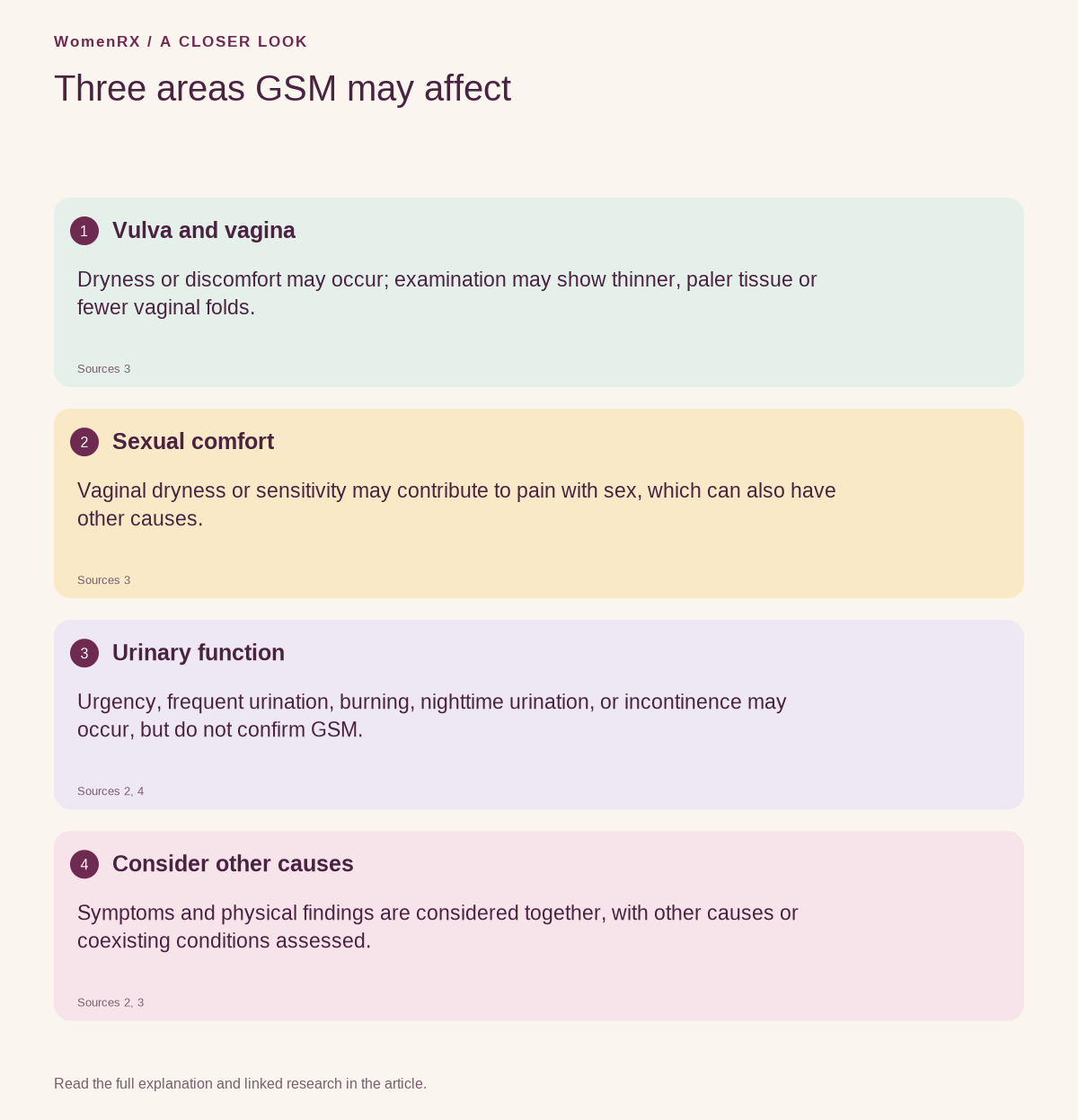
Three areas GSM may affect
Vulva and vagina: Dryness or discomfort may occur; examination may show thinner, paler tissue or fewer vaginal folds.3
Sexual comfort: Vaginal dryness or sensitivity may contribute to pain with sex, which can also have other causes.3
Urinary function: Urgency, frequent urination, burning, nighttime urination, or incontinence may occur, but do not confirm GSM.24
Consider other causes: Symptoms and physical findings are considered together, with other causes or coexisting conditions assessed.23
Read the figure as text
GSM can involve genital, sexual, and urinary symptoms. The map shows possible connections, not a set of symptoms everyone will have.- Vulva and vagina: Dryness or discomfort may occur; examination may show thinner, paler tissue or fewer vaginal folds.3
- Sexual comfort: Vaginal dryness or sensitivity may contribute to pain with sex, which can also have other causes.3
- Urinary function: Urgency, frequent urination, burning, nighttime urination, or incontinence may occur, but do not confirm GSM.24
- Consider other causes: Symptoms and physical findings are considered together, with other causes or coexisting conditions assessed.23
More questions, answered
Can GSM be present without visible tissue changes?
Yes. The 2025 guideline says GSM can be diagnosed from symptoms with or without related physical findings, once other causes or coexisting conditions have been considered. 2
Sources you can check
- The 2022 hormone therapy position statement of The North American Menopause Society.“The 2022 Hormone Therapy Position Statement of The North American Menopause Society” Advisory Panel. · Menopause (New York, N.Y.) · 2022Return to first citation
- Executive Summary: The AUA/SUFU/AUGS Guideline on Genitourinary Syndrome of Menopause.Kaufman MR, Ackerman AL, Amin KA, Coffey M, Danan E, Faubion SS, Hardart A, Goldstein I, Ippolito GM, Northington GM, Powell CR, Rubin RS, Westney OL, Wilson TS, Lee UJ. · Urogynecology (Philadelphia, Pa.) · 2025Return to first citation
- A Practical Management Approach to Vulvar Dermatoses and Genitourinary Syndrome of Menopause.Negris O, Ghafari-Saravi A, Mauskar MM. · Obstetrics and gynecology · 2026Return to first citation
- Urinary manifestations of genitourinary syndrome of menopause: a review of the pathophysiology, clinical presentation, and management.Saad JC, Brandon CA. · Gynecology and pelvic medicine · 2026Return to first citation