Painful Sex and Hormones: How Strong Is the Connection?
Estrogen-related changes can contribute to painful sex, but where and how it hurts can point to other causes too.
The hormone connection is strongest when painful sex is part of genitourinary syndrome of menopause (GSM), which can also involve vaginal dryness and urinary symptoms. But in perimenopause and after menopause, pain may involve the vaginal opening, pelvic floor, skin, or deeper pelvic structures, sometimes alongside GSM. Menopause timing alone can’t tell you which is responsible. 1 3
Where estrogen fits
Genitourinary syndrome of menopause, or GSM, describes genital and urinary symptoms associated with estrogen deficiency. Vaginal dryness, painful sex, and urinary symptoms can all be part of it. That makes a hormone link plausible when sex becomes uncomfortable around menopause, particularly if dryness is part of what you’re noticing. It doesn’t make hormones the explanation for every kind of pain. 1 3
There’s treatment evidence behind the connection, too. The North American Menopause Society recognizes hormone therapy as effective for GSM. For bothersome GSM symptoms that haven’t improved with over-the-counter options, its guidance recommends considering low-dose vaginal estrogen or other GSM therapies when systemic hormone therapy isn’t otherwise indicated. That guidance addresses a condition and its symptoms; it doesn’t mean an estrogen level can identify the cause of one person’s pain. 2
The place and pattern of pain offer different clues
Consider where the pain starts. Pain at the vaginal opening, especially with touch or penetration, may involve the vestibule, the sensitive area just outside the vaginal opening. Pelvic floor muscles may also be tender or tighten in a way that makes penetration painful. These contributors can occur alongside GSM rather than instead of it. 1
Pain that feels deeper inside is a different pattern and may need a broader pelvic evaluation. Skin conditions, inflammation, treatment effects, and psychosocial factors can also contribute to intercourse-related pain. Psychosocial factors are part of a whole-person assessment, not a reason to dismiss physical pain. A review focused on perimenopausal and postmenopausal women recommends distinguishing pain at the opening from deep pain, and pain triggered by touch from pain that occurs without it. 1
For example, dryness and friction may make GSM worth considering, while sharply localized pain from light touch at the opening raises a different question about vestibular sensitivity. If both are happening, addressing dryness may help without resolving all the pain. These patterns are clues, not diagnoses you have to make yourself. 1 2
Why one explanation may not be enough
Research on postmenopausal GSM offers a useful reminder that biology and symptoms don’t always move together. A systematic review found that estrogen therapy partly restored a vaginal microbial pattern associated with estrogen exposure, but symptoms did not improve uniformly. Microbiome findings can’t establish why an individual person has pain. 3
The same caution applies to timing: developing pain during perimenopause or after menopause makes GSM worth considering, not certain. A menopause-focused review describes several pain contributors that can coexist, including GSM, vestibular pain, and pelvic floor dysfunction. 1
Match the response to the likely contributor
If dryness seems prominent, lubricants and vaginal moisturizers are practical options described in menopause-focused care. If GSM remains bothersome, there are prescription options directed at GSM. If penetration brings on muscle tenderness or guarding, pelvic floor physiotherapy may be considered, although research specific to menopausal pelvic floor pain is limited. A skin problem or deep pelvic pain calls for a different assessment than dryness alone. 1 2
You don’t need to decide whether your pain is “hormonal” before describing it. Where it hurts, whether touch triggers it, and whether dryness, urinary symptoms, or skin changes occur alongside it are more useful starting points. They help determine whether GSM fits and what else deserves attention. 1
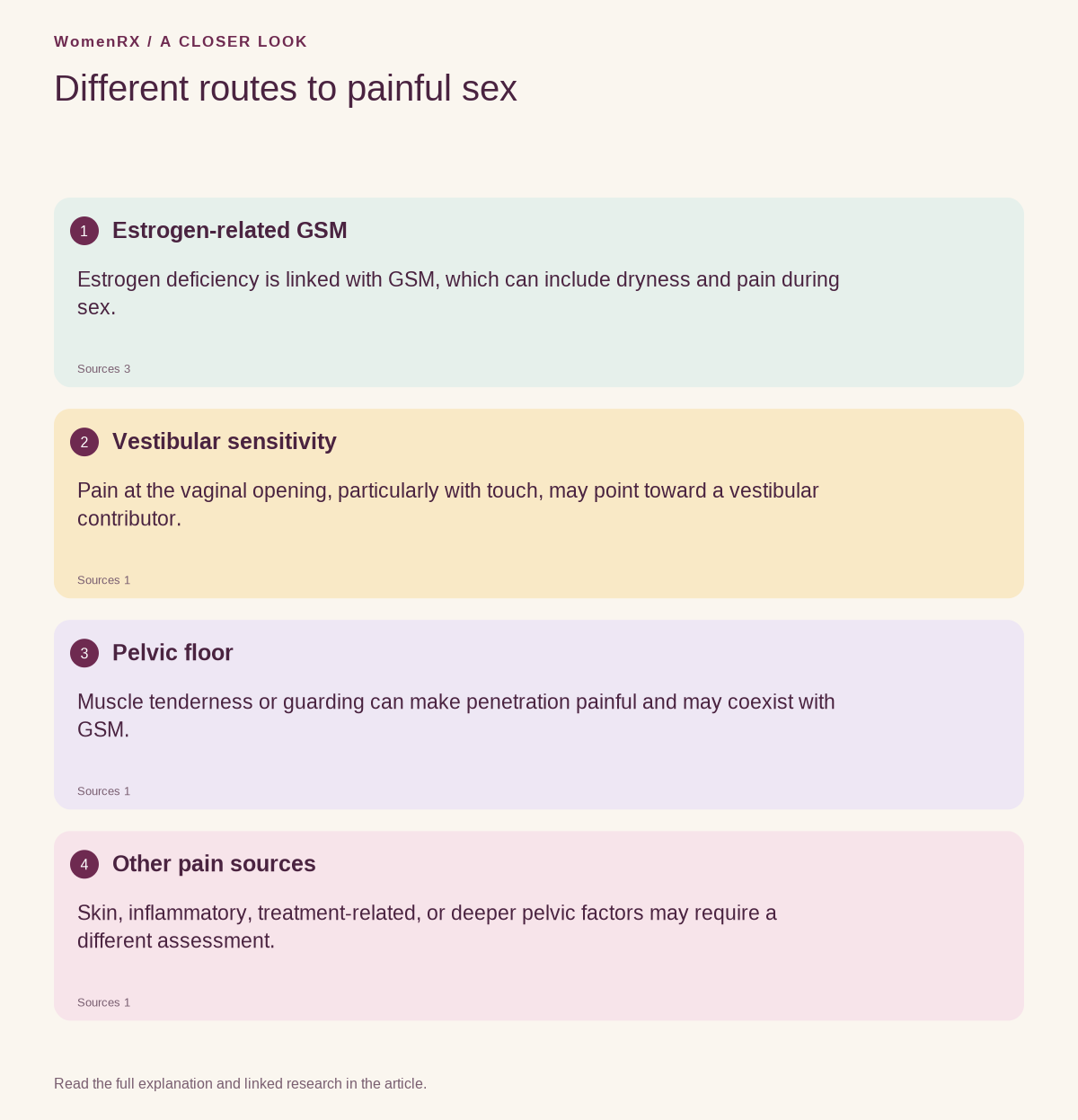
Different routes to painful sex
Estrogen-related GSM: Estrogen deficiency is linked with GSM, which can include dryness and pain during sex.3
Vestibular sensitivity: Pain at the vaginal opening, particularly with touch, may point toward a vestibular contributor.1
Pelvic floor: Muscle tenderness or guarding can make penetration painful and may coexist with GSM.1
Other pain sources: Skin, inflammatory, treatment-related, or deeper pelvic factors may require a different assessment.1
Read the figure as text
Estrogen-related GSM is one possible route to pain; other contributors may occur alongside it.- Estrogen-related GSM: Estrogen deficiency is linked with GSM, which can include dryness and pain during sex.3
- Vestibular sensitivity: Pain at the vaginal opening, particularly with touch, may point toward a vestibular contributor.1
- Pelvic floor: Muscle tenderness or guarding can make penetration painful and may coexist with GSM.1
- Other pain sources: Skin, inflammatory, treatment-related, or deeper pelvic factors may require a different assessment.1
More questions, answered
If treatment for GSM helps, does that mean hormones were the only cause?
Not necessarily. GSM can coexist with vestibular pain or pelvic floor dysfunction, so improvement in dryness or discomfort wouldn’t rule out another contributor if pain remains. 1
Sources you can check
- Assessment and management of dyspareunia in peri- and postmenopausal women: A phenotype-based gynecologic approach.Broul M, Vančo M, Banýrová J, Hujová A. · International journal of gynaecology and obstetrics: the official organ of the International Federation of Gynaecology and Obstetrics · 2026Return to first citation
- The 2022 hormone therapy position statement of The North American Menopause Society.“The 2022 Hormone Therapy Position Statement of The North American Menopause Society” Advisory Panel. · Menopause (New York, N.Y.) · 2022Return to first citation
- Gut, vaginal, and urinary microbiome alterations in women with genitourinary syndrome of menopause: A systematic review.Tsuboi I, Inoue S, Hirayama T, Mitsui Y, Watanabe M, Hirakawa H, Sadahira T. · Maturitas · 2026Return to first citation