Vaginal Estrogen and Weight: What It Is and Is Not Used For
Vaginal estrogen treats certain menopause-related symptoms, not weight loss, and it shouldn’t be confused with systemic hormone therapy.
Vaginal estrogen is used for genitourinary symptoms of menopause, such as vaginal dryness and irritation. It isn’t a weight-loss treatment, and you shouldn’t expect it to reduce body weight. General guidance says there’s no good evidence that estrogen causes weight gain, but that doesn’t show how every vaginal product affects an individual’s weight. 1 2

The treatment’s purpose is local symptom relief
Vaginal estrogen is used for genitourinary syndrome of menopause (GSM), which can include vaginal dryness and irritation. It comes in forms placed in the vagina, including tablets, creams, gels, and rings. Its intended job is to ease these symptoms, not to change body weight. A 2025 US guideline says low-dose vaginal estrogen has the most robust evidence base among treatments for GSM symptoms. 1 4
If you’re considering it mainly because of weight changes, it’s not a weight-management treatment. Guidance says there’s no good evidence that taking estrogen causes weight gain, while also noting that weight gain is common around menopause. Neither statement means vaginal estrogen causes weight loss or prevents menopause-related weight change. 2
Local vaginal treatment is not the same as systemic therapy
“Estrogen” can refer to treatments with different routes and purposes. Vaginal estrogen is placed in the vagina for genitourinary symptoms; the NHS reference describes little of the medicine as reaching the rest of the body. Systemic hormone therapy can treat symptoms beyond the vaginal area, such as hot flashes. A menopause position statement recommends low-dose vaginal estrogen for bothersome GSM symptoms when systemic hormone therapy isn’t indicated. 1 5
That distinction matters when interpreting claims about weight. A general statement about estrogen is not a direct study of a particular vaginal cream, tablet, or ring. Hormone therapy’s risks can differ by type, dose, duration, and route, so don’t assume different products or routes have identical exposure or effects. 5
What hormone-level studies do, and don’t, tell you
A systematic review of 17 studies in breast cancer survivors assessed hormone levels and safety across several treatments for vulvovaginal symptoms. Among the treatments it assessed, low-dose vaginal estrogen showed the smallest changes in serum estradiol. The review said safety remained unclear, especially for people taking aromatase inhibitors. These findings concern hormone levels and safety in that specific population, not weight change. 3
If you’re weighing whether to use vaginal estrogen, the practical question is whether the specific product is appropriate for the genitourinary symptoms you want to treat. Ask which route and formulation are being considered, and keep the weight question separate: vaginal estrogen is not intended as a way to lose weight, and the general guidance about estrogen and weight gain does not establish a weight effect for each vaginal product. 1 2
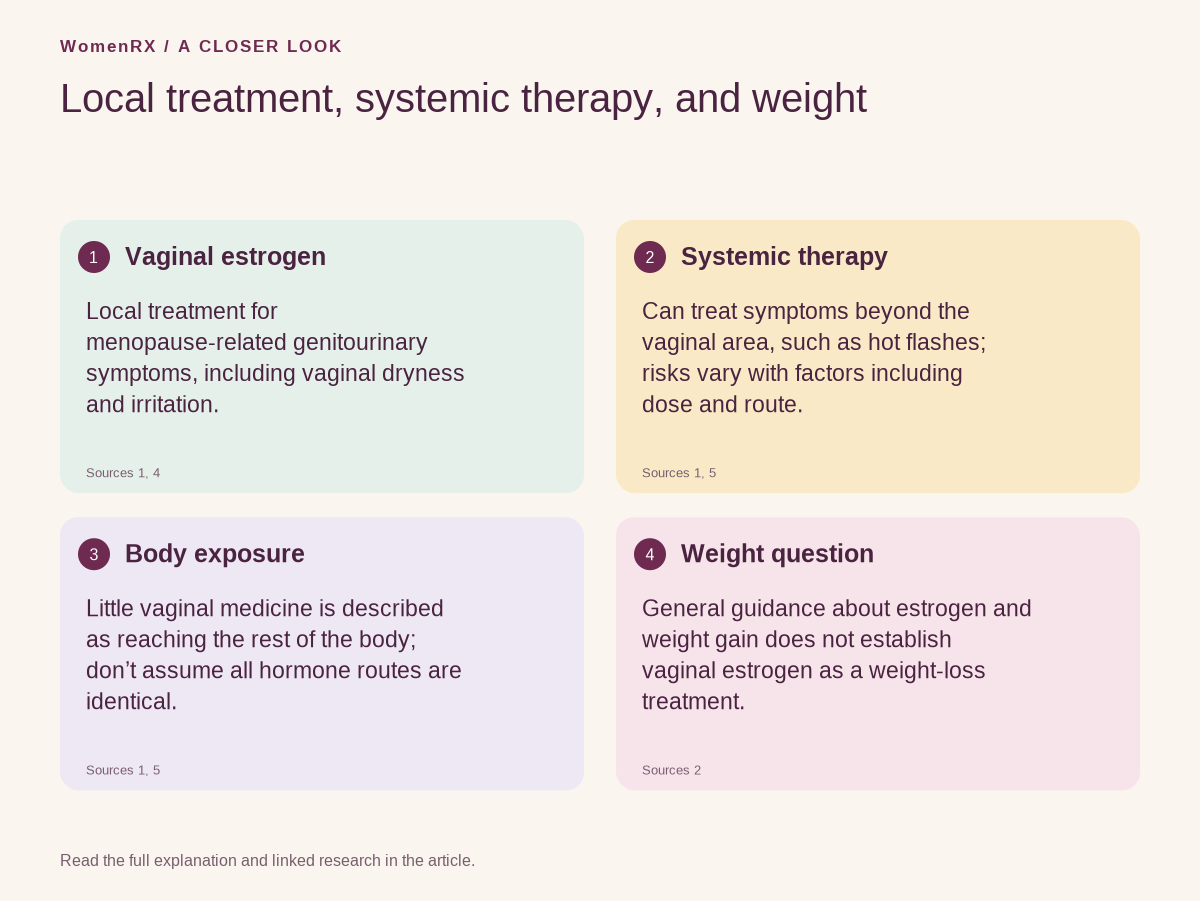
Local treatment, systemic therapy, and weight
Vaginal estrogen: Local treatment for menopause-related genitourinary symptoms, including vaginal dryness and irritation.14
Systemic therapy: Can treat symptoms beyond the vaginal area, such as hot flashes; risks vary with factors including dose and route.15
Body exposure: Little vaginal medicine is described as reaching the rest of the body; don’t assume all hormone routes are identical.15
Weight question: General guidance about estrogen and weight gain does not establish vaginal estrogen as a weight-loss treatment.2
Read the figure as text
Compare the purpose and route of vaginal estrogen with systemic hormone therapy, then separate those treatment roles from the question of weight.- Vaginal estrogen: Local treatment for menopause-related genitourinary symptoms, including vaginal dryness and irritation.14
- Systemic therapy: Can treat symptoms beyond the vaginal area, such as hot flashes; risks vary with factors including dose and route.15
- Body exposure: Little vaginal medicine is described as reaching the rest of the body; don’t assume all hormone routes are identical.15
- Weight question: General guidance about estrogen and weight gain does not establish vaginal estrogen as a weight-loss treatment.2
Sources you can check
- About vaginal oestrogen - NHSAccessed 2026-09-25Return to first citation
- Common questions about vaginal oestrogen - NHSAccessed 2026-09-25Return to first citation
- Safety and Serum Estradiol Levels in Hormonal Treatments for Vulvovaginal Atrophy in Breast Cancer Survivors: A Systematic Review and Meta-Analysis.Comini ACM, Carvalho BM, Moreira MJB, Reis PCA, Colapietro L, Northern J, Batalini F. · Clinical breast cancer · 2023Return to first citation
- Executive Summary: The AUA/SUFU/AUGS Guideline on Genitourinary Syndrome of Menopause.Kaufman MR, Ackerman AL, Amin KA, Coffey M, Danan E, Faubion SS, Hardart A, Goldstein I, Ippolito GM, Northington GM, Powell CR, Rubin RS, Westney OL, Wilson TS, Lee UJ. · Urogynecology (Philadelphia, Pa.) · 2025Return to first citation
- The 2022 hormone therapy position statement of The North American Menopause Society.“The 2022 Hormone Therapy Position Statement of The North American Menopause Society” Advisory Panel. · Menopause (New York, N.Y.) · 2022Return to first citation