When Might Vaginal Estrogen Ease Genitourinary Symptoms?
Vaginal estrogen may take up to three months to work fully, and the clearest way to judge it is to follow the symptoms it was meant to treat.
Vaginal estrogen may take up to three months to work fully, but that isn’t a guaranteed wait for relief or a promise that every symptom will improve. Track the specific issue you’re treating, such as dryness, discomfort with sex, or urinary symptoms. If symptoms worsen, signs of infection appear, or you’re not feeling better by three months, arrange a treatment review. 124

What “working” means for a local treatment
After menopause, lower estrogen can affect tissues in and around the vagina and urinary tract. Symptoms may include dryness, irritation, discomfort with sex, urinary urgency or frequency, and recurrent urinary discomfort. Vaginal estrogen is a local treatment for genitourinary symptoms; it doesn’t treat other menopause symptoms such as hot flashes or sleep problems. 16
General medicine guidance says vaginal estrogen can take up to three months to work fully. That’s a guide to the possible time for full effect, not a date by which everyone should feel better. Response can differ from person to person, and products have different instructions. Don’t wait for that timeframe if symptoms are getting worse. 123
Track the symptom you want to change
Choose one or two symptoms that matter most to you. For example, you might track dryness and discomfort during sex, or urinary urgency and repeat urinary infections. Keep these as separate observations: improvement in vaginal comfort doesn’t necessarily mean a urinary symptom has changed too.
A simple note can help you spot a pattern. For example, once a week you could rate each chosen symptom from 0 to 10, note whether it affected sex or daily activities, and record any side effects. This is a practical tracking idea, not a validated test.
Note which product you use and whether you’ve been able to follow its instructions. Tablets, creams, pessaries, gels, and rings can have different directions, so don’t transfer instructions from one form to another or change your use on your own. 3
Give urinary symptoms their own measure
Urinary urgency, frequency, or discomfort can occur as part of genitourinary symptoms after menopause, but those symptoms may also need separate assessment. Preventing recurrent urinary tract infections is a different goal from treating discomfort during an infection that is happening now.
A review of five randomized trials reported that vaginal estrogen reduced culture-confirmed recurrent UTIs. The review found no head-to-head trials showing that one vaginal estrogen formulation is better than another. It also found no identified trial evaluating starting vaginal estrogen alongside antibiotics at the onset of an acute UTI. That finding is about starting the two together at that point; it doesn’t establish that vaginal estrogen treats an active infection. 5
If urinary symptoms come with a raised temperature, an urgent need to pee, local pain, or itching, contact a clinician for assessment rather than waiting for a three-month check-in. 4
When to review the treatment
If you’re not feeling better by about three months, arrange a treatment review. The guidance recommends discussing a lack of improvement at that point; the review can consider whether the product and its instructions fit your situation, whether another formulation might be worth trying, or whether another cause is contributing. Some people may need to try different types. 23
Ask for advice sooner if symptoms are worsening or side effects are bothering you. Heavy bleeding, or unexpected bleeding after six months of use, should also be discussed with a clinician. 4
If you’ve noticed some improvement, your notes can help make a follow-up conversation specific: which symptom changed, which did not, and whether the benefit is enough for you.
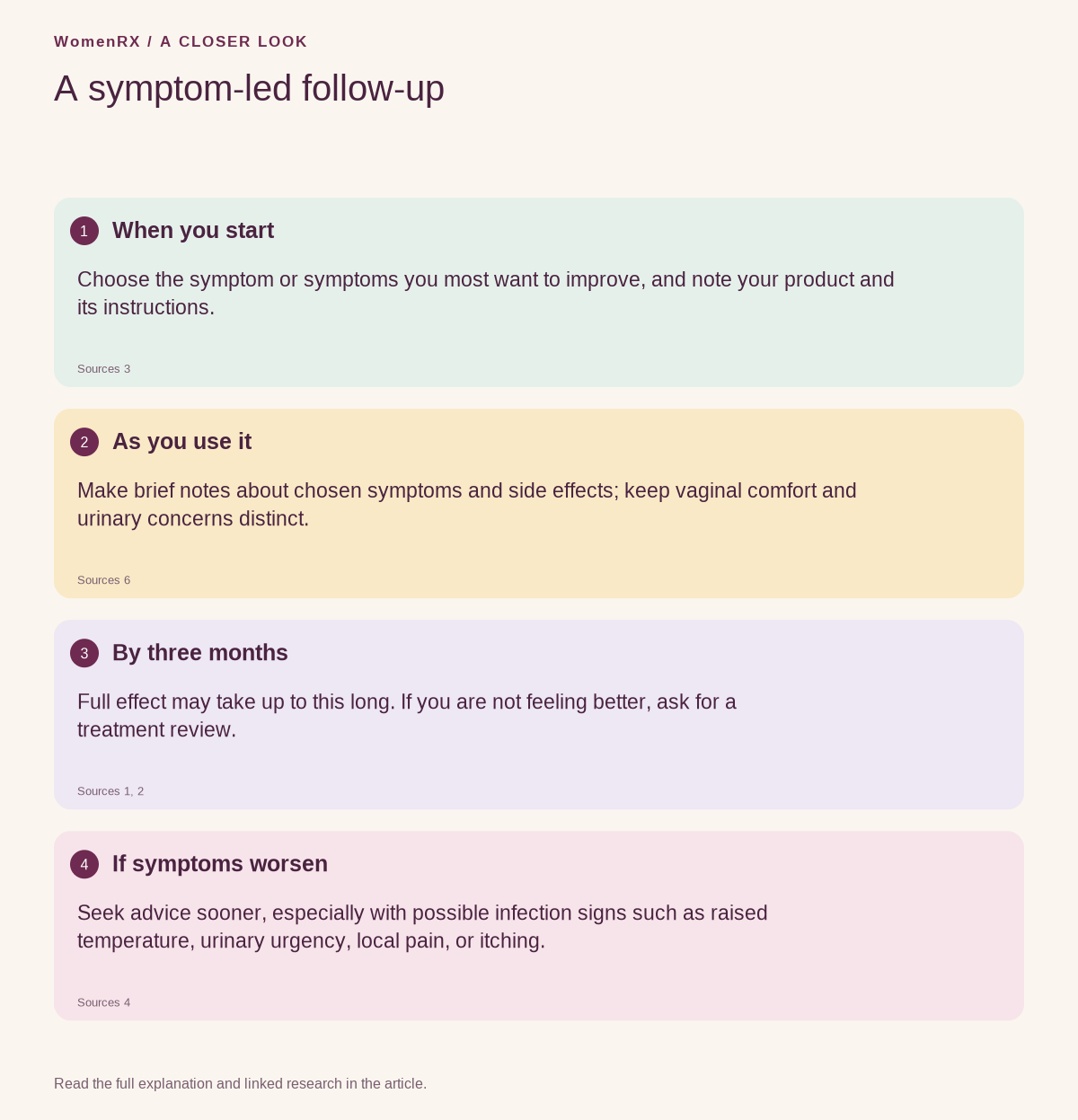
A symptom-led follow-up
When you start: Choose the symptom or symptoms you most want to improve, and note your product and its instructions.3
As you use it: Make brief notes about chosen symptoms and side effects; keep vaginal comfort and urinary concerns distinct.6
By three months: Full effect may take up to this long. If you are not feeling better, ask for a treatment review.12
If symptoms worsen: Seek advice sooner, especially with possible infection signs such as raised temperature, urinary urgency, local pain, or itching.4
Read the figure as text
Use these points to separate practical tracking from the general timeframe for full effect. They are not a promise of when relief will begin.- When you start: Choose the symptom or symptoms you most want to improve, and note your product and its instructions.3
- As you use it: Make brief notes about chosen symptoms and side effects; keep vaginal comfort and urinary concerns distinct.6
- By three months: Full effect may take up to this long. If you are not feeling better, ask for a treatment review.12
- If symptoms worsen: Seek advice sooner, especially with possible infection signs such as raised temperature, urinary urgency, local pain, or itching.4
More questions, answered
Should I use more vaginal estrogen if I’m not improving?
Don’t change the amount or schedule on your own. Instructions differ by product; if symptoms aren’t improving, a treatment review can help determine whether the directions, formulation, or plan should change. 23
Sources you can check
- About vaginal oestrogen - NHSAccessed 2026-09-25Return to first citation
- Common questions about vaginal oestrogen - NHSAccessed 2026-09-25Return to first citation
- How and when to use vaginal oestrogen - NHSAccessed 2026-09-25Return to first citation
- Side effects of vaginal oestrogen - NHSAccessed 2026-09-25Return to first citation
- Vaginal Estrogen for Urinary Tract Infection Prevention: A Narrative Review of Evidence, Guidelines, and Regulatory Gaps.Ghasoub R, Mackay W, Shepherd A. · Gynecologic and obstetric investigation · 2026Return to first citation
- Vaginal Lactobacillus iners Abundance Predicts Response to Local Estrogen Therapy in Postmenopausal Women with Genitourinary Syndrome of Menopause.Han X, Sun B, Zhu Y, Liu Y. · Microorganisms · 2026Return to first citation