Vaginal Estrogen: Benefits, Safety, and Practical Use
Local vaginal estrogen can ease menopause-related vaginal symptoms, but the right product and safety conversation depend on your goals and health history.
Low-dose vaginal estrogen is used for menopause-related vaginal dryness and irritation, and a small trial also found improvement in painful sex compared with a moisturizer. It mainly acts locally, but absorption isn’t zero. Before starting, discuss your health history and any bleeding, then learn the instructions for your exact product: tablets, creams, gels, and rings are not used the same way. 17
Start with the symptom you want to change
Vaginal estrogen is intended for local menopause-related symptoms such as dryness and irritation. It won’t treat hot flashes or other symptoms throughout the body. A small randomized trial offers some evidence for painful sex too: among 23 breast cancer survivors taking aromatase inhibitors, those assigned vaginal estrogen reported greater improvement in dryness and pain during sex than those assigned a nonhormonal moisturizer over 24 weeks. The small sample and short follow-up limit what the trial can say about longer-term safety. 17
If dryness or irritation is the main concern, a lubricant or vaginal moisturizer may also be an option. Vaginal estrogen can take up to three months to work fully, so it may help to agree on what improvement you’re looking for and when you’ll reassess it. 2
“Local” is a difference in exposure, not zero exposure
Vaginal estrogen is designed to act mainly in vaginal tissue. Much less reaches the rest of the body than with systemic hormone therapy, but some absorption can occur. That’s why low-dose vaginal estrogen and systemic estrogen are not interchangeable safety categories. 156
Guidance says a progestogen generally isn’t needed with vaginal estrogen because little medicine reaches the rest of the body. This isn’t a guarantee that every dose, product, or health history is the same. Ask how the recommendation applies to the particular product you’re considering. 1
The endometrial evidence has limits. In one 24-week study, 325 postmenopausal women used a low-dose estradiol vaginal tablet; the study reported no abnormal endometrial thickness. That’s a finding about one treatment and timeframe, not proof of long-term safety for every formulation or person. 8
If you’ve had breast cancer, especially if you’re taking an aromatase inhibitor, raise that history before starting. A small trial found symptom improvement in survivors taking these medicines, but a review describes recurrence evidence for people using vaginal estrogen with aromatase inhibitors as unsettled. The decision calls for an individualized conversation, rather than assuming local treatment has no risk or is automatically off limits. 67
The form changes how you use it
Use the instructions for your exact prescribed product, not a schedule you find for another brand or form. For example, product guidance describes inserting a vaginal tablet with its applicator, pressing the plunger to release it, and going only as far as comfortable. A vaginal ring has a different routine; the cited guidance describes one ring used for three months. These are examples, not directions for your prescription. 3
Schedules can differ even within a form. For instance, the cited guidance gives examples of some tablet or gel regimens that begin with more frequent use and then move to twice-weekly use. Cream instructions vary too. Check your product’s package instructions or ask your pharmacist to show you how its applicator works and clarify the schedule. 3
If you forget a dose, don’t insert two doses together or add an extra one to catch up. Some estrogen creams and gels can affect condoms or diaphragms; ask whether that applies to your product if you use either. 3
Know what to bring into the decision
Before starting, be ready to explain which symptom you want treated, what form you’ve been offered, and any relevant health history, including breast cancer treatment. Mention vaginal bleeding before treatment and report new or unexpected bleeding while using it. Headache, vaginal discomfort, or bleeding can occur; if a side effect is persistent or worrying, ask about the next step rather than changing the product or schedule on your own. 46
A useful follow-up focuses on the result: Is the symptom you chose improving? Are side effects or bleeding getting in the way? If it hasn’t helped after a few months, the product or treatment plan may need another look. Periodic review helps keep the choice matched to your symptoms and circumstances. 25
A short list of questions to ask
- Which symptom are we treating, and what change should I look for?
- What are the exact instructions for this product and applicator?
- Does my health history, including breast cancer treatment, affect the decision?
- Could this product affect condoms or a diaphragm I use?
- When should we check whether it’s helping, and what bleeding or side effects should I report?
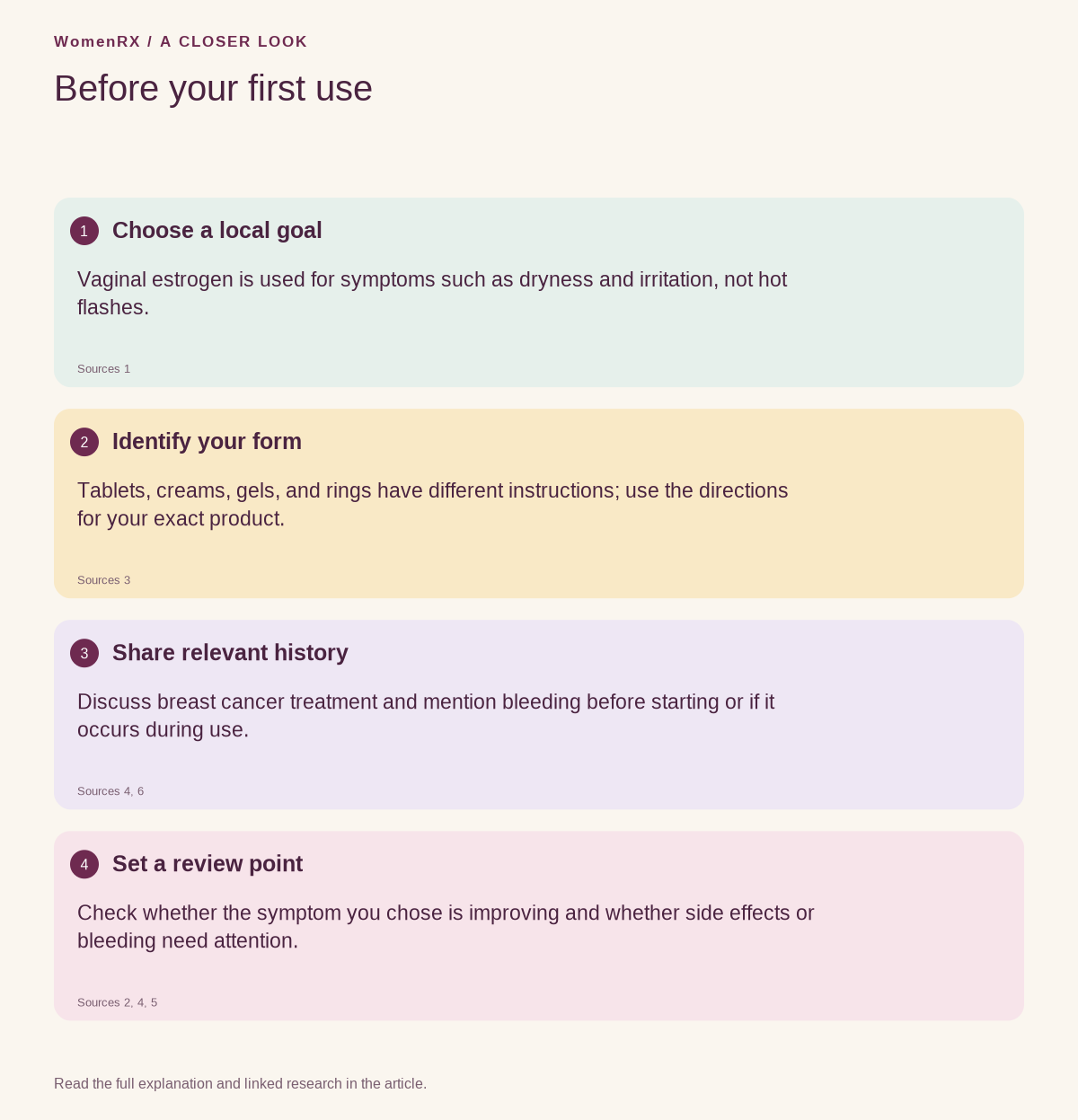
Before your first use
Choose a local goal: Vaginal estrogen is used for symptoms such as dryness and irritation, not hot flashes.1
Identify your form: Tablets, creams, gels, and rings have different instructions; use the directions for your exact product.3
Share relevant history: Discuss breast cancer treatment and mention bleeding before starting or if it occurs during use.46
Set a review point: Check whether the symptom you chose is improving and whether side effects or bleeding need attention.245
Read the figure as text
Connect the symptom you want to treat with the product directions and personal safety questions that need an answer.- Choose a local goal: Vaginal estrogen is used for symptoms such as dryness and irritation, not hot flashes.1
- Identify your form: Tablets, creams, gels, and rings have different instructions; use the directions for your exact product.3
- Share relevant history: Discuss breast cancer treatment and mention bleeding before starting or if it occurs during use.46
- Set a review point: Check whether the symptom you chose is improving and whether side effects or bleeding need attention.245
More questions, answered
Does vaginal estrogen help hot flashes?
No. Vaginal estrogen is for local symptoms such as vaginal dryness and irritation; it does not treat hot flashes. 1
Do I need a progestogen with vaginal estrogen?
Guidance generally says a progestogen isn’t needed with vaginal estrogen because little of the medicine reaches the rest of the body. Ask whether that applies to your specific product and health situation. 1
Sources you can check
- About vaginal oestrogen - NHSAccessed 2026-09-25Return to first citation
- Common questions about vaginal oestrogen - NHSAccessed 2026-09-25Return to first citation
- How and when to use vaginal oestrogen - NHSAccessed 2026-09-25Return to first citation
- Side effects of vaginal oestrogen - NHSAccessed 2026-09-25Return to first citation
- The 2022 hormone therapy position statement of The North American Menopause Society.“The 2022 Hormone Therapy Position Statement of The North American Menopause Society” Advisory Panel. · Menopause (New York, N.Y.) · 2022Return to first citation
- Safety of vaginal estrogen in breast cancer survivors: Current evidence on systemic absorption and oncologic outcomes.Mainar LB, Nieto-Pascual L, Bravo EI, García-Ramos BO, Llaneza IP, Vilanova CT, Lloret AM, Alsina JC. · Maturitas · 2026Return to first citation
- VEMORA: Vaginal Estrogen versus non-hormonal MOisturizer in women Receiving Aromatase inhibitors: a randomized, controlled trial.Niravath P, Rimawi M, Sun K, Mai H, Puri A, Vyas A, Nangia J, Brock A, Foreman C, Adnan H, Shafer M, Anand A, Moges A, Al Najjar E, Mathur S, Antosh D, High R, Zaid T, Chang J, Osb... · Breast cancer research and treatment · 2026Return to first citation
- Local estrogen replacement therapy in postmenopausal atrophic vaginitis: efficacy and safety of low dose 17beta-estradiol vaginal tablets.Mainini G, Scaffa C, Rotondi M, Messalli EM, Quirino L, Ragucci A. · Clinical and experimental obstetrics & gynecology · 2005Return to first citation