How Long Does Vaginal Estrogen Take to Help?
Vaginal estrogen may take up to three months to work fully, but your product’s directions, the symptoms you’re treating, and your own progress matter more than a promised start date.
Vaginal estrogen can take up to three months to work fully for menopause-related vaginal symptoms such as dryness and irritation. That’s an estimate, not a guaranteed date for relief. Use the product as prescribed, since directions differ by form. If you haven’t improved after three months, discuss your symptoms and product with your prescriber; ask sooner about persistent pain or itching or possible infection symptoms. 1234
The full-effect window is an estimate
Vaginal estrogen is a local treatment for vaginal symptoms related to menopause, especially dryness and irritation. It isn’t meant to treat hot flashes or sleep problems, so those symptoms may continue even if vaginal symptoms improve. 1
NHS guidance says it can take up to three months to work fully. Think of that as a reasonable point to assess progress, not a promise that relief will begin on a particular day or that every symptom will be gone by then. 12
Let your prescription set the routine
Vaginal estrogen comes in different forms, including creams, tablets, gels, and rings. Their instructions are not interchangeable, so follow the directions for your own prescription rather than borrowing a schedule from another product or changing it to try to get faster relief. If you’re unsure how to use it, ask your prescriber or pharmacist. 13
It may help to write down the product name and its instructions when you start. Then note the symptoms you’re using it for, such as dryness or irritation, and whether each seems better, unchanged, or worse. This is a practical way to describe your experience, not a validated score or a way to predict how quickly treatment should work. The available guidance gives a general full-effect window, not a separate onset timetable for each product or symptom. 12
For example, you might tell your prescriber: “I’m using the cream as directed. The irritation seems better, but the dryness hasn’t changed.” That gives you both a specific symptom and your product’s routine to discuss without assuming that all symptoms should improve at the same pace.
If you’re still uncomfortable
If you haven’t felt better after three months, talk with your prescriber about what you’re experiencing and how you’re using the product. They may consider whether a different type would suit you better; guidance notes that some people need to try different types before finding one that helps. 2
Pain or itching that hasn’t improved after a week is a reason to ask sooner. Seek advice sooner as well if you have symptoms that could suggest an infection, such as a fever, an urgent need to urinate, or local pain and itching. Don’t wait for the three-month check-in when these issues arise. 4
If your main concern is a hot flash, sleep problem, or another symptom beyond vaginal dryness or irritation, mention that specifically. Vaginal estrogen is a local treatment and isn’t expected to address those broader menopause symptoms. 1
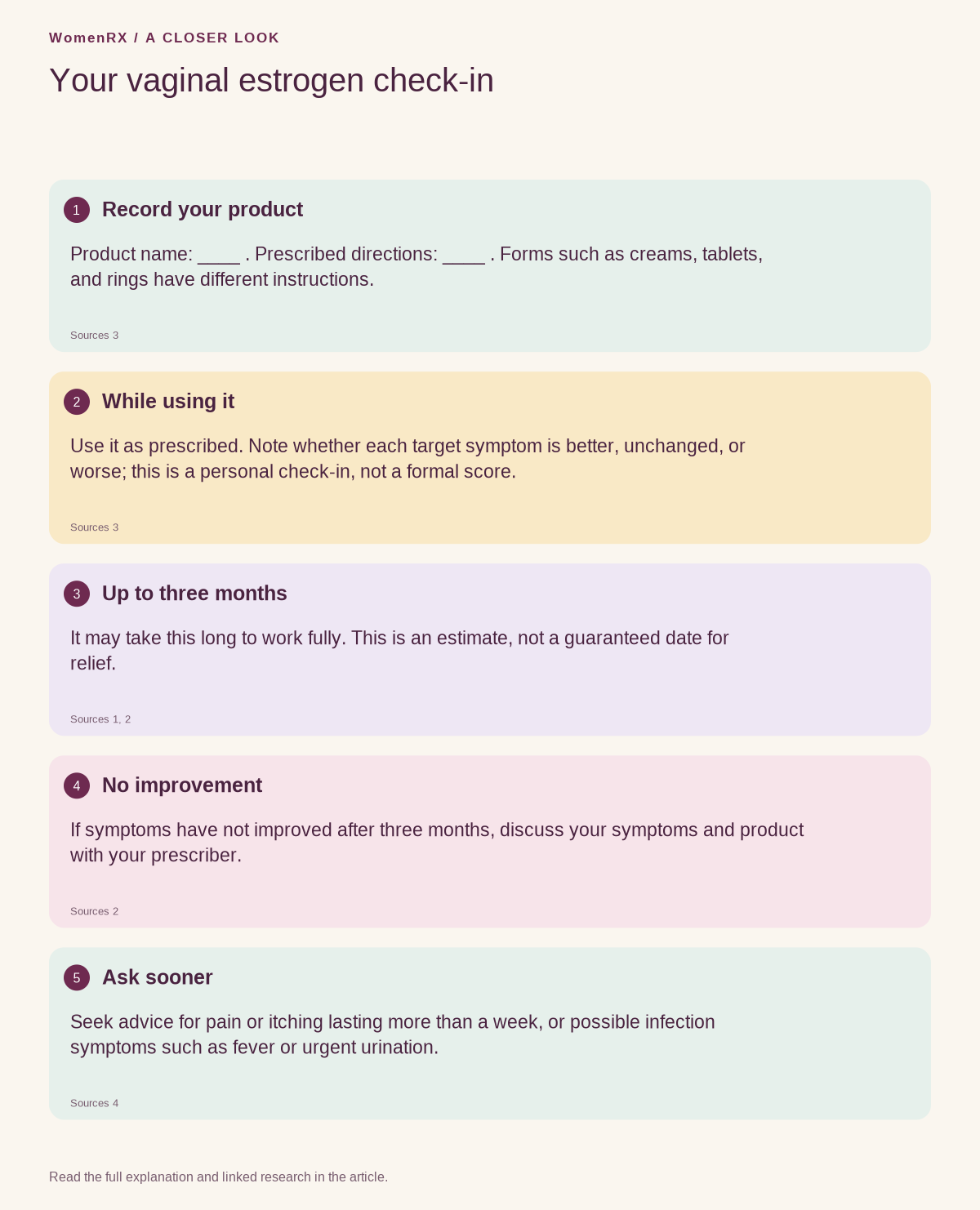
Your vaginal estrogen check-in
Record your product: Product name: ____ . Prescribed directions: ____ . Forms such as creams, tablets, and rings have different instructions.3
While using it: Use it as prescribed. Note whether each target symptom is better, unchanged, or worse; this is a personal check-in, not a formal score.3
Up to three months: It may take this long to work fully. This is an estimate, not a guaranteed date for relief.12
No improvement: If symptoms have not improved after three months, discuss your symptoms and product with your prescriber.2
Ask sooner: Seek advice for pain or itching lasting more than a week, or possible infection symptoms such as fever or urgent urination.4
Read the figure as text
A practical timeline for following your own product instructions, observing target symptoms, and deciding when to ask about progress.- Record your product: Product name: ____ . Prescribed directions: ____ . Forms such as creams, tablets, and rings have different instructions.3
- While using it: Use it as prescribed. Note whether each target symptom is better, unchanged, or worse; this is a personal check-in, not a formal score.3
- Up to three months: It may take this long to work fully. This is an estimate, not a guaranteed date for relief.12
- No improvement: If symptoms have not improved after three months, discuss your symptoms and product with your prescriber.2
- Ask sooner: Seek advice for pain or itching lasting more than a week, or possible infection symptoms such as fever or urgent urination.4
More questions, answered
Does vaginal estrogen help hot flashes?
No. Vaginal estrogen is used locally for symptoms such as menopause-related vaginal dryness and irritation; it does not treat hot flashes. 1
Should I change how often I use it if it isn’t helping yet?
Don’t change the prescribed schedule to speed up relief. Product instructions differ, so ask your prescriber or pharmacist if you’re unsure about use or what to do next. 3
Sources you can check
- About vaginal oestrogen - NHSAccessed 2026-09-25Return to first citation
- Common questions about vaginal oestrogen - NHSAccessed 2026-09-25Return to first citation
- How and when to use vaginal oestrogen - NHSAccessed 2026-09-25Return to first citation
- Side effects of vaginal oestrogen - NHSAccessed 2026-09-25Return to first citation