How Is Vaginal Estrogen Dosing Determined?
The schedule depends on the exact product: some start with more frequent use and then move to maintenance, while others follow a different pattern.
There isn’t one schedule for every vaginal estrogen product. The form and exact product determine its instructions, including whether there’s a more frequent starting phase followed by maintenance use. Follow the directions for your prescription, not a schedule from another cream, tablet, insert, or ring. If the label and package instructions don’t match or aren’t clear, ask your pharmacist or prescriber. 3
The schedule belongs to the product
Vaginal estrogen is used for menopause-related genitourinary symptoms, including vaginal dryness and irritation. It comes in forms such as creams, tablets, gels, inserts, and rings. Those forms don’t all have the same directions, so there isn’t one schedule that applies to every prescription. 1 3
A useful distinction is between starting instructions and maintenance instructions. Some products begin with more frequent use and later move to less frequent use. A ring, by contrast, may have directions based on how long it stays in place. These are different product instructions, not doses to translate from one form to another. 3
Examples show why the details matter
UK NHS guidance illustrates how much schedules can differ. For the specific products it describes, some vaginal tablets begin with daily use for two weeks and then move to twice-weekly use. Its gel and pessary examples begin with daily use for three weeks before moving to twice weekly. The ring example is inserted for three months rather than used on a daily-then-weekly schedule. 3
Even two creams in that guidance have different starting instructions: one example uses daily application for up to four weeks before reducing use according to symptoms, while another moves from daily use for two weeks to twice-weekly use. These are UK guidance examples, not directions for a US prescription. Use your own product’s label and instructions, and don’t copy or convert a schedule from a different product. 3
Your prescription is the reference point
A prescriber chooses a product and regimen for your situation. The North American Menopause Society recommends low-dose vaginal estrogen as an option for bothersome genitourinary symptoms that haven’t improved with over-the-counter therapies when systemic hormone therapy isn’t indicated. Its position statement also says hormone therapy should be individualized and periodically reevaluated. It doesn’t give one schedule for every vaginal estrogen product. 4
When you check your directions, match the product name and form on the pharmacy label to the instructions that came with it. Look for whether the directions describe a starting phase, when that phase ends, and what the maintenance directions are. Don’t assume that products with the same general name, or products that both go in the vagina, use the same amount or schedule.
If you’re offered a different product, your refill looks different, or the label and package instructions seem to conflict, pause and ask the pharmacist who filled it or your prescriber what directions apply. A switch may be considered if a product is unavailable, isn’t helping, or causes side effects, but that doesn’t mean every product can be substituted on the same schedule. 2
If you’re unsure what to do next, ask: “What are my starting instructions, when do they change, and where can I find the directions for this exact product?” If symptoms aren’t improving or side effects are bothering you, raise that with your prescriber rather than changing the schedule yourself. Vaginal estrogen can take up to three months to work fully, so the timing of a check-in may matter. 2
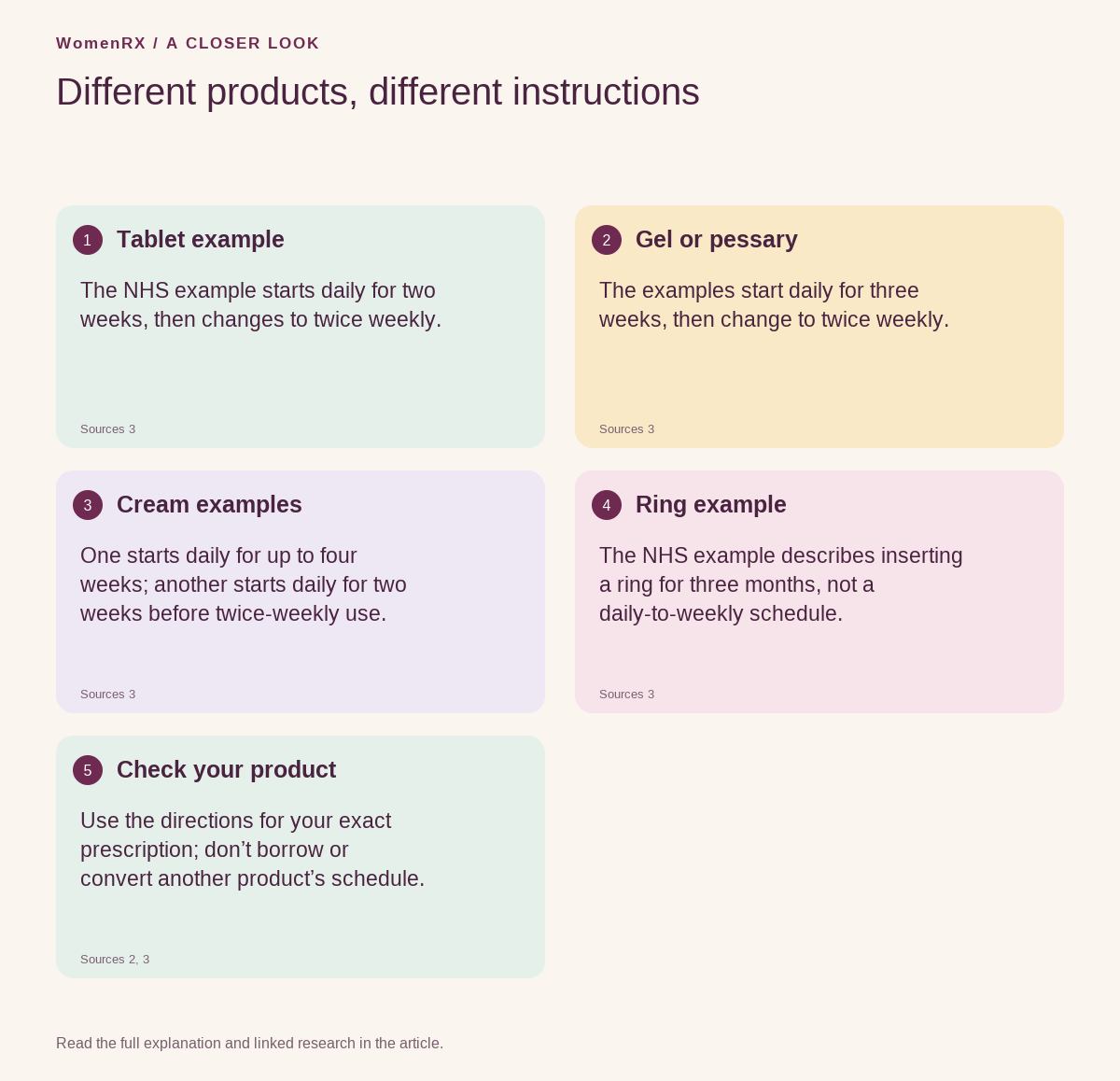
Different products, different instructions
Tablet example: The NHS example starts daily for two weeks, then changes to twice weekly.3
Gel or pessary: The examples start daily for three weeks, then change to twice weekly.3
Cream examples: One starts daily for up to four weeks; another starts daily for two weeks before twice-weekly use.3
Ring example: The NHS example describes inserting a ring for three months, not a daily-to-weekly schedule.3
Check your product: Use the directions for your exact prescription; don’t borrow or convert another product’s schedule.23
Read the figure as text
These UK NHS examples illustrate how a starting phase, maintenance schedule, or period of ring use can differ. They are not directions for a US prescription.- Tablet example: The NHS example starts daily for two weeks, then changes to twice weekly.3
- Gel or pessary: The examples start daily for three weeks, then change to twice weekly.3
- Cream examples: One starts daily for up to four weeks; another starts daily for two weeks before twice-weekly use.3
- Ring example: The NHS example describes inserting a ring for three months, not a daily-to-weekly schedule.3
- Check your product: Use the directions for your exact prescription; don’t borrow or convert another product’s schedule.23
More questions, answered
Can I use the directions for another vaginal estrogen product?
No. Forms and products can have different schedules, including different starting and maintenance phases. Follow the instructions for your exact prescription; ask a pharmacist or prescriber if you’re unsure whether a switch changes the directions. 2 3
How long can vaginal estrogen take to work?
It can take up to three months to work fully. If you’re not feeling better after that, discuss next steps with your prescriber. 2
Sources you can check
- About vaginal oestrogen - NHSAccessed 2026-09-25Return to first citation
- Common questions about vaginal oestrogen - NHSAccessed 2026-09-25Return to first citation
- How and when to use vaginal oestrogen - NHSAccessed 2026-09-25Return to first citation
- The 2022 hormone therapy position statement of The North American Menopause Society.“The 2022 Hormone Therapy Position Statement of The North American Menopause Society” Advisory Panel. · Menopause (New York, N.Y.) · 2022Return to first citation