What Vaginal Estrogen Treats After Menopause
Vaginal estrogen can ease dryness and irritation and may help prevent recurrent UTIs, but it won’t treat hot flashes or an infection you have now.
Vaginal estrogen delivers a low dose of estrogen to the vagina to relieve menopause-related dryness and irritation. It may also reduce recurrent UTIs in postmenopausal women who’ve had them before. It doesn’t treat an active UTI, hot flashes, or every urinary symptom. Little of the medicine reaches the rest of the body, but “local” doesn’t mean zero absorption. 1 2 5
Why a local treatment can help
As estrogen levels fall during and after menopause, vaginal dryness and irritation can develop. Vaginal estrogen raises estrogen levels mainly where it’s used, helping relieve those symptoms. It comes in forms including a cream, vaginal tablet, and ring. “Local” describes where the treatment acts most. A small amount of the medicine can still reach the rest of the body. 1 2
That distinction matters if you have several menopause symptoms at once. Vaginal estrogen can address dryness or irritation, but it won’t treat hot flashes, mood changes, or sleep problems. Systemic hormone therapy is a different approach; The North American Menopause Society describes hormone therapy as the most effective treatment for hot flashes and other vasomotor symptoms. 1 6
What about urinary symptoms?
Vaginal estrogen has a role in preventing recurrent UTIs after menopause, but prevention isn’t the same as treating an infection that’s happening now. In a small randomized trial, postmenopausal women with documented recurrent UTIs received vaginal estrogen by ring or cream, or placebo cream. Within six months, a UTI occurred in 11 of 18 women assigned estrogen and 16 of 17 assigned placebo in the trial’s intention-to-treat analysis, which counted dropouts as having had a UTI. Nine of the 35 women dropped out before six months. The result is promising for this specific group, not a promise that estrogen will prevent every infection. 5
The trial also doesn’t show that vaginal estrogen will fix every reason you might feel an urgent need to pee or have discomfort. Repeated urinary symptoms can have different causes, including bacterial infections and noninfectious problems. If you develop a fever, a new urgent need to pee, or local pain and itching, get the symptoms checked rather than assuming they’re part of menopause. An active bacterial UTI needs its own assessment and treatment. 3 4
Choosing the approach that fits the problem
If vaginal dryness or irritation is your main concern, lubricants or vaginal moisturizers may help. For bothersome genitourinary symptoms that haven’t improved with over-the-counter options, The North American Menopause Society recommends considering low-dose vaginal estrogen or other treatments when there isn’t a reason to use systemic hormone therapy. 2 6
It can take up to three months for vaginal estrogen to work fully. If it isn’t helping, the question isn’t simply whether to wait longer: the symptom, its cause, or the treatment choice may need another look. Symptoms can also return after treatment stops. 2
The recurrent-UTI trial enrolled postmenopausal women. Dryness and irritation can arise as estrogen falls during the menopause transition, but that trial doesn’t tell us how well vaginal estrogen prevents UTIs during perimenopause or after a medical treatment that lowers estrogen. Those situations call for a decision based on the symptoms you’re actually having, rather than assuming the postmenopausal UTI result applies unchanged. 2 5
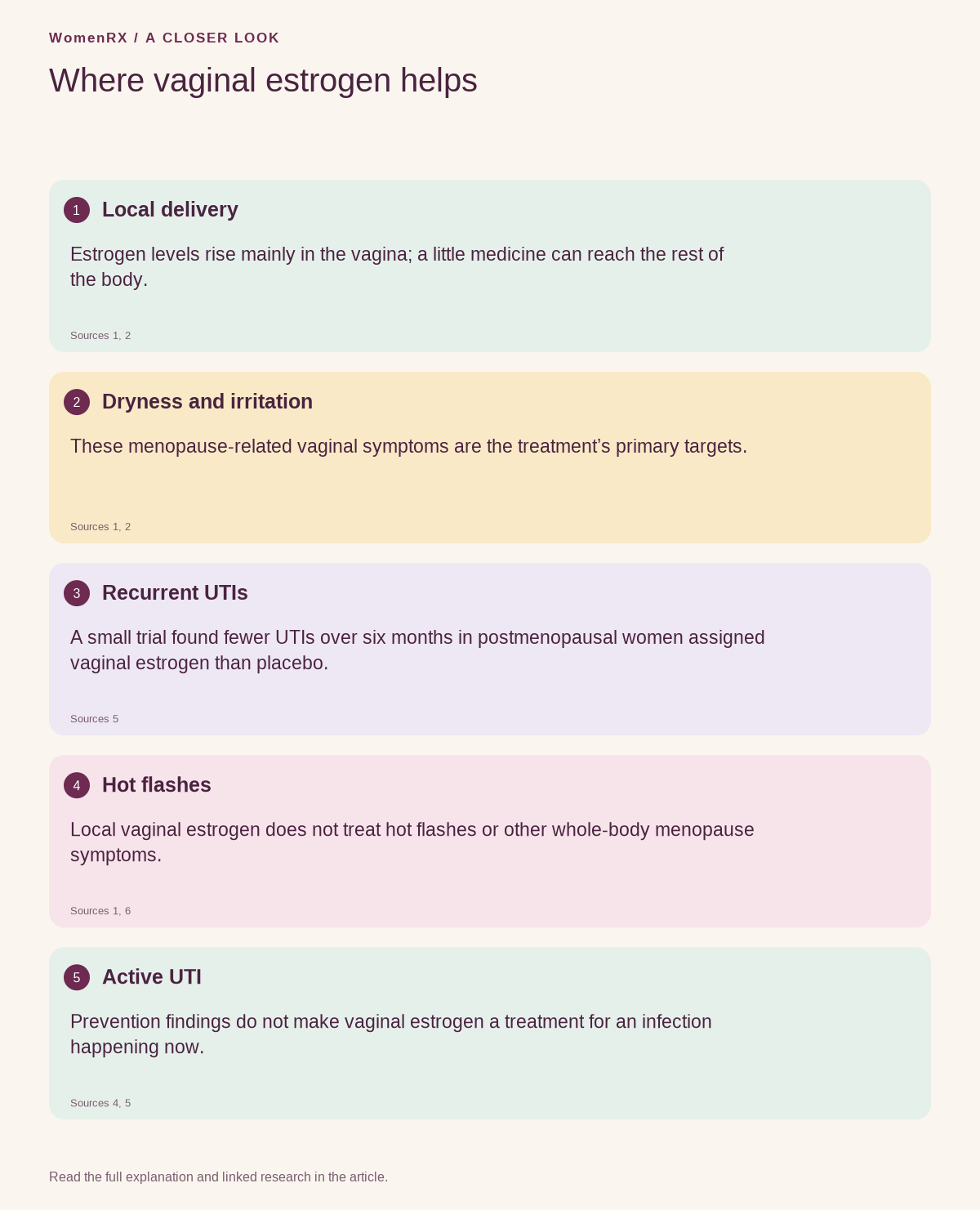
Where vaginal estrogen helps
Local delivery: Estrogen levels rise mainly in the vagina; a little medicine can reach the rest of the body.12
Dryness and irritation: These menopause-related vaginal symptoms are the treatment’s primary targets.12
Recurrent UTIs: A small trial found fewer UTIs over six months in postmenopausal women assigned vaginal estrogen than placebo.5
Hot flashes: Local vaginal estrogen does not treat hot flashes or other whole-body menopause symptoms.16
Active UTI: Prevention findings do not make vaginal estrogen a treatment for an infection happening now.45
Read the figure as text
A local treatment can relieve symptoms where it acts without treating every menopause or urinary concern.- Local delivery: Estrogen levels rise mainly in the vagina; a little medicine can reach the rest of the body.12
- Dryness and irritation: These menopause-related vaginal symptoms are the treatment’s primary targets.12
- Recurrent UTIs: A small trial found fewer UTIs over six months in postmenopausal women assigned vaginal estrogen than placebo.5
- Hot flashes: Local vaginal estrogen does not treat hot flashes or other whole-body menopause symptoms.16
- Active UTI: Prevention findings do not make vaginal estrogen a treatment for an infection happening now.45
Sources you can check
- About vaginal oestrogen - NHSAccessed 2026-09-25Return to first citation
- Common questions about vaginal oestrogen - NHSAccessed 2026-09-25Return to first citation
- Side effects of vaginal oestrogen - NHSAccessed 2026-09-25Return to first citation
- Recurrent urinary tract infection is not one disease: moving from antibiotic suppression to phenotype-guided prevention.Ahmad B, Khan K. · Annals of medicine and surgery (2012) · 2026Return to first citation
- Vaginal Estrogen for the Prevention of Recurrent Urinary Tract Infection in Postmenopausal Women: A Randomized Clinical Trial.Ferrante KL, Wasenda EJ, Jung CE, Adams-Piper ER, Lukacz ES. · Female pelvic medicine & reconstructive surgery · 2021Return to first citation
- The 2022 hormone therapy position statement of The North American Menopause Society.“The 2022 Hormone Therapy Position Statement of The North American Menopause Society” Advisory Panel. · Menopause (New York, N.Y.) · 2022Return to first citation