When Vaginal Estrogen Needs a Closer Look
A breast cancer history or bleeding after menopause calls for a more tailored conversation, not a one-size-fits-all rule.
Vaginal estrogen isn’t automatically off-limits after breast cancer, but the type of cancer treatment matters: uncertainty is greater while taking an aromatase inhibitor, so the decision should be made with the cancer-care team. Bleeding after menopause should be assessed rather than assumed to be a treatment effect or vaginal dryness. These concerns call for different next steps: individualized advice for cancer history, and assessment for unexplained bleeding. 2 1
Vaginal estrogen can help with menopausal vaginal and urinary symptoms, but a few details can change the conversation. A history of breast cancer calls for an individualized risk review. Bleeding after menopause calls for assessment to find its cause. Neither concern fits a simple “always avoid” or “always fine” rule.
If you’ve had breast cancer, treatment details matter
Studies of people with a history of breast cancer are generally reassuring about vaginal estrogen, but they cannot settle every individual decision. A 2025 meta-analysis of eight observational studies found no association between vaginal estrogen use and higher breast cancer recurrence or breast cancer mortality. Because these were observational studies, the results show an association, not proof that treatment cannot affect an individual’s risk. 4
The question deserves extra care if you take an aromatase inhibitor. These medicines lower estrogen levels, and the discussion accompanying a 2026 retrospective cohort study notes that they do not block the effects of estrogen introduced from outside the body. It also describes earlier studies that raised concern about recurrence in some people using vaginal estrogen with an aromatase inhibitor, while noting that how well those findings apply today is uncertain. 2
That is a reason to discuss your specific cancer history and current treatment with your oncology team and the clinician treating your vaginal symptoms. It is not evidence that every person taking an aromatase inhibitor must avoid vaginal estrogen. A large observational analysis of breast cancer survivors aged 65 and older did not find worse survival among vaginal-estrogen users, but its associations weakened in a time-dependent analysis, which the authors said could reflect bias. Survival findings also cannot answer every question about recurrence or treatment for a particular person. 2
Bleeding after menopause needs its own assessment
If you have gone 12 months without a period and then notice vaginal bleeding, don’t assume it is simply a side effect or a sign of vaginal dryness. Postmenopausal bleeding can have several causes, including thinning of the vaginal or uterine lining and polyps; less commonly, it can be related to cancer. It should be checked even if it happens only once. 1
This matters before starting vaginal estrogen as well as if bleeding appears during treatment: first establish what is causing the bleeding rather than guessing. An evaluation may include an examination or imaging, depending on your situation. The point is not that bleeding means cancer; it is that the cause can’t be determined from the symptom alone. 1
A practical way to sort the next step
Routine treatment conversation: If your main concern is menopausal vaginal or urinary symptoms and you have no history of breast cancer or unexplained bleeding, discuss whether local treatment fits your symptoms and circumstances. The North American Menopause Society recommends low-dose vaginal estrogen or other therapies for bothersome genitourinary symptoms not relieved by over-the-counter options in people without a reason to use systemic hormone therapy. 5
Individualized cancer-care discussion: If you’ve had breast cancer, share your cancer history and current or recent hormone-blocking treatment with the clinicians involved before deciding. Be especially deliberate about this if you take an aromatase inhibitor. Research is reassuring overall, but observational evidence and the specific uncertainty around aromatase inhibitors don’t support promising zero risk. 2 3 4
Assessment rather than assumption: If you have bleeding after menopause, arrange an evaluation, whether or not you use vaginal estrogen. A clinician can consider causes such as vaginal or uterine lining changes, polyps, or other conditions. 1
The useful distinction is between a risk conversation and a symptom that needs its cause checked. Breast cancer history changes how treatment is weighed; postmenopausal bleeding changes what should be assessed. They are not interchangeable reasons to automatically rule treatment in or out.
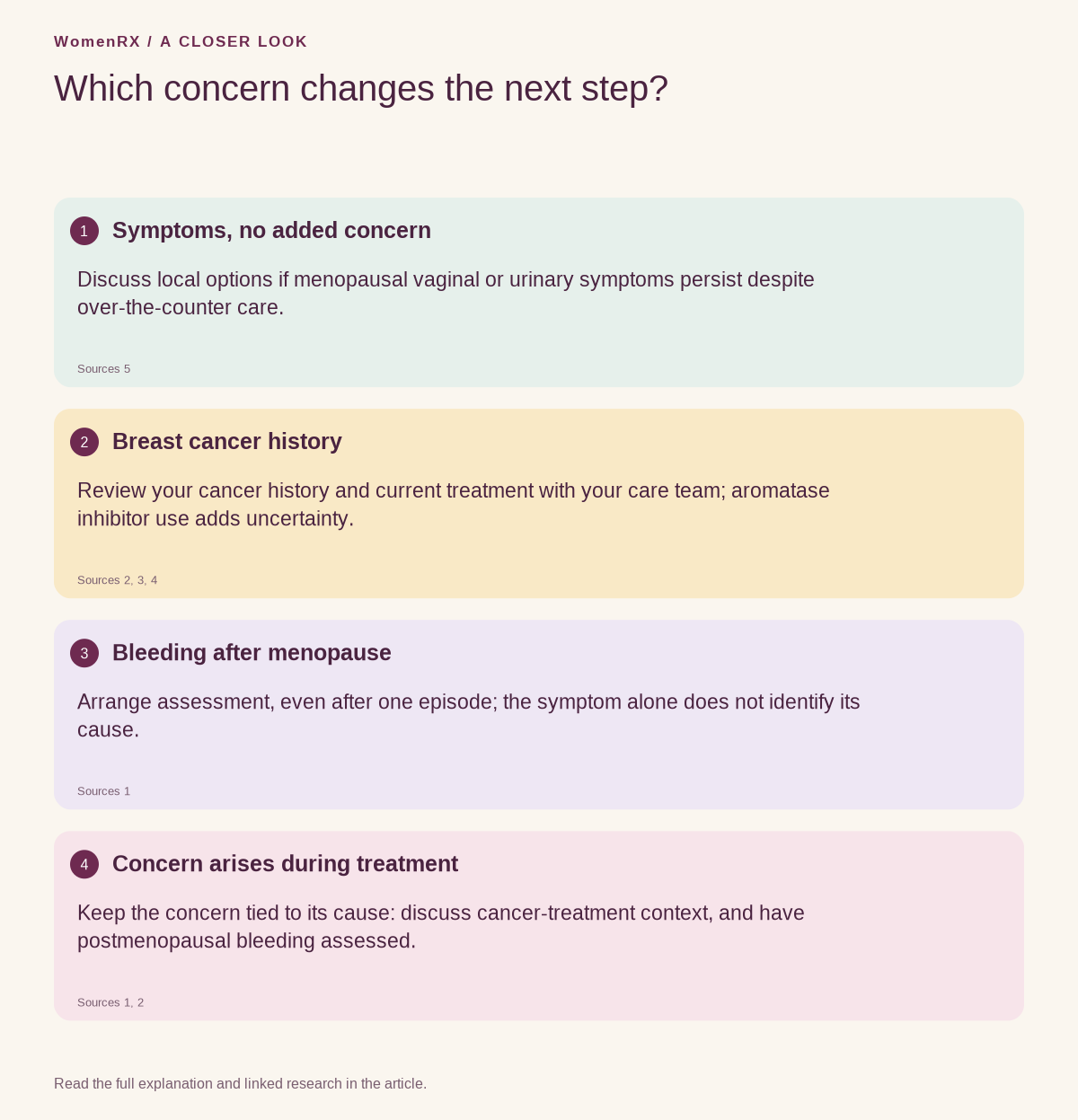
Which concern changes the next step?
Symptoms, no added concern: Discuss local options if menopausal vaginal or urinary symptoms persist despite over-the-counter care.5
Breast cancer history: Review your cancer history and current treatment with your care team; aromatase inhibitor use adds uncertainty.234
Bleeding after menopause: Arrange assessment, even after one episode; the symptom alone does not identify its cause.1
Concern arises during treatment: Keep the concern tied to its cause: discuss cancer-treatment context, and have postmenopausal bleeding assessed.12
Read the figure as text
Separate a routine symptom-treatment discussion from a cancer-specific risk review and assessment of postmenopausal bleeding.- Symptoms, no added concern: Discuss local options if menopausal vaginal or urinary symptoms persist despite over-the-counter care.5
- Breast cancer history: Review your cancer history and current treatment with your care team; aromatase inhibitor use adds uncertainty.234
- Bleeding after menopause: Arrange assessment, even after one episode; the symptom alone does not identify its cause.1
- Concern arises during treatment: Keep the concern tied to its cause: discuss cancer-treatment context, and have postmenopausal bleeding assessed.12
More questions, answered
Does a history of breast cancer automatically rule out vaginal estrogen?
No single rule fits everyone. Observational research has not found higher recurrence or mortality overall among vaginal-estrogen users with a breast cancer history, but the evidence cannot guarantee safety for an individual. If you take an aromatase inhibitor, the decision needs particular care with your cancer-care team. 2 3 4
Sources you can check
- Postmenopausal bleeding - NHSAccessed 2026-09-25Return to first citation
- Survival Outcomes in Breast Cancer Patients With Use of Vaginal Estrogen Therapy: A SEER Analysis.Mitchel OR, Hsu CP, Millheiser LS, Wapnir IL, Chandak S, Tran M, Erdrich J. · JCO oncology practice · 2026Return to first citation
- Vaginal estrogen therapy for treatment of menopausal genitourinary syndrome among breast cancer survivors: a systematic review and meta-analysis.Santos GML, Magalhães AO, Teichmann PDV, Wender MCO. · Revista brasileira de ginecologia e obstetricia : revista da Federacao Brasileira das Sociedades de Ginecologia e Obstetricia · 2025Return to first citation
- Vaginal estrogen use in breast cancer survivors: a systematic review and meta-analysis of recurrence and mortality risks.Beste ME, Kaunitz AM, McKinney JA, Sanchez-Ramos L. · American journal of obstetrics and gynecology · 2025Return to first citation
- The 2022 hormone therapy position statement of The North American Menopause Society.“The 2022 Hormone Therapy Position Statement of The North American Menopause Society” Advisory Panel. · Menopause (New York, N.Y.) · 2022Return to first citation