When Estradiol May Be Unsuitable: Risks to Review Before Treatment
Unexplained bleeding, uterine status, medical history, and the exact estradiol product can all change the treatment decision.
Before starting or continuing estradiol for menopause symptoms, make sure unexplained bleeding is assessed and review your uterine status, cancer and cardiovascular history, medicines, and the exact product being considered. If you have a uterus, ask how the plan protects its lining. These factors don’t all have the same implications for every formulation, so the decision needs to fit your history and treatment goal. 1 2 3
First, identify the treatment you’re considering
An estradiol patch and low-dose vaginal estrogen aren’t the same treatment decision. Start with the symptom you want to treat, the exact product, and whether it’s intended as systemic treatment or a local option for vaginal or urinary symptoms. Menopausal hormone therapy is effective for hot flashes and other vasomotor symptoms, while the Endocrine Society identifies low-dose vaginal estrogen as an option for genitourinary symptoms of menopause. 3
For systemic hormone therapy, the Endocrine Society recommends assessing cardiovascular and breast cancer risk before treatment and weighing those risks alongside symptoms and preferences. Age and time since menopause also affect the balance. Hormone therapy shouldn’t be used to prevent heart disease or dementia. 3 4
Bleeding needs an explanation before it’s dismissed
Tell your prescriber about unusual bleeding after menopause, including bleeding that starts or recurs while you’re using hormone therapy. It shouldn’t simply be assumed to be a treatment effect: postmenopausal bleeding can be a warning sign of uterine cancer. The Climara estradiol patch information says unusual bleeding should be checked; the Climara Pro combination-patch information specifically calls for diagnostic assessment when abnormal postmenopausal bleeding is unexplained and persistent or recurring. What that assessment involves depends on the situation. 2 1
If you’re still having menstrual periods during perimenopause, describe what has changed rather than assuming the same explanation applies to every bleeding pattern. The key question before a treatment decision is whether the bleeding has been adequately explained. 1 2
Whether you have a uterus changes the regimen
Estrogen used without a progestogen increases the risk of endometrial cancer in someone with a uterus. Adding a progestogen has been shown to reduce endometrial hyperplasia, a possible precursor to that cancer. If you have a uterus, ask how the proposed regimen protects its lining. 1 2
After a hysterectomy, estrogen generally does not need to be paired with a progestogen. There’s a qualification worth mentioning if it applies to you: the Climara label says a history of endometriosis may change that plan even after the uterus has been removed. 2
Bring cancer and cardiovascular history into the decision
If you have or have had cancer, say which type and share the details with the prescriber. Climara patient information specifically flags certain cancers, including breast and uterine cancer, and advises discussing whether that product is appropriate. This calls for a decision about your particular history, not a rule that every cancer history means the same thing. 2
A history of stroke or blood clots, or other substantial cardiovascular risk, also belongs in the review. Hormone-therapy studies have found vascular risks, but results from one formulation shouldn’t be presented as the risk of every estradiol product. For example, a stroke and deep-vein-thrombosis finding described in the Climara Pro information came from a study of oral conjugated equine estrogen, not an estradiol patch. A clinical review says transdermal therapy may be associated with lower clot and stroke risks than oral therapy, while emphasizing that more research is needed. Route matters to the discussion; it isn’t a promise of safety. 1 4
Check medicines against the exact product
A medicine or supplement review can uncover an issue that a medical-history checklist misses. The Climara patch information says St. John’s wort, carbamazepine, phenobarbital, and rifampin may lower estrogen concentrations, potentially reducing the patch’s effect or changing bleeding patterns. It also lists medicines including clarithromycin, erythromycin, ketoconazole, itraconazole, and ritonavir, as well as grapefruit juice, as possible causes of higher estrogen concentrations and adverse effects. These are interactions identified for that product, not instructions to change another medicine on your own. 2
A practical way to bring these threads together is to ask: What symptom is this exact treatment meant to help? Does my bleeding need assessment first? If I have a uterus, what protects its lining? How do my cancer or cardiovascular history and current medicines affect this choice? The answers may point to a different regimen or a separate local treatment discussion. If treatment is already underway, it’s also worth revisiting whether it’s still helping and whether anything in your health or medicines has changed. 2 3 4
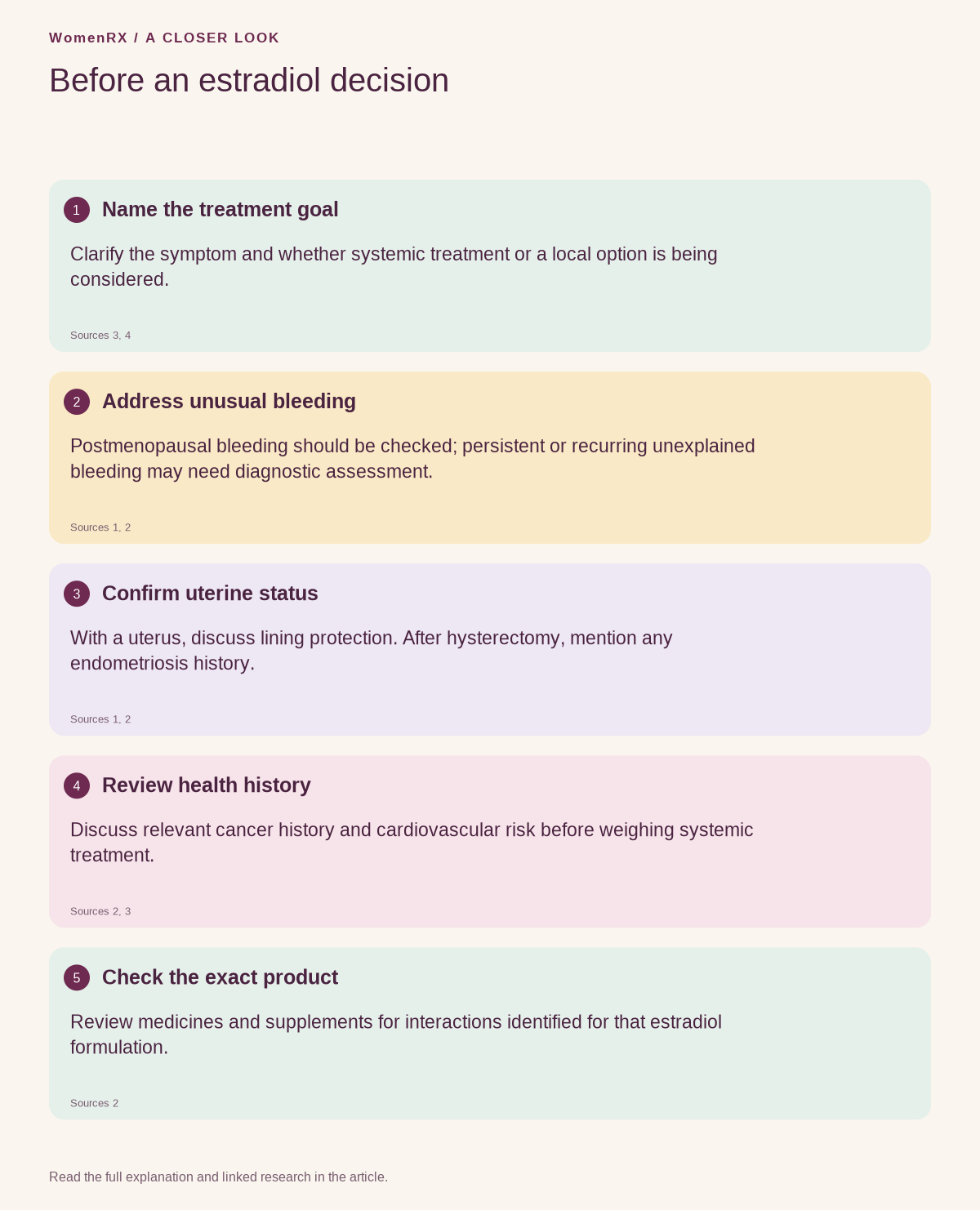
Before an estradiol decision
Name the treatment goal: Clarify the symptom and whether systemic treatment or a local option is being considered.34
Address unusual bleeding: Postmenopausal bleeding should be checked; persistent or recurring unexplained bleeding may need diagnostic assessment.12
Confirm uterine status: With a uterus, discuss lining protection. After hysterectomy, mention any endometriosis history.12
Review health history: Discuss relevant cancer history and cardiovascular risk before weighing systemic treatment.23
Check the exact product: Review medicines and supplements for interactions identified for that estradiol formulation.2
Read the figure as text
Use this sequence to organize the discussion. A flagged issue calls for assessment or a closer look at the plan, not an automatic ruling for every product.- Name the treatment goal: Clarify the symptom and whether systemic treatment or a local option is being considered.34
- Address unusual bleeding: Postmenopausal bleeding should be checked; persistent or recurring unexplained bleeding may need diagnostic assessment.12
- Confirm uterine status: With a uterus, discuss lining protection. After hysterectomy, mention any endometriosis history.12
- Review health history: Discuss relevant cancer history and cardiovascular risk before weighing systemic treatment.23
- Check the exact product: Review medicines and supplements for interactions identified for that estradiol formulation.2
More questions, answered
Does having had a hysterectomy mean I never need a progestogen?
Usually, someone without a uterus doesn’t need a progestogen with estrogen. The Climara label notes a possible exception for people with a history of endometriosis, so mention that history when discussing the regimen. 2
Sources you can check
- CLIMARA PRO (ESTRADIOL AND LEVONORGESTREL) PATCH [BAYER HEALTHCARE PHARMACEUTICALS INC.] | US prescribing information and patient instructionsAccessed 2026-09-25Return to first citation
- CLIMARA (ESTRADIOL) PATCH [BAYER HEALTHCARE PHARMACEUTICALS INC.] | US prescribing information and patient instructionsAccessed 2026-09-25Return to first citation
- Treatment of Symptoms of the Menopause: An Endocrine Society Clinical Practice Guideline.Stuenkel CA, Davis SR, Gompel A, Lumsden MA, Murad MH, Pinkerton JV, Santen RJ. · The Journal of clinical endocrinology and metabolism · 2015Return to first citation
- Current recommendations: what is the clinician to do?Manson JE. · Fertility and sterility · 2014Return to first citation