Metabolic Health in Your 40s: What to Review
Perimenopause can overlap with age-related metabolic changes, so a useful checkup looks at your risk factors and symptoms rather than blaming every change on hormones.
In your 40s, ask for a review of blood pressure, blood sugar, triglycerides, and HDL cholesterol, alongside your health and family history. Perimenopause may coincide with changes in body composition and cardiometabolic risk, but age and other factors matter too. Weight or waist changes alone don’t diagnose metabolic syndrome or explain a symptom. 1 4 6
Start with risk factors, not a label
Cardiometabolic health includes factors that affect the heart and blood vessels, such as blood pressure, blood sugar, and blood fats. Metabolic syndrome is a cluster of risk factors, not a symptom you can reliably recognize by how you feel. MedlinePlus describes it as having at least three factors, including a large waistline, high triglycerides, low HDL cholesterol, high blood pressure, and high fasting blood sugar. A waist measurement by itself does not establish the diagnosis. 1
Several of these factors may have no obvious symptoms. Testing and timing depend on your individual history. MedlinePlus lists these values as metabolic-syndrome risk-factor cutoffs: waist measurement of 35 inches or more for women, triglycerides of 150 mg/dL or higher, HDL cholesterol below 50 mg/dL for women, blood pressure of 130/85 mmHg or higher, and fasting blood sugar of 100 mg/dL or higher. They’re useful context for discussing a result, not a reason to diagnose yourself from one number. 1
What perimenopause may add to the picture
The menopausal transition is not separate from aging. Both can be relevant at the same time, and the changes aren’t identical for every woman. Reviews describe possible changes in body composition and cardiometabolic measures during perimenopause, sometimes without a large change on the scale. One review identifies uncertainty about the long-term effectiveness of specific nutrition approaches; it does not establish how these changes affect every woman over time. 4 6
That makes weight an incomplete measure. If your weight is stable but your waist, sleep, or menstrual pattern has changed, those details may still be worth discussing. They don’t prove that perimenopause is the cause or that your cardiometabolic risk has increased. A clinician can interpret them alongside measurements and your broader health history.
Separate the numbers from the symptoms
A practical way to decide what to raise is to keep two questions distinct:
- For risk review: Ask which blood pressure, blood sugar, and blood-fat results you have, and how they compare with the metabolic-syndrome factors above. In particular, the listed blood-fat factors are high triglycerides and low HDL cholesterol, not cholesterol in general. 1
- For follow-up: If a result is flagged or meets one of the listed cutoffs, ask what it means in your situation and whether it needs follow-up. Metabolic risk factors often have no obvious symptoms, so feeling well doesn’t replace reviewing results. 1 2
- For symptom care: If your periods have become irregular, or you’re having hot flashes or sleep disruption, describe what changed and how it affects you. These can be part of perimenopause care, but they are not themselves metabolic-syndrome criteria. 1 5
- For context: Share relevant health conditions, family history, and prior results. Assessment may include personal and family medical history as well as blood tests. 2
- For practical support: If you want help with activity or eating, ask about an approach that fits your health and daily life. Heart-healthy eating and avoiding long inactive periods are among the general measures described for metabolic syndrome. 1 2
You don’t need to arrive with a diagnosis or a perfect record of every symptom. Bring the measurements and changes you know about, then ask which deserve attention now and what, if anything, should be checked again.
Keep symptom treatment separate from prevention
If symptoms such as hot flashes are affecting you, discuss them as their own care question. The North American Menopause Society’s position statement says hormone therapy’s benefits and risks vary by treatment characteristics, including route and timing, and that decisions should be individualized. That is a different discussion from checking blood pressure, blood sugar, or blood fats. 3
The practical takeaway: don’t dismiss changes as “just age” or “just menopause,” but don’t assume they signal a metabolic problem either. Pair your symptom story with the numbers that help assess risk.
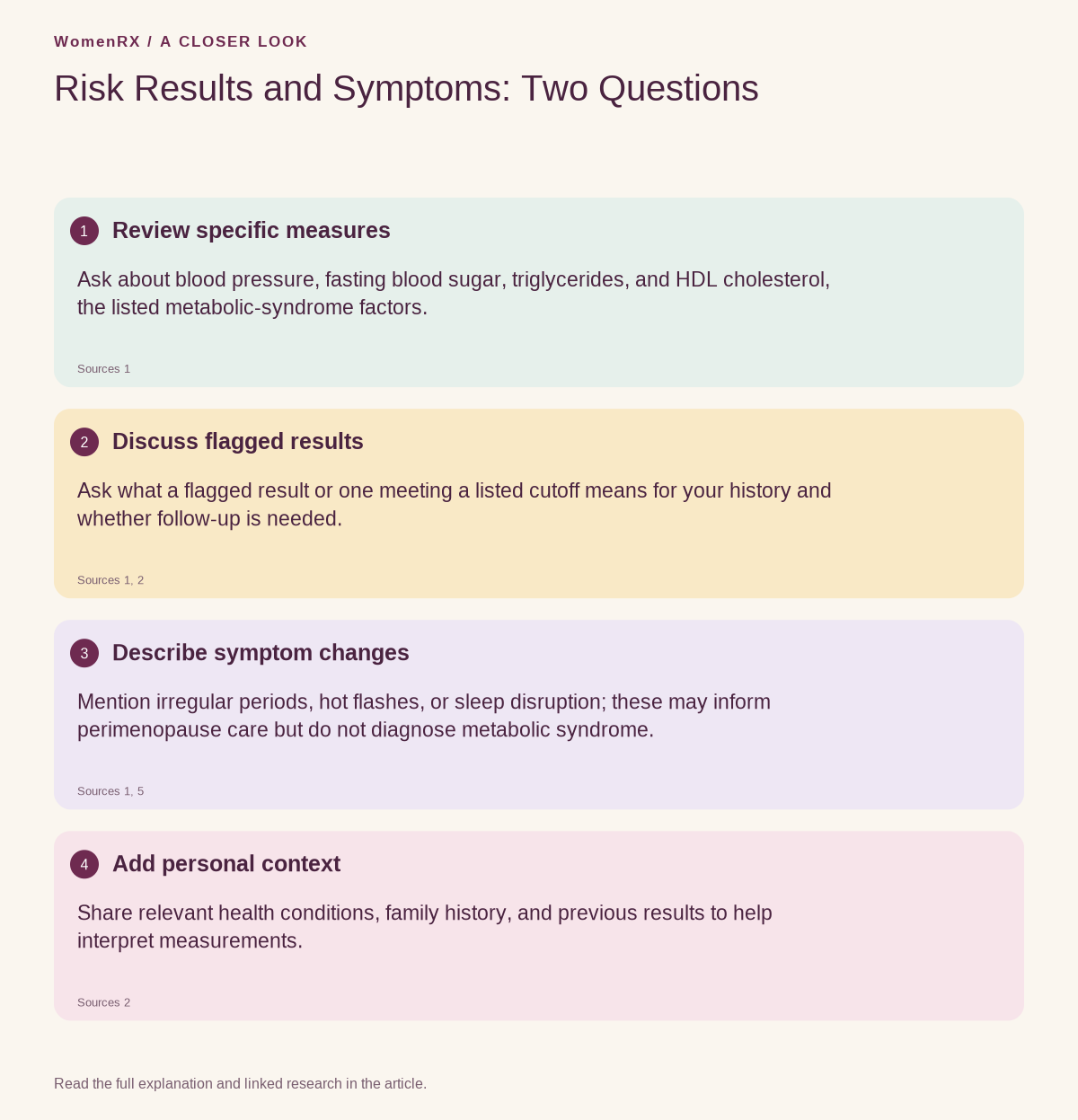
Risk Results and Symptoms: Two Questions
Review specific measures: Ask about blood pressure, fasting blood sugar, triglycerides, and HDL cholesterol, the listed metabolic-syndrome factors.1
Discuss flagged results: Ask what a flagged result or one meeting a listed cutoff means for your history and whether follow-up is needed.12
Describe symptom changes: Mention irregular periods, hot flashes, or sleep disruption; these may inform perimenopause care but do not diagnose metabolic syndrome.15
Add personal context: Share relevant health conditions, family history, and previous results to help interpret measurements.2
Read the figure as text
Use this checklist to keep measurable metabolic risk separate from symptoms that may need their own perimenopause discussion.- Review specific measures: Ask about blood pressure, fasting blood sugar, triglycerides, and HDL cholesterol, the listed metabolic-syndrome factors.1
- Discuss flagged results: Ask what a flagged result or one meeting a listed cutoff means for your history and whether follow-up is needed.12
- Describe symptom changes: Mention irregular periods, hot flashes, or sleep disruption; these may inform perimenopause care but do not diagnose metabolic syndrome.15
- Add personal context: Share relevant health conditions, family history, and previous results to help interpret measurements.2
More questions, answered
Can metabolic changes happen without weight gain?
They may. A review of research on perimenopause describes body-composition changes that can occur without a major increase in weight, so the scale alone may not tell the whole story. That doesn’t mean every woman will experience these changes or that a specific symptom proves they’re happening. 6
Does perimenopause cause metabolic syndrome?
Perimenopause may coincide with changes in cardiometabolic risk, but metabolic syndrome is a cluster of risk factors and isn’t explained by menopause alone. Age, insulin resistance, activity, and other individual factors can also matter. Review your measurements and history rather than assuming one cause. 1 4
Sources you can check
- Metabolic Syndrome | MedlinePlusAccessed 2026-09-25Return to first citation
- Metabolic syndrome - NHSAccessed 2026-09-25Return to first citation
- The 2022 hormone therapy position statement of The North American Menopause Society.“The 2022 Hormone Therapy Position Statement of The North American Menopause Society” Advisory Panel. · Menopause (New York, N.Y.) · 2022Return to first citation
- Metabolic Changes of Perimenopause and Nutritional Advice.Bonnes SLR, Nordhues H, Sood R, Kulick D, Muratore A, Bischof E. · Current nutrition reports · 2026Return to first citation
- Hormonal Options for Perimenopause: A Clinician Toolkit.Piasta J, Zewail A. · Obstetrics and gynecology · 2026Return to first citation
- Perimenopause and metabolic vulnerability: hormones, body composition and lifestyle changes.Lobato VA, Minari TP, Pisani LP. · Climacteric : the journal of the International Menopause Society · 2026Return to first citation