Metabolic Health in Your 30s: What’s Worth Checking?
Your blood pressure, family history, and pregnancy or PCOS history can help make a preventive visit more useful than a checklist based on age alone.
In your 30s, start with what’s known: blood pressure, past blood sugar or cholesterol results, close relatives’ health, and any PCOS or pregnancy complications. These details help determine which metabolic checks fit you. Use the same visit to ask about cervical screening and bring up pregnancy plans, sexual health, or mood concerns that matter to you. Age alone doesn’t set the whole agenda. 1368101112
Start with risk, not a birthday
Metabolic health describes how factors such as blood pressure, blood sugar, and blood fats relate to future diabetes and cardiovascular risk. These factors often cause no obvious symptoms. A routine visit can therefore reveal something you wouldn’t notice day to day, but being in your 30s doesn’t, by itself, tell you which blood tests you need. Screening choices depend on age, family history, and other risk factors. 13
A useful way to prepare is to separate what’s already known from what might change the plan. If you have previous blood pressure, cholesterol, triglyceride, or blood sugar results, bring them or make sure your care team can see them. Ask what the results mean together and whether any need follow-up. A blood pressure reading and tests of blood glucose and blood fats are among the checks used when metabolic risk factors are being assessed. 12
What the usual checks can, and can’t, tell you
Blood pressure is one part of the picture. Blood tests can show glucose levels and blood fats, including triglycerides and cholesterol. A waist measurement may also be considered when assessing metabolic syndrome, a grouping of several risk factors rather than a diagnosis made from weight alone. Having one factor is not the same as having the syndrome, and you don’t need to have symptoms for a result to matter. 12
That distinction is useful at a visit. For example, if a past blood sugar result was high but your blood pressure was not, you can ask which finding needs attention and what follow-up is appropriate. If several results were flagged, ask how they fit together. There’s no need to request a fixed panel simply because you’ve turned 30; the purpose of testing is to answer a question about your risk. 13
Bring the history that a lab result can’t show
Family history: Tell your care team if close relatives have had heart disease or stroke, and share what you know about their diagnoses. Relatives share genes, environments, and habits, so family history can help identify risk. It isn’t a prediction that you’ll develop the same condition. If you don’t know much about one side of your family, say so rather than guessing. 8
Pregnancy history: If you’ve been pregnant, mention gestational diabetes or a pregnancy affected by high blood pressure, even if the pregnancy was years ago. A review reports an association between lactation and lower metabolic-syndrome risk among women with prior gestational diabetes; it does not establish when an individual should be screened. Another review identifies hypertensive disorders of pregnancy as relevant information for cardiovascular risk assessment. That history belongs alongside your current results, not in place of them. 67
If you’re recently postpartum, also say where you are in your recovery and what follow-up you’ve already had. The postpartum period brings physical and emotional changes, so a visit should address your present needs as well as longer-term risk. 9 If you’re planning a pregnancy, you can mention that too.
PCOS or reproductive concerns: If you have a PCOS diagnosis, include it in your medical history. International PCOS guidance recognizes metabolic risk as part of PCOS care. If you have cycle or other reproductive concerns but no diagnosis, describe the concern rather than assuming it explains a blood sugar or cholesterol result. 10
Which reproductive details deserve emphasis?
Reproductive history can add context, but it isn’t a metabolic scorecard. In a cross-sectional analysis of women aged 30 to 49 across 15 countries, measures such as number of births were associated with some cardiometabolic indicators. A separate analysis of women in India also found associations between reproductive characteristics and clusters of risk factors. Because these studies observed people rather than testing a screening strategy, their findings don’t tell you what an individual result will be or establish a US testing schedule. 45
For a visit in your 30s, lead with details that can make the conversation more specific: a known PCOS diagnosis, gestational diabetes, high blood pressure during pregnancy, existing abnormal results, and close family history. You can mention other reproductive history when relevant, but you don’t need to calculate your risk from the age of your first period or the number of pregnancies you’ve had. 34567810
Make room for concerns beyond screening
Screening looks for disease before symptoms appear. A concern you already have belongs in the conversation too, even if it doesn’t fit a screening question. If you’re postpartum and feel extremely sad or unable to care for yourself or your baby, bring that up promptly rather than saving it for a later routine visit. 39
Cervical screening: Ask whether you’re due for a Pap or HPV test, especially if you don’t recall your last result. US guidance says most women ages 21 to 65 need routine cervical screening, but the test and timing depend on age and health history. Prior abnormal results or cervical cancer can change follow-up; screening after a hysterectomy depends on the type of surgery and your history. If you live outside the US, follow your local screening guidance rather than assuming these ages apply. That’s a separate decision from whether you need blood sugar or cholesterol testing. 12
Pregnancy plans and sexual health: If you’re considering pregnancy, say so when you discuss your current health and any earlier pregnancy complications. If you have a question about STI exposure or testing, bring it up rather than assuming there’s one testing schedule for everyone. Birth control methods such as pills, shots, and implants don’t protect against STIs; condoms can reduce risk, though they don’t cover every area where HPV can spread. 61112
Mood and family history: You can raise mood concerns whether or not you’ve recently had a baby. And if cancer, as well as heart disease or stroke, runs in your family, share what you know. A family history can inform a screening conversation without predicting your own outcome. 89
A concise question to close the visit is: “Given my results, history, and concerns, which checks do I need now, and when should we revisit them?” Ask how you’ll receive any new results and whom to contact about them. That turns screening into a plan you can actually use. 3
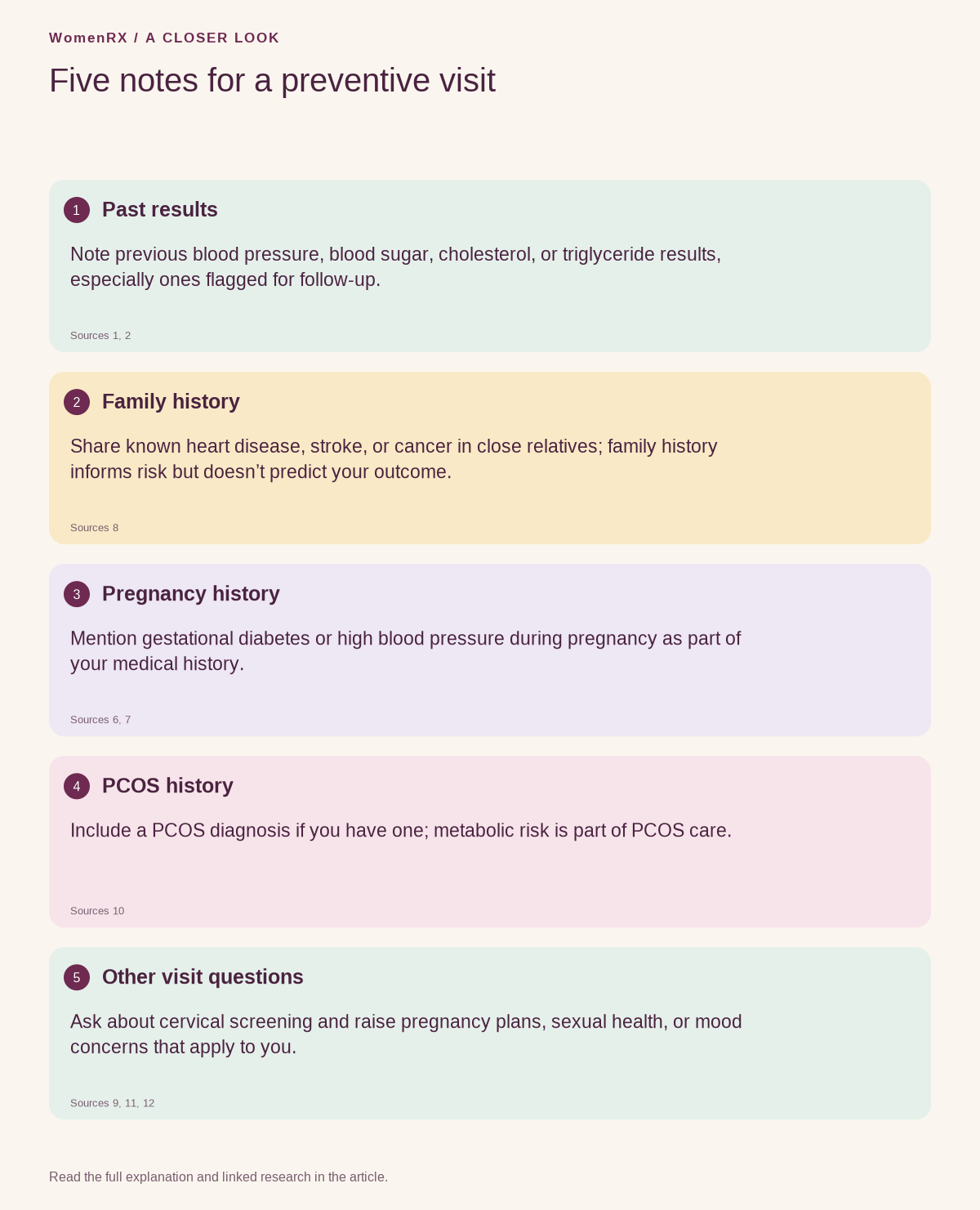
Five notes for a preventive visit
Past results: Note previous blood pressure, blood sugar, cholesterol, or triglyceride results, especially ones flagged for follow-up.12
Family history: Share known heart disease, stroke, or cancer in close relatives; family history informs risk but doesn’t predict your outcome.8
Pregnancy history: Mention gestational diabetes or high blood pressure during pregnancy as part of your medical history.67
PCOS history: Include a PCOS diagnosis if you have one; metabolic risk is part of PCOS care.10
Other visit questions: Ask about cervical screening and raise pregnancy plans, sexual health, or mood concerns that apply to you.91112
Read the figure as text
A conversation aid for choosing relevant questions, not a required set of tests or a risk score.- Past results: Note previous blood pressure, blood sugar, cholesterol, or triglyceride results, especially ones flagged for follow-up.12
- Family history: Share known heart disease, stroke, or cancer in close relatives; family history informs risk but doesn’t predict your outcome.8
- Pregnancy history: Mention gestational diabetes or high blood pressure during pregnancy as part of your medical history.67
- PCOS history: Include a PCOS diagnosis if you have one; metabolic risk is part of PCOS care.10
- Other visit questions: Ask about cervical screening and raise pregnancy plans, sexual health, or mood concerns that apply to you.91112
More questions, answered
Can I have metabolic risk factors if I feel fine?
Yes. Most metabolic risk factors have no obvious symptoms; they’re often identified through a blood pressure check, blood tests, or a routine visit. Feeling well doesn’t tell you what your numbers are. 12
Does a family history mean I’ll develop the same condition?
No. A close relative’s condition can raise your risk without determining your future. It’s useful information for deciding what to discuss and whether testing is needed. 8
Sources you can check
- Metabolic Syndrome | MedlinePlusAccessed 2026-09-25Return to first citation
- Metabolic syndrome - NHSAccessed 2026-09-25Return to first citation
- Health Screening: MedlinePlusAccessed 2026-09-25Return to first citation
- Reproductive history, menopause and cardiometabolic health in women: a multicountry analysis.Quarpong W, Chandrasekaran S, Narayan KMV, Ramakrishnan U, Tandon N, Patel SA. · Journal of epidemiology and community health · 2025Return to first citation
- Cardiometabolic Risk Clusters and Their Reproductive Correlates: A Latent Class Analysis of Indian Women.Quarpong W, Chandrasekaran S, Narayan KMV, Ramakrishnan U, Tandon N, Patel SA. · Global heart · 2025Return to first citation
- Beyond traditional risk factors: Social, reproductive, and environmental determinants of cardiovascular health in women.Cocchi C, Bisaccia G, Rizzuto ML, Moscucci F, Coppi F, Sciomer S, Gallina S, Renda G, Mattioli AV. · Current problems in cardiology · 2026Return to first citation
- Legacy of Tehran Lipid and Glucose Study; Evidence on Reproductive Lifespan and Cardiometabolic Health.Farahmand M, Mousavi M, Saei Ghare Naz M, Farhadi-Azar M, Noroozzadeh M, Azizi F, Ramezani Tehrani F. · International journal of endocrinology and metabolism · 2026Return to first citation
- Family History: MedlinePlusAccessed 2026-09-25Return to first citation
- Postpartum Care: MedlinePlusAccessed 2026-09-25Return to first citation
- Recommendations from the 2023 International Evidence-based Guideline for the Assessment and Management of Polycystic Ovary Syndrome†.Teede HJ, Tay CT, Laven J, Dokras A, Moran LJ, Piltonen TT, Costello MF, Boivin J, Redman LM, Boyle JA, Norman RJ, Mousa A, Joham AE, International PCOS Network. · Human reproduction (Oxford, England) · 2023Return to first citation
- Healthy living in your 30sAccessed 2026-09-25Return to first citation
- Pap and HPV testsAccessed 2026-09-25Return to first citation