Breast Tenderness in Perimenopause: What Changes Are Worth Checking?
A pattern that comes and goes with your cycle is different from pain that stays in one spot, and new breast findings deserve attention rather than a hormonal guess.
Breast tenderness can follow a cyclical pattern, but irregular perimenopausal periods can make that pattern harder to recognize. Diffuse or cyclical pain usually doesn’t call for extra imaging beyond routine screening. A new lump or nipple discharge, or pain that stays in one spot and isn’t cyclical, is a reason to arrange clinical assessment. 1 3
First, look at the pattern
Tenderness that comes and goes with your menstrual cycle differs from pain that stays in one specific area. During perimenopause, periods may become irregular, shorter or longer, or heavier or lighter, which can make a cycle-linked pattern harder to spot. The timing can offer a clue, but it can’t establish the cause of a particular breast symptom. 1 2 3
Try noting when the discomfort starts and eases, where you feel it, whether it affects one area or is more widespread, and when bleeding occurs. Record any new lump or nipple discharge, too. This is an organizing tool, not a diagnostic test. It can help you describe what has changed without asking you to decide the cause yourself.
Which patterns are usually less concerning?
Breast pain is common and rarely associated with breast cancer. When pain is cyclical, diffuse, or spread across more than one area, breast-pain guidance generally does not recommend imaging beyond what routine screening calls for, provided there isn’t a suspicious accompanying finding. 2 3
Pain that is persistent, noncyclical, and focused in one small area is a different pattern. Cancer is still rare as a cause, but clinical guidance considers this pain more significant; imaging may be appropriate depending on age. A clinician can assess the symptom and decide whether imaging is useful. 2 3
A new lump or nipple discharge also changes the picture. The reassurance about a low association between pain and cancer applies when there’s no suspicious accompanying finding. Don’t assume a lump or discharge is hormonal; arrange an assessment. 3
Symptoms and screening answer different questions
Screening is for detecting cancer in people without a concerning symptom. Assessing a symptom is a separate decision. For cyclical, diffuse, or nonfocal pain without suspicious findings, the breast-pain guideline recommends no imaging beyond what routine screening calls for. That doesn’t mean you should ignore a new finding, or that breast tenderness by itself means you need extra imaging. 3
Keep routine screening in view even if the tenderness settles. Recommendations can vary, and screening depends on age and individual risk. A screening schedule doesn’t replace assessment of a new or persistent symptom. 4 5
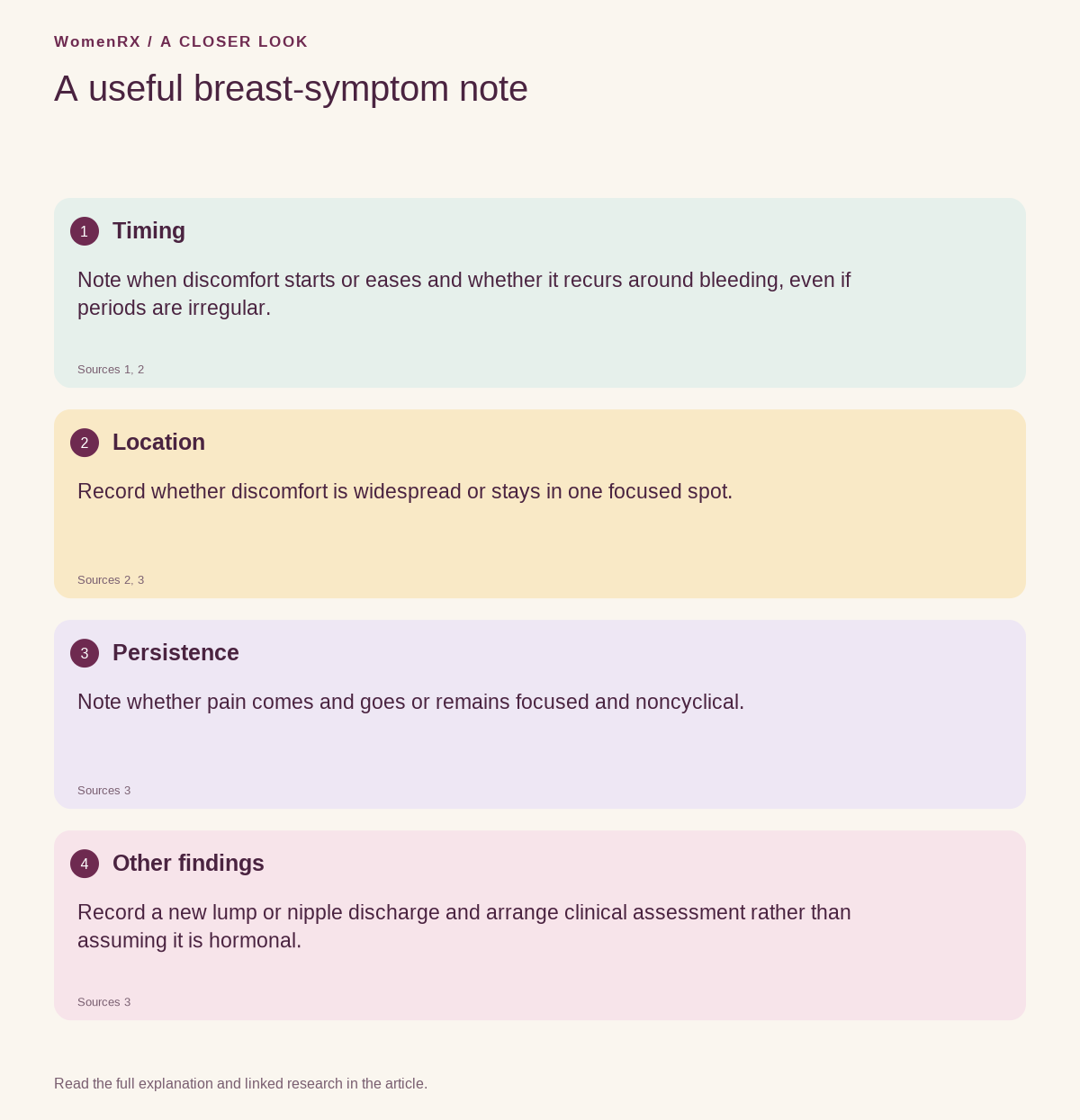
A useful breast-symptom note
Timing: Note when discomfort starts or eases and whether it recurs around bleeding, even if periods are irregular.12
Location: Record whether discomfort is widespread or stays in one focused spot.23
Persistence: Note whether pain comes and goes or remains focused and noncyclical.3
Other findings: Record a new lump or nipple discharge and arrange clinical assessment rather than assuming it is hormonal.3
Read the figure as text
Record the pattern to describe what is happening. These prompts help organize information; they are not a diagnostic checklist.- Timing: Note when discomfort starts or eases and whether it recurs around bleeding, even if periods are irregular.12
- Location: Record whether discomfort is widespread or stays in one focused spot.23
- Persistence: Note whether pain comes and goes or remains focused and noncyclical.3
- Other findings: Record a new lump or nipple discharge and arrange clinical assessment rather than assuming it is hormonal.3
More questions, answered
Does perimenopause itself explain breast tenderness?
Not on its own. Cycle timing can offer a clue, especially when periods are changing, but it can’t establish the cause of an individual breast symptom. A new lump or nipple discharge, or persistent pain in one focused area, deserves assessment rather than a hormonal assumption. 1 2 3
Does breast pain mean I need a mammogram?
Not necessarily. For cyclical, diffuse, or nonfocal pain without suspicious findings, guidance recommends no imaging beyond routine screening. Persistent pain focused in one area may warrant assessment and imaging, depending on age. 3
Sources you can check
- Menopause | Menopause Symptoms | MedlinePlusAccessed 2026-09-25Return to first citation
- ACR Appropriateness Criteria® Breast Pain.Expert Panel on Breast Imaging:, Jokich PM, Bailey L, D'Orsi C, Green ED, Holbrook AI, Lee SJ, Lourenco AP, Mainiero MB, Moy L, Sepulveda KA, Slanetz PJ, Trikha S, Yepes MM, Newell... · Journal of the American College of Radiology : JACR · 2017Return to first citation
- ACR Appropriateness Criteria® Breast Pain.Expert Panel on Breast Imaging:, Holbrook AI, Moy L, Akin EA, Baron P, Didwania AD, Heller SL, Le-Petross HT, Lewin AA, Lourenco AP, Mehta TS, Niell BL, Slanetz PJ, Stuckey AR, Tus... · Journal of the American College of Radiology : JACR · 2018Return to first citation
- Screening for Breast Cancer: A Comparative Review of Guidelines.Katsika L, Boureka E, Kalogiannidis I, Tsakiridis I, Tirodimos I, Lallas K, Tsimtsiou Z, Dagklis T. · Life (Basel, Switzerland) · 2024Return to first citation
- Patient counseling for breast cancer screening: Taking changes to USPSTF recommendations into account.Pleasant V. · OBG management · 2023Return to first citation