Breast Tenderness in Perimenopause: What Patterns Matter?
How the tenderness lines up with bleeding, where it occurs, and whether anything else has changed can help you decide what to do next.
Tenderness that builds before bleeding, affects both breasts, and eases when bleeding ends fits a common cyclical pattern, but it can be harder to spot when periods are irregular. Tenderness alone can’t confirm perimenopause. Note when it happens and any other breast changes; get it checked if it doesn’t improve or comes with a new lump, skin or nipple change, or signs of infection. 1 3
The cycle link is a clue, not proof
Breast pain linked to periods often starts in the two weeks before bleeding, gets worse, then eases when the period ends. It commonly affects both breasts and may spread toward the armpit. 1
If your periods have become irregular, it may be harder to tell whether tenderness follows that pattern. Record the days you have pain and the days you bleed rather than trying to infer a pattern from memory. A repeated link can be useful context, but it doesn’t establish the cause.
Tenderness by itself also can’t tell you that you’re in perimenopause. A review of studies in women aged 40 and older found that no single symptom or test was accurate enough to confirm or rule out the transition; age and menstrual history were more useful to the clinical assessment. 3
What to note while it’s happening
A short record can make the pattern easier to describe. Note:
- Timing: when tenderness begins and ends, and when bleeding starts.
- Location: one breast or both, and whether you feel it in one spot or more broadly.
- Duration and feel: how long it lasts and whether it feels sore, aching, or sharp.
- Other changes: any lump, nipple discharge, skin change, or change in breast shape.
- Relevant context: recent injury or strain, and medicines you take. Some medicines, including contraceptive pills and some antidepressants, can contribute to breast pain. 1
These details can help distinguish a recurring cycle-related pattern from pain that is new or not improving. They don’t diagnose the cause.
Tenderness can have causes besides cycle changes
Breast pain can also be felt after an injury or strain to the neck, shoulder, or back. Medicines and conditions such as mastitis or a breast abscess are other possible causes; hormone changes around menopause can contribute too. 1 That’s why a change in timing doesn’t, on its own, prove that menopause is responsible.
When to get breast pain checked
Arrange a medical visit if the pain doesn’t improve. Breast pain on its own is unlikely to be a sign of cancer, but that isn’t a reason to ignore a new breast change. 1
Seek prompt medical assessment if you have a hard lump that doesn’t move, nipple discharge (especially if blood-streaked), a change in breast shape, dimpling or an orange-peel look to the skin, a nipple that has turned inward, or a rash on or around the nipple. Redness, heat, or swelling in part of the breast, especially with a high temperature or feeling feverish, also needs prompt attention. 1
When you make an appointment, bring your notes and say what has changed from your usual pattern. If you’ve noticed a lump or skin or nipple change, mention that clearly rather than describing tenderness alone.
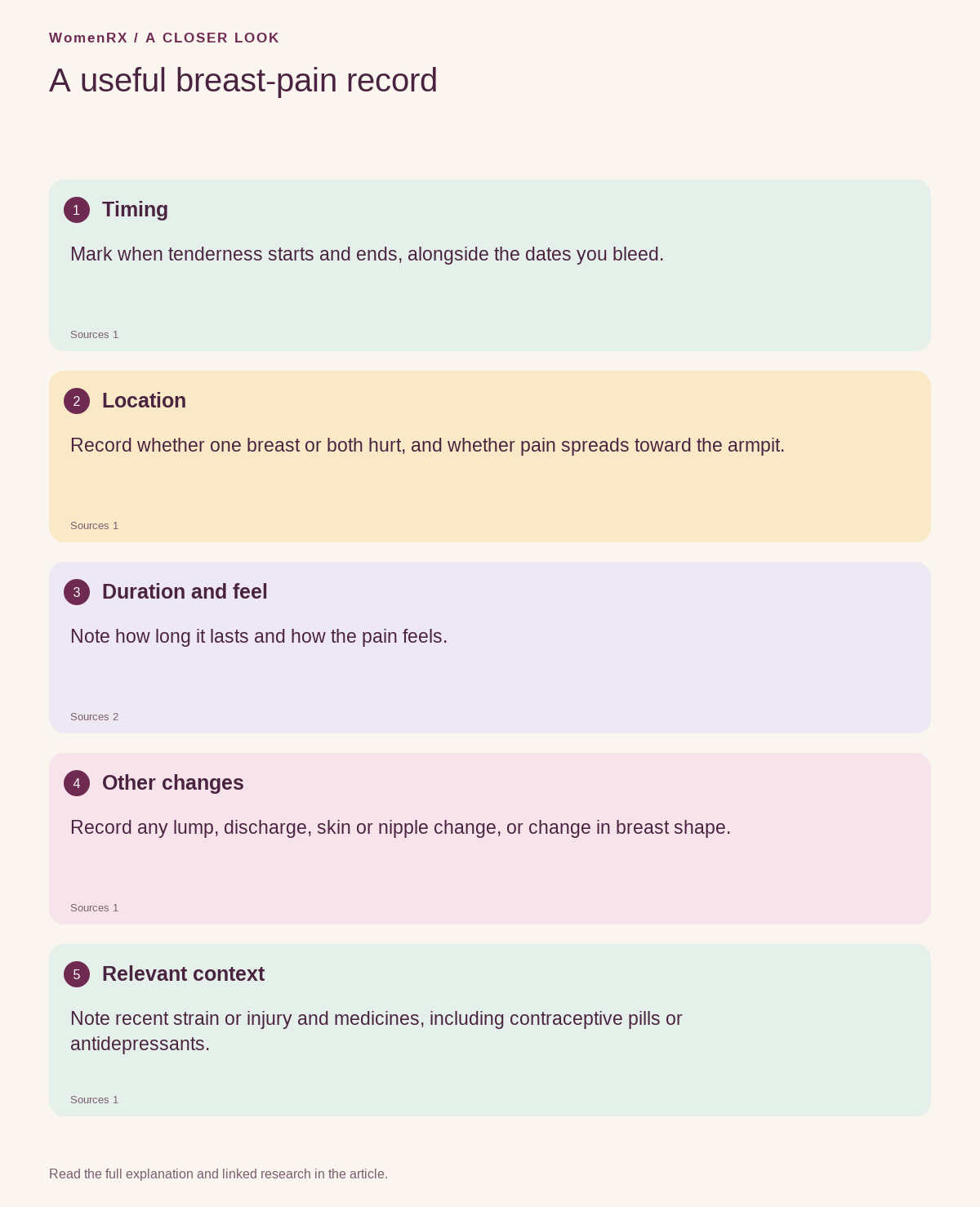
A useful breast-pain record
Timing: Mark when tenderness starts and ends, alongside the dates you bleed.1
Location: Record whether one breast or both hurt, and whether pain spreads toward the armpit.1
Duration and feel: Note how long it lasts and how the pain feels.2
Other changes: Record any lump, discharge, skin or nipple change, or change in breast shape.1
Relevant context: Note recent strain or injury and medicines, including contraceptive pills or antidepressants.1
Read the figure as text
These details can help you describe whether tenderness follows bleeding, persists, or comes with another breast change.- Timing: Mark when tenderness starts and ends, alongside the dates you bleed.1
- Location: Record whether one breast or both hurt, and whether pain spreads toward the armpit.1
- Duration and feel: Note how long it lasts and how the pain feels.2
- Other changes: Record any lump, discharge, skin or nipple change, or change in breast shape.1
- Relevant context: Note recent strain or injury and medicines, including contraceptive pills or antidepressants.1
More questions, answered
Can a medication contribute to breast pain?
Yes. Contraceptive pills and some antidepressants are among the medicines that can be associated with breast pain. Include your medicines in the details you share when you get the pain assessed. 1
Sources you can check
- Breast pain - NHSAccessed 2026-09-25Return to first citation
- Pain | MedlinePlusAccessed 2026-09-25Return to first citation
- Is this woman perimenopausal?Bastian LA, Smith CM, Nanda K. · JAMA · 2003Return to first citation