Breast Tenderness Around Menopause and Hormones
A repeating pattern around your period or a change after starting hormone therapy can make hormones relevant, but neither explains every breast symptom.
Breast tenderness can follow a menstrual pattern, and hormone changes during menopause are one possible cause. Tenderness is also listed as a possible side effect of one specific estradiol-and-progesterone product, though its reported rates shouldn’t be applied to every hormone therapy. Timing is useful context, not proof of the cause. A new lump, nipple change, or persistent pain still deserves attention. 1 2
When tenderness follows your cycle
Breast pain linked to periods often starts up to two weeks before bleeding, builds, then eases when the period ends. It commonly affects both breasts and may spread toward the armpit. If you’re still having periods during perimenopause, noting when tenderness happens in relation to bleeding can help show whether it repeats in a cycle-related pattern. 1
That pattern is a clue, not a hormone test. It doesn’t identify which hormone is involved or establish that hormones are the cause. Menopause-related hormone changes are another possible explanation for breast pain, but they don’t account for every breast symptom. 1
What hormone therapy can add
Breast tenderness is listed as a possible side effect of BIJUVA, a specific combined estradiol-and-progesterone product. Its prescribing information reports tenderness in 17 of 424 women (4.0%) in one treatment group and 43 of 415 (10.4%) in another, compared with 1 of 151 women (0.7%) taking placebo. These figures describe those study groups and that product, not the expected rate for every type of menopausal hormone therapy. 2
If tenderness starts or changes after you begin hormone therapy, tell the prescriber. The timing may be useful when considering the symptom alongside the specific product you use, but it can’t confirm the cause by itself. 2
Hormones aren’t the only possibility
Pain felt in the breast area can sometimes come from an injury or strain in the neck, shoulder, or back. Some medicines, including certain antidepressants and birth-control pills, are also listed as possible causes. Breast pain by itself is unlikely to be a sign of cancer, but that doesn’t mean every new breast change should be attributed to hormones. 1
A useful distinction is between a pattern and an explanation: recurring tenderness before a period, or tenderness that begins after starting a particular treatment, may point toward a hormone connection. Neither pattern rules out other causes.
Breast changes that need attention
Get medical assessment for a hard lump that doesn’t move, nipple discharge that may be streaked with blood, dimpling of the breast skin, a new rash on or around the nipple, or a nipple that has newly turned inward. A red, hot, swollen area, especially with fever or chills, also warrants prompt attention. If pain doesn’t improve, get it checked rather than assuming it is hormonal. 1
If it helps, keep a brief note of when tenderness occurs, whether it affects one or both breasts, and whether it began around a period or a change in treatment. That information can describe the pattern without treating the pattern as a diagnosis.
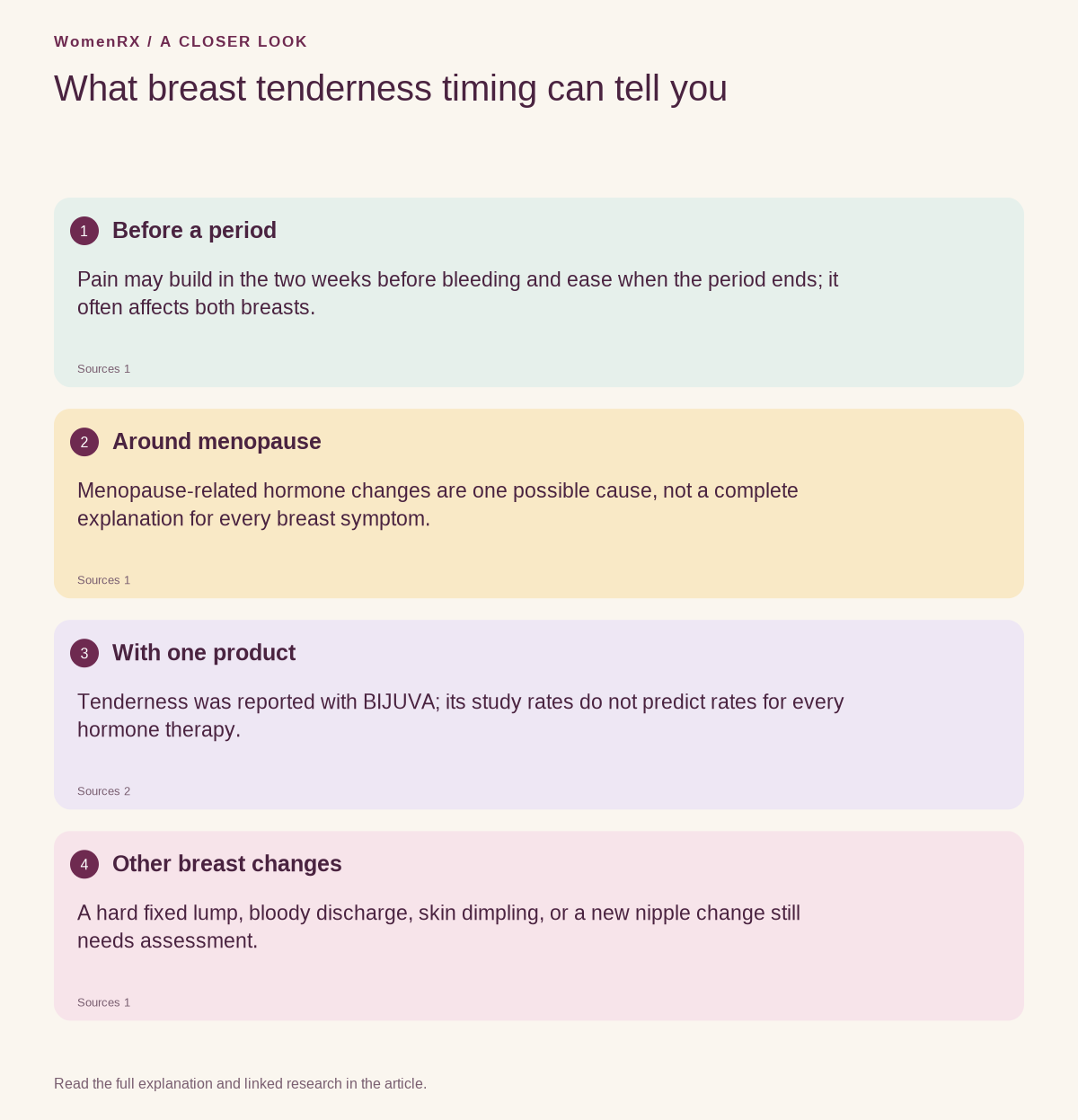
What breast tenderness timing can tell you
Before a period: Pain may build in the two weeks before bleeding and ease when the period ends; it often affects both breasts.1
Around menopause: Menopause-related hormone changes are one possible cause, not a complete explanation for every breast symptom.1
With one product: Tenderness was reported with BIJUVA; its study rates do not predict rates for every hormone therapy.2
Other breast changes: A hard fixed lump, bloody discharge, skin dimpling, or a new nipple change still needs assessment.1
Read the figure as text
Timing may make a hormone connection plausible, but it cannot confirm the cause or rule out other explanations.- Before a period: Pain may build in the two weeks before bleeding and ease when the period ends; it often affects both breasts.1
- Around menopause: Menopause-related hormone changes are one possible cause, not a complete explanation for every breast symptom.1
- With one product: Tenderness was reported with BIJUVA; its study rates do not predict rates for every hormone therapy.2
- Other breast changes: A hard fixed lump, bloody discharge, skin dimpling, or a new nipple change still needs assessment.1