Breast Tenderness Around Menopause: What Helps and When to Get It Checked
Tenderness that comes and goes with your periods often has a different pattern from new, persistent pain after periods stop.
Before periods stop, breast pain that affects both breasts and builds before bleeding, then eases when the period ends, often follows a cyclical pattern. After menopause, pain no longer has a period to track and may have other causes, including chest-wall pain. Supportive bras and some over-the-counter pain relievers may help, but a new lump, breast change, or persistent pain deserves assessment. 1 4
The pattern can shift as your periods change
If you’re still having periods, notice whether the soreness follows a repeating pattern. Menstrual-cycle-related pain commonly affects both breasts, may spread toward the armpit, and can begin up to two weeks before a period. It often gets worse before easing when the period ends. 1
As cycles become irregular during perimenopause, it may be harder to tell whether tenderness follows your cycle. Hormone changes around menopause can coincide with breast pain, but that doesn’t prove menopause is the cause. If you use hormone therapy, note whether pain appeared or changed around the same time you started or changed treatment, and bring that timing up with the clinician who manages it. A small study in postmenopausal women taking particular hormone-therapy regimens recorded breast pain, but it cannot establish that hormone therapy caused the pain or predict what will happen for an individual woman. 1 2
After periods have stopped, there’s no cycle to use as a guide. Pain that isn’t linked to a menstrual cycle is often described as noncyclic and can occur after menopause. Sometimes pain felt in the breast actually comes from the chest wall or another nearby source. A change in pattern doesn’t automatically mean something serious, but persistent or focused pain is worth getting checked rather than assuming it’s menopause. 4
Breast pain by itself is unlikely to be a sign of cancer. Still, pain is only one part of the picture: a new lump or a change in the breast, skin, or nipple should not be explained away as a hormone shift. 1 4
Comfort measures worth trying
Start with support: a well-fitting bra during the day, or a soft bra for sleep if that feels more comfortable. Some people also use over-the-counter acetaminophen or ibuprofen for pain relief; follow the package directions and use only a medicine that’s normally safe for you. 1
Supplements are less convincing. Guidance on breast pain says there’s little evidence that vitamin E or evening primrose oil helps. A 2025 systematic review and meta-analysis of three small studies in women with mastalgia did not find a statistically significant pain benefit from vitamin B6 compared with placebo; the review rated the evidence very low certainty. So these supplements shouldn’t be treated as established remedies. 1 3
Know what should be checked
Arrange a clinical assessment if the pain doesn’t improve, keeps returning in one specific spot, or is accompanied by a new lump or other breast change. Changes to report include nipple discharge, a change in breast shape, dimpling or puckering of the skin, a new rash around the nipple, or a nipple that has turned inward. 1 4
Get prompt medical assessment if the breast becomes red, hot, or swollen, particularly if you also have a high temperature or feel feverish or shivery. Those signs need attention rather than a wait-and-see approach. 1
When you describe the pain, a few details can make the pattern clearer: whether it affects one or both breasts, whether it’s in one spot or spread out, whether it tracks with bleeding, and whether it began around a change in hormone therapy. These observations help distinguish a cyclical pattern from pain that needs a closer look; they don’t replace assessment of a new breast change.
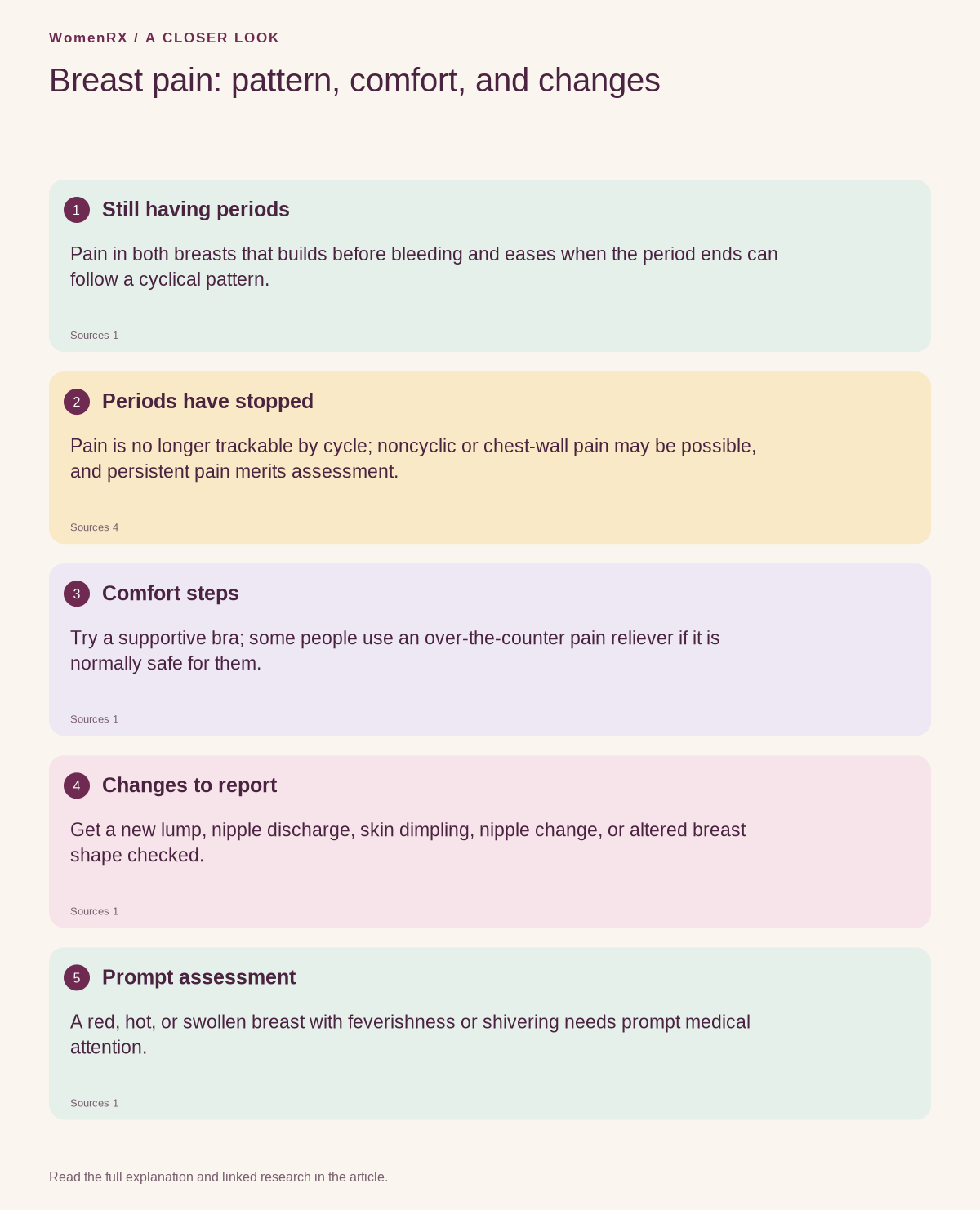
Breast pain: pattern, comfort, and changes
Still having periods: Pain in both breasts that builds before bleeding and eases when the period ends can follow a cyclical pattern.1
Periods have stopped: Pain is no longer trackable by cycle; noncyclic or chest-wall pain may be possible, and persistent pain merits assessment.4
Comfort steps: Try a supportive bra; some people use an over-the-counter pain reliever if it is normally safe for them.1
Changes to report: Get a new lump, nipple discharge, skin dimpling, nipple change, or altered breast shape checked.1
Prompt assessment: A red, hot, or swollen breast with feverishness or shivering needs prompt medical attention.1
Read the figure as text
Use the pattern as context, not as a diagnosis. A new breast change deserves assessment even if tenderness seems linked to menopause.- Still having periods: Pain in both breasts that builds before bleeding and eases when the period ends can follow a cyclical pattern.1
- Periods have stopped: Pain is no longer trackable by cycle; noncyclic or chest-wall pain may be possible, and persistent pain merits assessment.4
- Comfort steps: Try a supportive bra; some people use an over-the-counter pain reliever if it is normally safe for them.1
- Changes to report: Get a new lump, nipple discharge, skin dimpling, nipple change, or altered breast shape checked.1
- Prompt assessment: A red, hot, or swollen breast with feverishness or shivering needs prompt medical attention.1
More questions, answered
Does breast pain alone usually mean breast cancer?
No. Breast pain by itself is unlikely to be a sign of cancer. A new lump, nipple discharge, skin or nipple change, or change in breast shape should still be assessed. 1 4
Do evening primrose oil or vitamin B6 help?
They aren’t established treatments for breast pain. There’s little evidence that evening primrose oil helps, and a review of three studies found no clear benefit of vitamin B6 over placebo, with very low certainty in that result. 1 3
Sources you can check
- Breast pain - NHSAccessed 2026-09-25Return to first citation
- [Monitoring the breast changes of Chinese postmenopausal women under long-term hormone replacement therapy by mammary ultrasonography].Huang MT, Jiang YX, Lin SQ, Zhang Y, Zhou YZ. · Zhongguo yi xue ke xue yuan xue bao. Acta Academiae Medicinae Sinicae · 2004Return to first citation
- The effectiveness of vitamin B6 in reducing mastalgia: a systematic review and meta-analysis.Sharifipour F, Siahkal SF, Bagherinia M. · BMC women's health · 2025Return to first citation
- Evaluation and management of breast pain.Smith RL, Pruthi S, Fitzpatrick LA. · Mayo Clinic proceedings · 2004Return to first citation