Breast Tenderness Around Menopause: Are Supplements Worth Trying?
Vitamin E and evening primrose oil haven’t shown a clear advantage for breast pain, so the timing and type of breast change matter more than choosing a supplement.
Supplements are unlikely to be a reliable fix: a systematic review found no clear pain-relief advantage for evening primrose oil over placebo or several other treatments, including vitamin E. If you still have periods, notice whether tenderness happens before bleeding and whether it affects one or both breasts. Don’t use supplements to put off assessment of a hard lump that doesn’t move, nipple discharge, breast skin dimpling, or persistent pain. 4 1
First, look at the pattern
Breast tenderness that affects both breasts and comes before a period, then eases when bleeding starts, can fit a cycle-related pattern. In a review of mastalgia research, cyclical pain was described as often diffuse and bilateral, starting one to two weeks before a period. Pain that doesn’t follow a cycle may be more localized or persistent. 4
If you still have periods, note whether the pain happens in relation to bleeding, where you feel it, and whether it is in one or both breasts. That can help distinguish a recurring pattern from a new or persistent change. Hormonal changes during menopause can be associated with breast pain, but tenderness by itself doesn’t establish a hormone imbalance. 1
Pain felt in the breast area can also come from elsewhere, such as an injury or strain in the neck, shoulder, or back. Some medicines, including birth control pills and certain antidepressants, are also listed as possible causes. 1
What the supplement research can tell you
Evening primrose oil is often suggested for breast pain, but a systematic review of 13 randomized trials involving 1,752 participants found no difference in pain relief compared with placebo or other treatments. The comparisons included topical nonsteroidal anti-inflammatory drugs, danazol, and vitamin E. This research addressed mastalgia in women generally; it doesn’t establish a specific benefit during perimenopause. 4
Vitamin E tablets haven’t shown a clear benefit for breast pain, so they aren’t a dependable treatment. There’s also a safety reason to check before starting a supplement: vitamin E supplements may be harmful for people taking blood thinners. Ask a pharmacist or prescriber to check your medicines and the exact product before you use it. 1 2
Match your next step to what’s happening
If tenderness is mild and follows a familiar pattern, a well-fitting supportive bra may help. An over-the-counter pain reliever such as acetaminophen or ibuprofen is another option if it’s safe for you. If pain isn’t improving or these measures aren’t helping, arrange an assessment rather than trying supplement after supplement. 1
A review of perimenopause hormone-therapy trials included breast pain among the outcomes it considered, but it covered only seven studies and 704 participants. That limited evidence doesn’t tell you what is causing your own tenderness or whether a change in hormone therapy would help. 3
Arrange prompt clinical review for a hard breast lump that doesn’t move, nipple discharge, breast skin dimpling, a rash on or around the nipple, a nipple that has sunk in, or a breast that is red, hot, or swollen. Breast pain alone is unlikely to signal cancer, but these changes deserve attention. 1
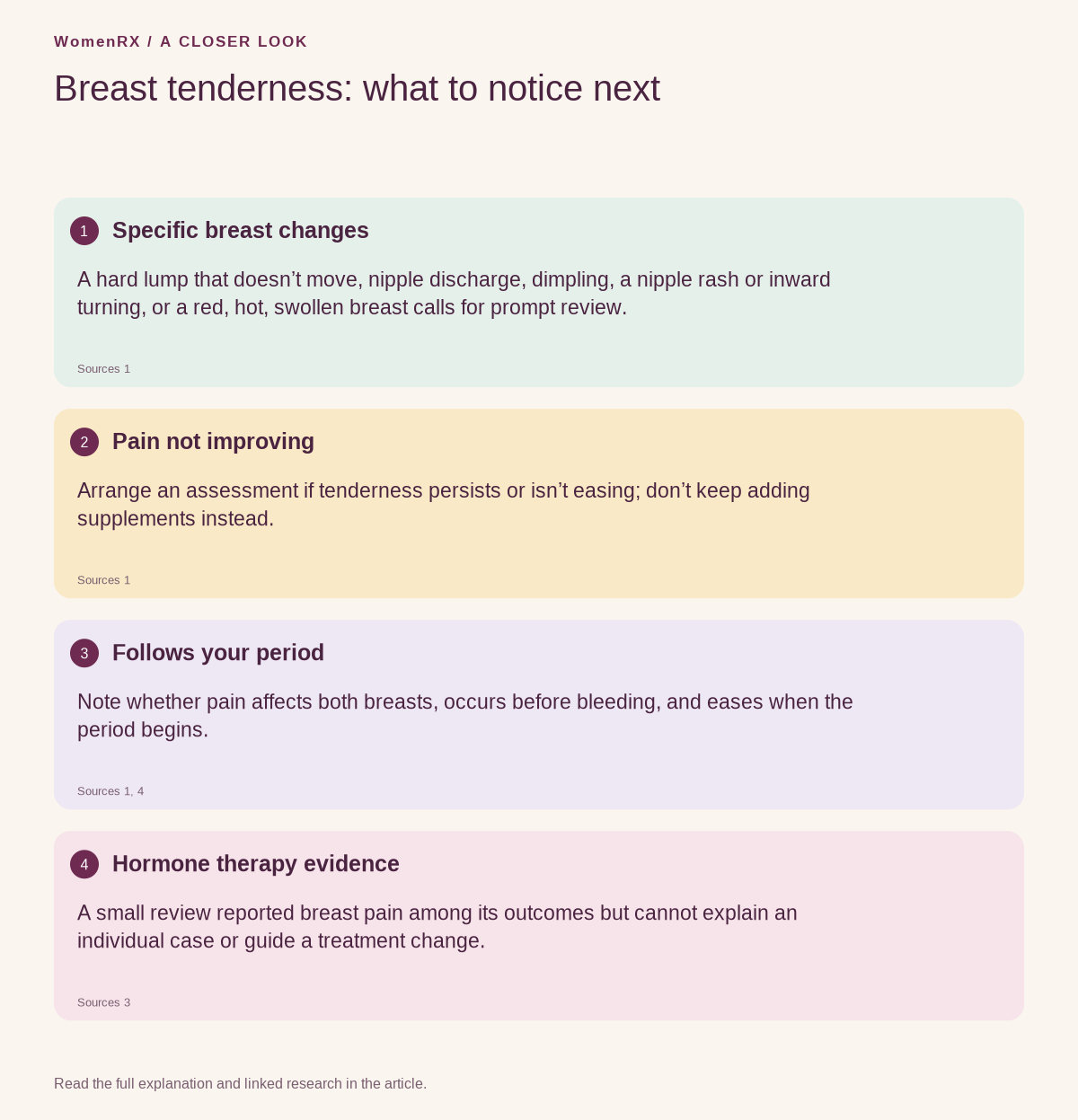
Breast tenderness: what to notice next
Specific breast changes: A hard lump that doesn’t move, nipple discharge, dimpling, a nipple rash or inward turning, or a red, hot, swollen breast calls for prompt review.1
Pain not improving: Arrange an assessment if tenderness persists or isn’t easing; don’t keep adding supplements instead.1
Follows your period: Note whether pain affects both breasts, occurs before bleeding, and eases when the period begins.14
Hormone therapy evidence: A small review reported breast pain among its outcomes but cannot explain an individual case or guide a treatment change.3
Read the figure as text
Use the pattern and any accompanying changes to decide whether symptom relief or clinical review is the next step.- Specific breast changes: A hard lump that doesn’t move, nipple discharge, dimpling, a nipple rash or inward turning, or a red, hot, swollen breast calls for prompt review.1
- Pain not improving: Arrange an assessment if tenderness persists or isn’t easing; don’t keep adding supplements instead.1
- Follows your period: Note whether pain affects both breasts, occurs before bleeding, and eases when the period begins.14
- Hormone therapy evidence: A small review reported breast pain among its outcomes but cannot explain an individual case or guide a treatment change.3
More questions, answered
Does breast tenderness mean my hormones are out of balance?
No. Tenderness can occur alongside menstrual or menopause-related hormone changes, but the symptom alone doesn’t show that you have a hormone imbalance. Medicines, strain, and other causes can also contribute. 1
When should I get breast pain checked?
Arrange an assessment if pain isn’t improving. Seek prompt clinical review for a hard lump that doesn’t move, nipple discharge, breast skin dimpling, a rash on or around the nipple, a nipple that has sunk in, or redness, heat, or swelling. 1
Sources you can check
- Breast pain - NHSAccessed 2026-09-25Return to first citation
- Vitamin E: MedlinePlusAccessed 2026-09-25Return to first citation
- Hormone therapy with different administration routes for patients with perimenopausal syndrome: a systematic review and network meta-analysis.Wang L, Luo X, Ren M, Wang Y. · Gynecological endocrinology : the official journal of the International Society of Gynecological Endocrinology · 2025Return to first citation
- A Systematic Review and Meta-Analysis of the Efficacy of Evening Primrose Oil for Mastalgia Treatment.Ahmad Adni LL, Norhayati MN, Mohd Rosli RR, Muhammad J. · International journal of environmental research and public health · 2021Return to first citation