Evening Primrose Oil: Evidence for Women’s Symptoms
Evening primrose oil has been studied for several women’s health concerns, but results for one symptom don’t establish benefits for another.
Evening primrose oil hasn’t shown a dependable benefit across women’s symptoms. A trial in women with severe chronic breast pain found no advantage over control oils; a smaller cyclical-pain pilot found improvement within the EPO group but no significant advantage over placebo. A systematic review found no PMS benefit over placebo, and evidence for menopausal hot flashes remains too uncertain for a strong recommendation. 2 3 5 7
Evening primrose oil (EPO) is often promoted as a general remedy for women’s health. The research is more specific: studies have tested it for particular symptoms in particular groups, and results for one condition can’t be carried over to another. Breast-pain trials have not established an advantage over their comparison treatments, findings for premenstrual syndrome (PMS) are discouraging, and evidence for menopausal hot flashes is too uncertain to support a strong recommendation. 2 3 5 7
Breast pain: chronic and cyclical trials
Breast pain that follows the menstrual cycle is called cyclical mastalgia. The two EPO trials here did not enroll identical groups: one studied severe chronic breast pain, while the other explicitly studied cyclical discomfort. 5 7
In a randomized trial of 120 premenopausal women with severe, chronic mastalgia, researchers compared EPO, fish oil, both oils, and control oils over six months. The percentage of days with breast pain fell in all groups. EPO did not outperform its control oil: pain days decreased by 12.3% with EPO and 13.8% with control oil. The trial’s reported population was women with chronic mastalgia; its abstract does not specify that their pain was cyclical. 5
A smaller U.S. pilot trial enrolled 85 women with cyclical breast discomfort, but only 41 completed the study. Its results need careful reading: an analysis found improvement in worst pain within the EPO group, but the direct comparison between EPO and placebo did not show a statistically significant difference. That within-group improvement is a possible signal for further study, not proof that EPO works better than placebo. 7
Neither trial demonstrated a significant EPO advantage in its direct comparison with a control treatment. The chronic-pain trial should not be treated as a trial specifically of cyclical pain, and the smaller cyclical-pain pilot does not establish relief as an EPO benefit. 5 7
PMS: a combined supplement isn’t proof for EPO
A systematic review of herbal treatments for PMS reported that evening primrose oil did not improve symptoms more than placebo. The review also found variation in study populations, designs, and symptom measures, which limited how confidently the findings could be combined. 3
One separate trial may look more encouraging at first glance: a supplement containing EPO plus vitamins B6 and E was tested in 40 women with PMS over two menstrual cycles, and the researchers reported symptom improvement. But because the product combined three ingredients, the trial cannot show whether EPO itself helped, whether the vitamins mattered, or whether the combination was responsible. 4
PMS and premenstrual dysphoric disorder (PMDD) should not be treated as interchangeable study outcomes. Evidence about a supplement for PMS symptoms doesn’t establish that it treats PMDD, a condition involving severe emotional and physical symptoms before a period. 1 3
Menopausal hot flashes: a possible signal, not a recommendation
A 2024 systematic review of EPO trials included menopausal hot flashes among the conditions where some results were reported. But the review described the overall literature as highly heterogeneous and concluded that it did not support strong recommendations about EPO’s effectiveness. The reported information does not establish a reliable size of benefit for hot flashes or identify which women might benefit. 2
So, hot flashes have been studied, but the available findings aren’t enough to call EPO an effective treatment. That conclusion doesn’t mean every possible EPO study has found no effect.
Other uses don’t fill the evidence gap
EPO has also been tested for labor-related outcomes, which is a separate question from treating menstrual or menopausal symptoms. In a randomized trial, 80 low-risk, first-time pregnant women at 40 weeks received EPO or placebo. The groups did not differ significantly in gestational age at delivery, need for labor induction or augmentation, or duration of labor stages. This trial doesn’t support assuming EPO helps with labor, and it says nothing about its effectiveness for other conditions. 6
The practical comparison is simple: neither breast-pain trial showed a significant advantage over its control treatment, the systematic-review finding for PMS is negative, and menopausal hot-flash evidence remains too uncertain for a strong recommendation. A positive result for a multi-ingredient supplement or an improvement within one study group shouldn’t be read as proof that EPO balances hormones or relieves women’s symptoms generally. 2 3 4 5 7
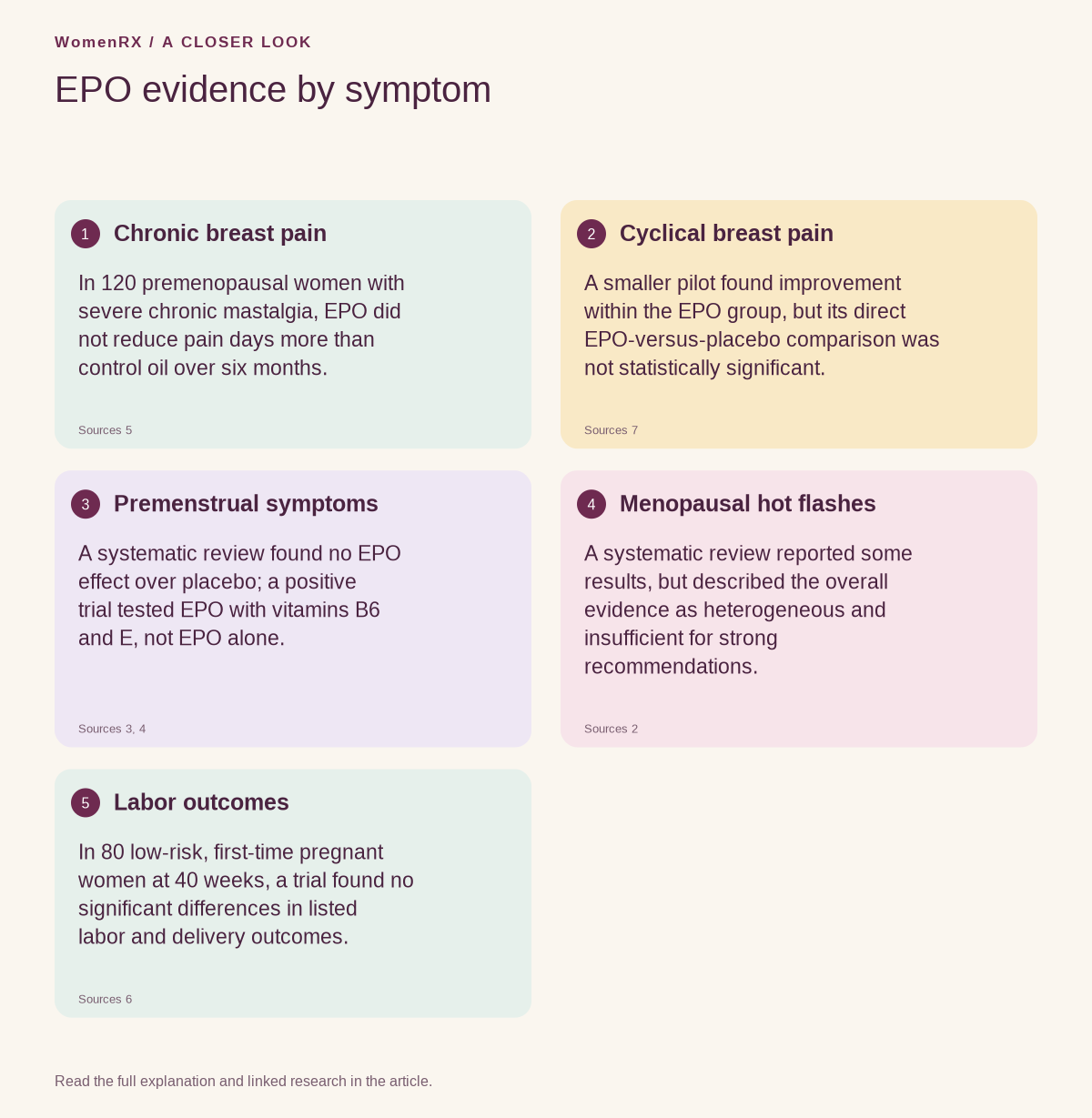
EPO evidence by symptom
Chronic breast pain: In 120 premenopausal women with severe chronic mastalgia, EPO did not reduce pain days more than control oil over six months.5
Cyclical breast pain: A smaller pilot found improvement within the EPO group, but its direct EPO-versus-placebo comparison was not statistically significant.7
Premenstrual symptoms: A systematic review found no EPO effect over placebo; a positive trial tested EPO with vitamins B6 and E, not EPO alone.34
Menopausal hot flashes: A systematic review reported some results, but described the overall evidence as heterogeneous and insufficient for strong recommendations.2
Labor outcomes: In 80 low-risk, first-time pregnant women at 40 weeks, a trial found no significant differences in listed labor and delivery outcomes.6
Read the figure as text
These findings come from different study populations and outcomes. Each row answers a separate question, not one general claim about women’s health.- Chronic breast pain: In 120 premenopausal women with severe chronic mastalgia, EPO did not reduce pain days more than control oil over six months.5
- Cyclical breast pain: A smaller pilot found improvement within the EPO group, but its direct EPO-versus-placebo comparison was not statistically significant.7
- Premenstrual symptoms: A systematic review found no EPO effect over placebo; a positive trial tested EPO with vitamins B6 and E, not EPO alone.34
- Menopausal hot flashes: A systematic review reported some results, but described the overall evidence as heterogeneous and insufficient for strong recommendations.2
- Labor outcomes: In 80 low-risk, first-time pregnant women at 40 weeks, a trial found no significant differences in listed labor and delivery outcomes.6
More questions, answered
Does a PMS study of a combination supplement prove EPO works?
No. The trial tested EPO together with vitamins B6 and E, so it cannot isolate EPO’s effect. A systematic review of herbal PMS treatments reported that EPO itself did not perform better than placebo. 3 4
Does breast-pain research show a clear benefit?
No. A trial in 120 premenopausal women with severe chronic breast pain found no advantage over control oils. A smaller pilot specifically studying cyclical discomfort found improvement within the EPO group, but no significant EPO-versus-placebo difference. 5 7
Sources you can check
- PMDD (premenstrual dysphoric disorder) - NHSAccessed 2026-09-25Return to first citation
- The effect of Oenothera biennis (Evening primrose) oil on inflammatory diseases: a systematic review of clinical trials.Sharifi M, Nourani N, Sanaie S, Hamedeyazdan S. · BMC complementary medicine and therapies · 2024Return to first citation
- Herbal treatments for alleviating premenstrual symptoms: a systematic review.Dante G, Facchinetti F. · Journal of psychosomatic obstetrics and gynaecology · 2011Return to first citation
- Femicomfort in the treatment of premenstrual syndromes: a double-blind, randomized and placebo controlled trial.Kashani L, Saedi N, Akhondzadeh S. · Iranian journal of psychiatry · 2010Return to first citation
- Evening primrose oil and fish oil for severe chronic mastalgia: a randomized, double-blind, controlled trial.Blommers J, de Lange-De Klerk ES, Kuik DJ, Bezemer PD, Meijer S. · American journal of obstetrics and gynecology · 2002Return to first citation
- Evening primrose oil and labour, is it effective? A randomised clinical trial.Kalati M, Kashanian M, Jahdi F, Naseri M, Haghani H, Sheikhansari N. · Journal of obstetrics and gynaecology : the journal of the Institute of Obstetrics and Gynaecology · 2018Return to first citation
- Vitamin E and evening primrose oil for management of cyclical mastalgia: a randomized pilot study.Pruthi S, Wahner-Roedler DL, Torkelson CJ, Cha SS, Thicke LS, Hazelton JH, Bauer BA. · Alternative medicine review : a journal of clinical therapeutic · 2010Return to first citation