Evening Primrose Oil: What the Evidence Actually Shows
Evidence varies by condition: short menopause trials suggest a possible effect on psychological symptoms, but that finding doesn’t establish benefits for hot flashes, breast pain, or other concerns.
Evening primrose oil contains gamma-linolenic acid (GLA), but a proposed effect on fatty-acid signaling isn’t proof that the supplement helps a particular symptom. Two short randomized trials in postmenopausal women reported improvements in psychological symptom scores. They did not establish benefits for hot flashes or cyclic breast pain. A small labor trial did not find statistically significant differences in the specific labor outcomes it measured. Check what symptom a study measured, who took part, and how long it lasted before applying its result to yourself. 1 2 3 4
Start with the symptom, not the ingredient
Evening primrose oil is an oil from the evening primrose seed. It contains linoleic acid and gamma-linolenic acid, or GLA. A proposed explanation is that these fatty acids help with the synthesis of prostaglandin E1. That’s a proposed mechanism, not evidence that taking the oil improves a symptom. The useful question is whether a study tested the condition and outcome you care about. 1
Menopause: a possible signal for psychological symptoms
Two randomized, placebo-controlled trials studied psychological symptoms in postmenopausal women. In one, 189 women completed eight weeks of treatment. The study used 1,000 mg of evening primrose oil daily and reported a greater reduction in the psychological subscale of the Menopause Rating Scale with oil than with placebo. In another trial of 100 women, participants took two 1 g capsules daily; researchers reported lower psychological symptom scores than with placebo after two and four weeks. 2 4
These results are a reason to describe the evidence as promising but limited, not as proof that evening primrose oil treats menopause generally. The trials were short, and their reported outcome was psychological symptoms. They don’t show that it relieves hot flashes or other symptoms that weren’t measured. One trial reported a single case of gastric upset in the oil group, but these short studies can’t settle longer-term safety. 2 4
Labor: different outcomes, different study designs
A placebo-controlled trial followed 80 low-risk, first-time pregnant women who were at 40 weeks of pregnancy. It did not find statistically significant differences between groups in the specific labor outcomes it measured: gestational age at delivery, need for labor induction or augmentation, and duration of labor stages. 3
A separate trial compared vaginal evening primrose oil with misoprostol for cervical preparation in 110 first-time pregnant women at 40 weeks or later. It reported higher Bishop scores and fewer cesarean sections in the oil group, while most other reported outcomes did not differ significantly. Because this study compared the oil with a medication rather than a placebo, and studied a specific clinical use, it shouldn’t be read as proof that an oral supplement helps start labor or improves birth outcomes. 5
Taken together, these trials don’t establish a general benefit for labor. Pregnancy-related use is a distinct clinical question, not a reason to assume an over-the-counter product is appropriate during pregnancy.
Cyclic breast pain: don’t fill in the missing result
Cyclic breast pain is mentioned as a proposed use in one labor study, but that isn’t a trial of evening primrose oil for breast pain. The studies summarized here don’t establish whether it helps cyclic breast pain, how much it might help, or which women might benefit. A mention of a use, or a plausible mechanism, can’t substitute for a study that measures that symptom. 3
A quick way to check a claim
Before choosing a product, look for three things:
- The exact symptom: Does the study measure your concern, rather than a nearby one? Psychological menopause scores, for example, aren’t the same outcome as hot flashes.
- The people studied: A finding in postmenopausal women doesn’t automatically apply to women who still menstruate, are pregnant, or are in another life stage.
- The comparison and timeframe: Was the oil compared with placebo or another treatment, and for how long? A short trial can’t answer questions about lasting benefit or long-term safety.
The menopause trials offer concrete examples of why dose and duration matter when comparing claims: one studied 1,000 mg daily for eight weeks, and the other studied two 1 g capsules daily, with outcomes reported at two and four weeks. These are study details, not personal-use recommendations. Also check what the label actually reports. Evening primrose oil is not the same thing as purified GLA: the oil contains other fatty acids, and the study results apply to the tested product and use, not every supplement marketed with a related ingredient. 1 2 4
For now, the clearest condition-specific signal in these studies is for short-term psychological symptom scores in postmenopausal women. For cyclic breast pain and hot flashes, these results don’t answer the question. For labor, the available trials point to different outcomes and do not establish a general benefit.
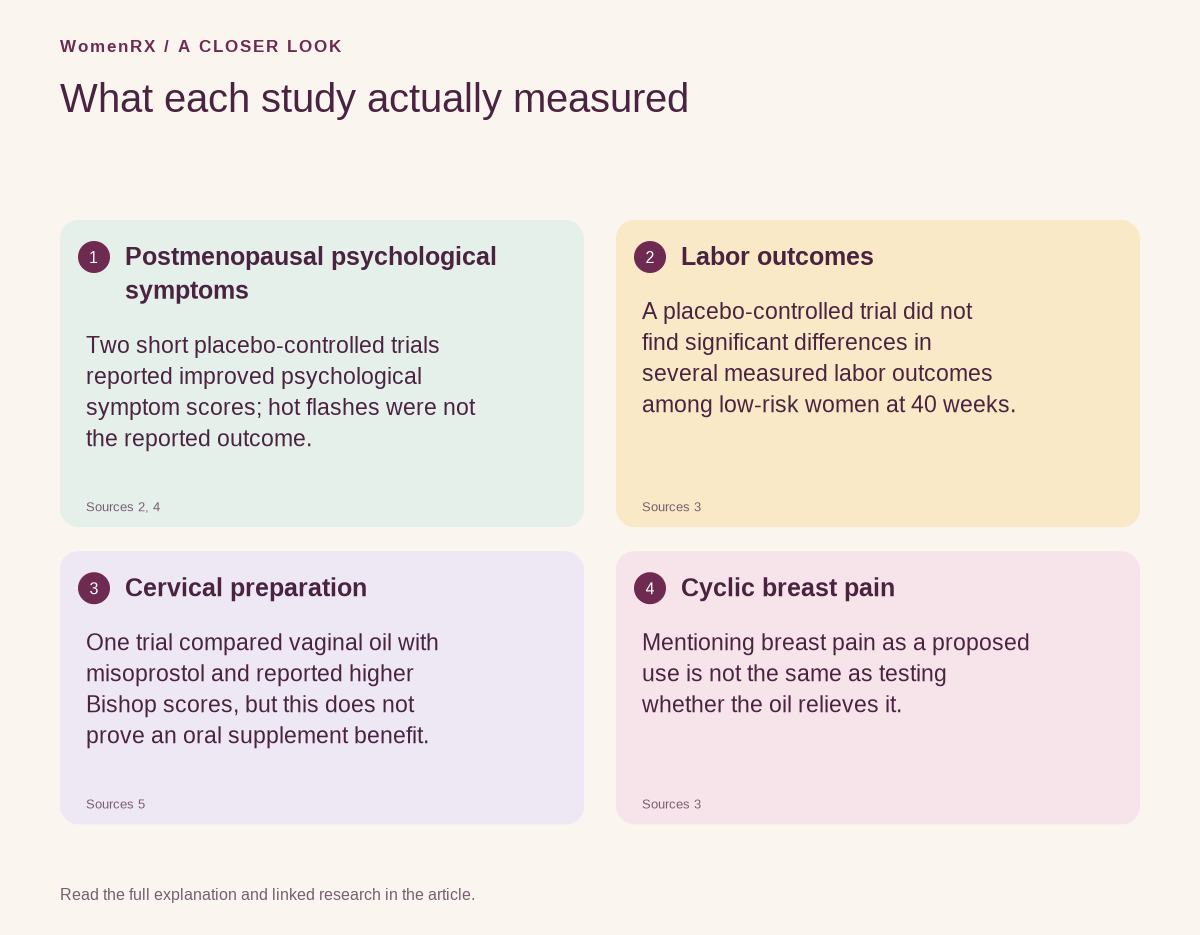
What each study actually measured
Postmenopausal psychological symptoms: Two short placebo-controlled trials reported improved psychological symptom scores; hot flashes were not the reported outcome.24
Labor outcomes: A placebo-controlled trial did not find significant differences in several measured labor outcomes among low-risk women at 40 weeks.3
Cervical preparation: One trial compared vaginal oil with misoprostol and reported higher Bishop scores, but this does not prove an oral supplement benefit.5
Cyclic breast pain: Mentioning breast pain as a proposed use is not the same as testing whether the oil relieves it.3
Read the figure as text
The condition and outcome studied matter: evidence for one use does not automatically transfer to another.- Postmenopausal psychological symptoms: Two short placebo-controlled trials reported improved psychological symptom scores; hot flashes were not the reported outcome.24
- Labor outcomes: A placebo-controlled trial did not find significant differences in several measured labor outcomes among low-risk women at 40 weeks.3
- Cervical preparation: One trial compared vaginal oil with misoprostol and reported higher Bishop scores, but this does not prove an oral supplement benefit.5
- Cyclic breast pain: Mentioning breast pain as a proposed use is not the same as testing whether the oil relieves it.3
More questions, answered
Does evening primrose oil help hot flashes?
The menopause trials described here measured psychological symptoms, not hot flashes. Their results can’t establish whether evening primrose oil helps vasomotor symptoms such as hot flashes. 2 4
Is evening primrose oil the same as GLA?
No. Evening primrose oil contains GLA along with other fatty acids. A study of the oil is not automatically evidence for a product containing isolated GLA, or vice versa. 1
Sources you can check
- Comparison of the effect of vaginal misoprostol and evening primrose oil capsule with misoprostol alone on the consequences of abortion in women with intrauterine fetal death: a randomized clinical trial.Hashemi H, Hasanpoor-Azghady SB, Farahani M, Amiri-Farahani L. · BMC complementary medicine and therapies · 2023Return to first citation
- Impact of evening primrose oil consumption on psychological symptoms of postmenopausal women: a randomized double-blinded placebo-controlled clinical trial.Sharif SN, Darsareh F. · Menopause (New York, N.Y.) · 2020Return to first citation
- Evening primrose oil and labour, is it effective? A randomised clinical trial.Kalati M, Kashanian M, Jahdi F, Naseri M, Haghani H, Sheikhansari N. · Journal of obstetrics and gynaecology : the journal of the Institute of Obstetrics and Gynaecology · 2018Return to first citation
- Effect of Evening Primrose Oil on Postmenopausal Psychological Symptoms: A Triple-Blind Randomized Clinical Trial.Safdari F, Motaghi Dastenaei B, Kheiri S, Karimiankakolaki Z. · Journal of menopausal medicine · 2021Return to first citation
- Comparative Study of the Effect of Vaginal use of Primrose Oil with Misoprostol on Cervical Preparation of Prim Gravid Women: A Double-blind Clinical Trial.Shahraki AD, Mirhoseini S, Movahedi M, Hajihashemy M, Haghollahi F. · Advanced biomedical research · 2023Return to first citation