Evening Primrose Oil: What the Human Evidence Says
Evidence differs by symptom: a breast-pain trial found no clear benefit, while PMS and menopause findings are limited or mixed.
Evening primrose oil hasn’t shown a clear benefit for chronic breast pain in a randomized trial. For PMS, a small study tested it only as part of a combination supplement, while a review reported conflicting results. One postmenopausal trial found fewer or less severe night sweats, but not a clear hot-flash benefit. These findings don’t establish the oil as a hormone treatment or settle its safety and interactions. 2 3 4 5
Start with the symptom, not the supplement
Evening primrose oil is not one evidence-backed answer for every women’s health concern. The studies looked at different people and different outcomes: chronic breast pain in premenopausal women, cyclical PMS symptoms, and hot flashes or night sweats after menopause. A result for one symptom doesn’t establish a benefit for another.
The oil contains gamma-linolenic acid, a fatty acid. A proposed biological explanation is not the same as showing that taking the oil improves a symptom. The clinical question is whether people who take it do better than those who take a comparison product. 4
Breast pain: the trial found no clear advantage
A randomized, double-blind trial followed 120 premenopausal women with severe, chronic mastalgia for six months. The percentage of days with breast pain decreased by 12.3% in the evening-primrose-oil group and 13.8% in its control-oil group. The study found no clear benefit from evening primrose oil over the control. The fact that pain decreased in all groups doesn’t show that the supplement caused the change. 5
This result applies to the trial’s participants and measure: premenopausal women with severe, chronic breast pain, and the change in days with pain. It doesn’t answer whether the oil helps every kind of breast discomfort.
PMS: combination results can’t tell you what the oil did
One small randomized trial tested Femicomfort, a supplement containing evening primrose oil, vitamin B6, and vitamin E, against a placebo over two menstrual cycles. It reported improved PMS symptoms, but because the product contained three ingredients, the result can’t show that evening primrose oil itself was responsible. The study randomized 40 women, so the finding is preliminary. 2
A review of PMS supplement trials reported conflicting findings for evening primrose oil and said the two most rigorous studies it assessed showed no evidence of benefit. Taken together, the evidence doesn’t support treating a positive result from a combination product as proof that evening primrose oil relieves PMS. 3
Menopause: night sweats and hot flashes didn’t move together
In a randomized trial of postmenopausal women, researchers compared evening primrose oil with placebo over eight weeks. The study reported lower frequency and severity of night sweats in the oil group. But it did not find a statistically significant reduction in hot-flash duration, frequency, or severity in the main comparison. In a further analysis, the severity difference was statistically significant, but the reported effect size was small (Cohen’s d = 0.13), and the authors said it was not effective for reducing hot-flash severity. 4
That’s a signal for one outcome in one trial, not proof of a broad menopause benefit. Night sweats and hot flashes are related symptoms, but this study’s results differed by outcome. It also doesn’t establish benefit for PMS or breast pain.
What to ask before considering it
The studies above don’t establish specific medication interactions or answer whether evening primrose oil is safe for you. Bring the exact product label and a list of your medicines and other supplements to a pharmacist or clinician, and ask:
- Is there a known concern with this product and my medicines or health conditions?
- Is this product appropriate for me, including if I’m pregnant, trying to become pregnant, or breastfeeding?
- For my specific symptom, what result would count as a meaningful improvement, and what other options have better evidence?
If you’re pregnant, don’t treat a labor study as proof that the oil is appropriate for pregnancy. A randomized trial in women at 40 weeks found no significant difference in labor or delivery outcomes, and it was not designed to establish general pregnancy safety. 1
A useful decision is specific: “I’m considering this for night sweats,” for example, rather than “I’m taking it for hormones.” The research doesn’t support treating evening primrose oil as a proven hormone therapy, and the evidence for one symptom shouldn’t be carried over to another.
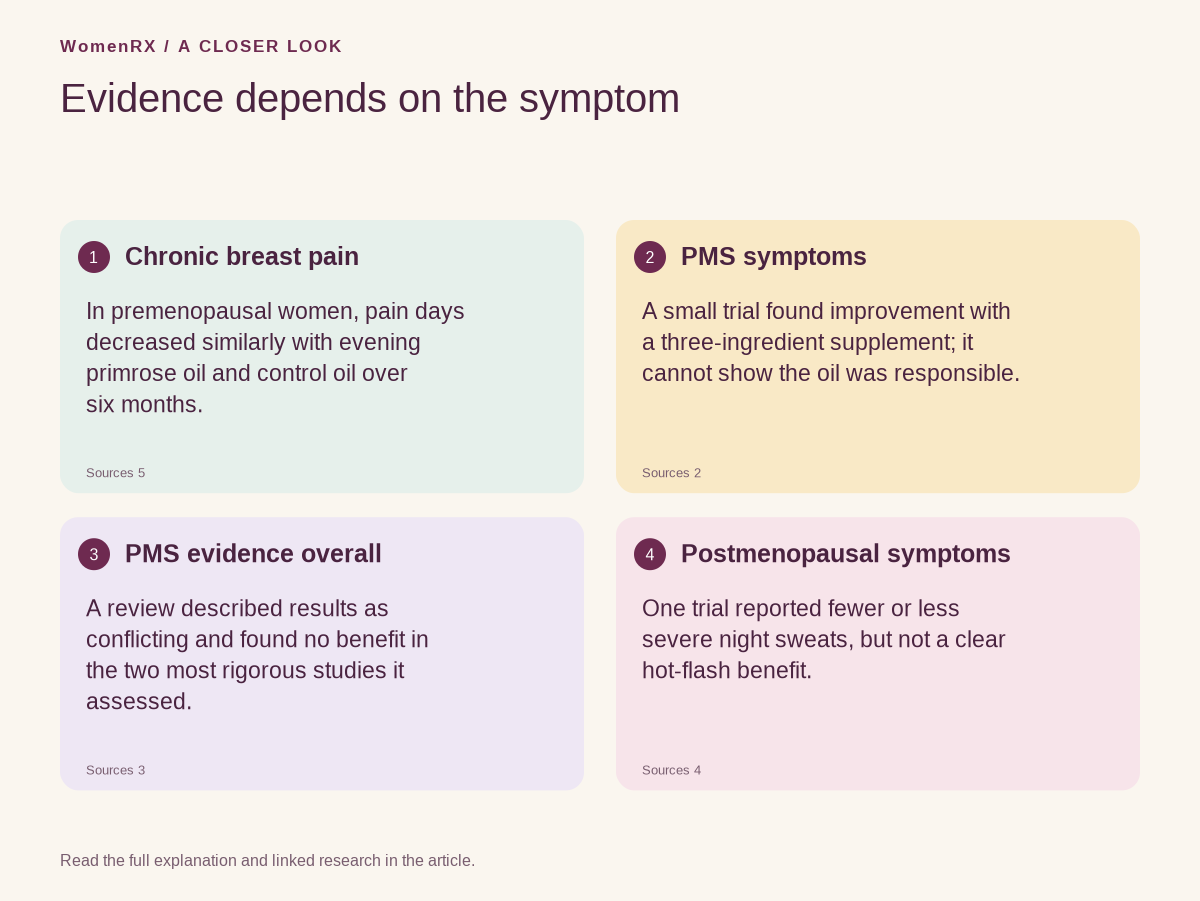
Evidence depends on the symptom
Chronic breast pain: In premenopausal women, pain days decreased similarly with evening primrose oil and control oil over six months.5
PMS symptoms: A small trial found improvement with a three-ingredient supplement; it cannot show the oil was responsible.2
PMS evidence overall: A review described results as conflicting and found no benefit in the two most rigorous studies it assessed.3
Postmenopausal symptoms: One trial reported fewer or less severe night sweats, but not a clear hot-flash benefit.4
Read the figure as text
These studies tested different symptoms in different groups, so their findings should not be treated as interchangeable.- Chronic breast pain: In premenopausal women, pain days decreased similarly with evening primrose oil and control oil over six months.5
- PMS symptoms: A small trial found improvement with a three-ingredient supplement; it cannot show the oil was responsible.2
- PMS evidence overall: A review described results as conflicting and found no benefit in the two most rigorous studies it assessed.3
- Postmenopausal symptoms: One trial reported fewer or less severe night sweats, but not a clear hot-flash benefit.4
More questions, answered
Does a positive PMS study prove evening primrose oil works?
No. The randomized PMS study tested a combination of evening primrose oil, vitamin B6, and vitamin E, so it can’t isolate the oil’s effect. A review also described the evening primrose oil evidence as conflicting. 2 3
Does the labor trial show evening primrose oil is safe during pregnancy?
No. It tested labor and delivery outcomes in a specific group of women at 40 weeks; it wasn’t designed to establish general pregnancy safety. 1
Sources you can check
- Evening primrose oil and labour, is it effective? A randomised clinical trial.Kalati M, Kashanian M, Jahdi F, Naseri M, Haghani H, Sheikhansari N. · Journal of obstetrics and gynaecology : the journal of the Institute of Obstetrics and Gynaecology · 2018Return to first citation
- Femicomfort in the treatment of premenstrual syndromes: a double-blind, randomized and placebo controlled trial.Kashani L, Saedi N, Akhondzadeh S. · Iranian journal of psychiatry · 2010Return to first citation
- The potential for dietary supplements to reduce premenstrual syndrome (PMS) symptoms.Bendich A. · Journal of the American College of Nutrition · 2000Return to first citation
- The Effect of Evening Primrose Oil Capsule on Hot Flashes and Night Sweats in Postmenopausal Women: A Single-Blind Randomized Controlled Trial.Kazemi F, Masoumi SZ, Shayan A, Oshvandi K. · Journal of menopausal medicine · 2021Return to first citation
- Evening primrose oil and fish oil for severe chronic mastalgia: a randomized, double-blind, controlled trial.Blommers J, de Lange-De Klerk ES, Kuik DJ, Bezemer PD, Meijer S. · American journal of obstetrics and gynecology · 2002Return to first citation