Vitamin E: Food Sources and What Supplements Can Do
Most people get enough vitamin E from food; whether a supplement makes sense depends on why you’re considering one.
Vitamin E supports antioxidant activity, immune function, and metabolic processes. Vegetable oils, leafy greens, and some fortified cereals provide it, and most people get enough from food. Certain health conditions may call for an assessment of vitamin E needs. Taking extra vitamin E routinely hasn’t shown consistent improvements in the pregnancy outcomes studied. 2 3 4
A useful nutrient isn’t automatically a useful supplement
Vitamin E is an antioxidant that also plays a role in immune function and metabolic processes. Those are reasons your body needs the nutrient. They aren’t proof that taking more will improve your skin, fertility, or long-term health. To judge a supplement claim, look for a benefit in the outcome you care about, not just a change in a lab value. 2 3
Vegetable oils and leafy greens are food sources of vitamin E. It’s also added to some foods, including cereals. MedlinePlus says most people get enough from what they eat, so your usual meals are a more useful starting point than a bottle marketed for “antioxidant support.” 2
When a health condition changes the question
Some people with liver disease, cystic fibrosis, or Crohn’s disease may need extra vitamin E. If one of these conditions affects you, the question isn’t simply Which supplement should I buy? It’s whether your vitamin E intake or status needs assessment and, if so, what’s appropriate for your situation. 2
That’s different from adding a high-dose pill just in case. Vitamin E supplements may be harmful for people taking blood thinners or other medicines. If you’re considering one, bring up the medicines and supplements you already take as part of that decision. 2 1
What pregnancy studies actually measured
Pregnancy research offers a clear example of why a higher nutrient level and a better health outcome aren’t interchangeable. A 2026 systematic review and meta-analysis of six randomized trials involving 3,823 pregnant women found that vitamin E supplementation raised maternal blood vitamin E levels. It did not find consistent improvements in birth weight or gestational age. The authors rated the evidence as low to moderate certainty and noted gaps in adherence monitoring and adverse-event reporting. 3
An earlier Cochrane review included 21 trials involving 22,129 women. All 17 trials that contributed data tested vitamin E with vitamin C and/or other agents, so they couldn’t isolate vitamin E’s effect. The review found no clear reduction in outcomes such as preeclampsia, preterm birth, or poor fetal growth. It did find fewer placental abruptions in the combined-supplement groups, but that result doesn’t establish a benefit from vitamin E alone. The authors did not support routine combined supplementation to prevent the major adverse outcomes assessed. 4
These findings don’t give everyone who is pregnant a reason to add a separate vitamin E pill. If you’re weighing an extra supplement alongside a prenatal vitamin or other medicines, make that a specific conversation about your needs rather than assuming more antioxidant intake will improve birth outcomes. The pregnancy trials measured maternal vitamin E levels and pregnancy or newborn outcomes; they don’t answer claims about fertility or skin. 1 3 4
How to make the choice more specific
Start with your reason for considering vitamin E. If it’s a concern tied to liver or digestive disease, ask whether you need an assessment. If it’s a broad promise on a supplement label, ask what outcome the claim refers to and whether taking extra vitamin E has been shown to improve it. Check products you already use for vitamin E, and flag any blood thinner or other medicine before adding a supplement. 2 1
For most people, food is the straightforward source. A supplement is a separate decision, especially when a health condition, pregnancy, or medicine could change the balance. 2 3
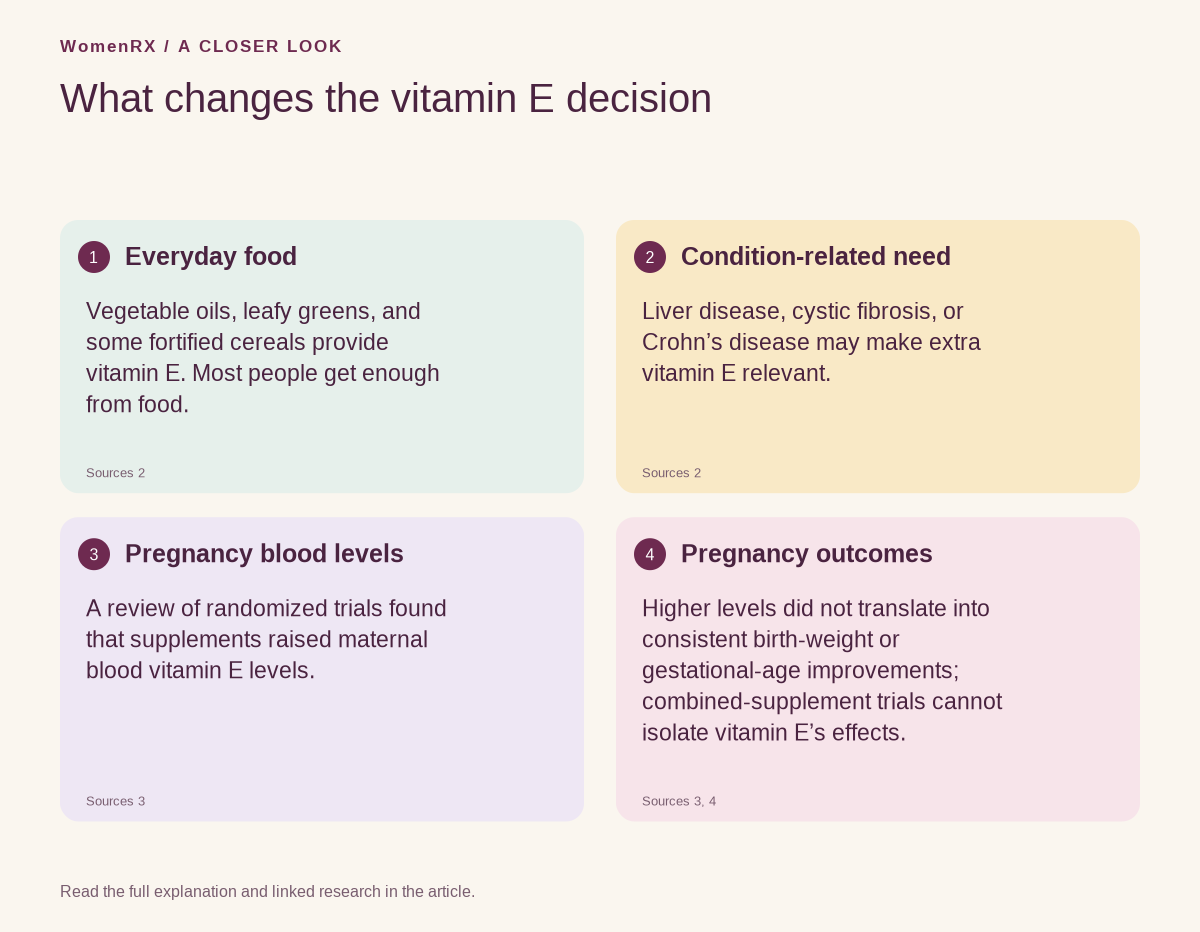
What changes the vitamin E decision
Everyday food: Vegetable oils, leafy greens, and some fortified cereals provide vitamin E. Most people get enough from food.2
Condition-related need: Liver disease, cystic fibrosis, or Crohn’s disease may make extra vitamin E relevant.2
Pregnancy blood levels: A review of randomized trials found that supplements raised maternal blood vitamin E levels.3
Pregnancy outcomes: Higher levels did not translate into consistent birth-weight or gestational-age improvements; combined-supplement trials cannot isolate vitamin E’s effects.34
Read the figure as text
This map separates an established dietary need from situations where a supplement requires a more specific reason.- Everyday food: Vegetable oils, leafy greens, and some fortified cereals provide vitamin E. Most people get enough from food.2
- Condition-related need: Liver disease, cystic fibrosis, or Crohn’s disease may make extra vitamin E relevant.2
- Pregnancy blood levels: A review of randomized trials found that supplements raised maternal blood vitamin E levels.3
- Pregnancy outcomes: Higher levels did not translate into consistent birth-weight or gestational-age improvements; combined-supplement trials cannot isolate vitamin E’s effects.34
More questions, answered
Does vitamin E’s antioxidant role mean a supplement will help my skin or fertility?
No specific skin or fertility benefit follows from its antioxidant role alone. Those claims need studies measuring those outcomes; the pregnancy trials discussed here measured vitamin E levels and pregnancy or newborn outcomes instead. 2 3
Sources you can check
- Dietary Supplements: MedlinePlusAccessed 2026-09-25Return to first citation
- Vitamin E: MedlinePlusAccessed 2026-09-25Return to first citation
- Efficacy of Vitamin E Supplementation During Pregnancy on the Vitamin E Nutritional Status of the Mother-Child Dyad: A Systematic Review and Meta-Analysis of Randomized Controlled Trial.Carneiro BR, de Araújo AC, Sisinano YM, de Oliveira AF, de Rezende AA, da Silva Ribeiro KD. · Food science & nutrition · 2026Return to first citation
- Vitamin E supplementation in pregnancy.Rumbold A, Ota E, Hori H, Miyazaki C, Crowther CA. · The Cochrane database of systematic reviews · 2015Return to first citation