When to Take Vitamin E: Food and Timing
Choose a time that fits your day, but check your product’s food directions before you settle on a routine.
Morning or evening can be a practical choice for a vitamin E supplement. The absorption studies discussed here examine food or formulation, not whether one time of day improves health benefits. Check your product’s directions before deciding whether to take it with food. If you take a blood thinner, check whether the supplement is appropriate before adding it to your routine. 3 5 2
Pick a time, then check the food directions
If breakfast is the one part of your day that rarely changes, morning may be easiest. If dinner is more predictable, evening may work better. The relevant absorption studies compare different preparations or fed and fasted states; they don’t test morning against night. Choose an hour for convenience rather than expecting it to change what the supplement does. 3 5
Before making that choice, read the directions on your particular bottle. If they say to take it with food, build your routine around a meal. If they don’t specify, you don’t need to invent a rule that it must be taken at breakfast or bedtime.
Does vitamin E need a fatty meal?
Vitamin E absorption is connected to fat absorption, but that fact alone doesn’t tell you how every supplement should be taken. People with certain conditions that impair fat absorption can have difficulty getting enough vitamin E; their needs are different from those of someone deciding when to take an ordinary supplement. 1 2
The form of vitamin E also matters when interpreting food studies. In a study of eight healthy men, blood-level measures for tocotrienols were higher after a high-fat meal than when the men were fasting. Tocotrienols are not the alpha-tocopherol supplied by many vitamin E supplements. That study doesn’t establish that every alpha-tocopherol product needs a high-fat meal, and it didn’t test health outcomes. 5 1
In another small study, a particular micellized vitamin E preparation produced higher short-term blood-level measures than the conventional preparations tested. The 14 participants included eight women, but the reported results weren’t separated by sex. This was a comparison of preparations, not a test of breakfast versus dinner or a reason to change a product’s directions. 3
The useful distinction is simple: food, formulation, and clock time are different questions. Follow your product’s food instructions. Don’t assume a study of a different form or preparation answers how yours should be taken.
Make sure the supplement belongs in your routine
The question of whether to take vitamin E comes before the question of when. MedlinePlus cautions that vitamin E supplements may be harmful for people taking blood thinners and other medicines. If you take a blood thinner, check with the clinician or pharmacist who manages it before adding a separate vitamin E supplement. Moving the supplement to another time of day doesn’t answer that safety question. 2
Some medicines can also affect absorption. In a small, open-label study of 17 adolescents taking orlistat and a multivitamin, acute alpha-tocopherol absorption decreased during orlistat treatment, although blood vitamin E levels did not change significantly over the study period. That finding doesn’t establish a timing fix for adults, but it’s a reason to mention orlistat when discussing a vitamin E product with a pharmacist or clinician. 4
If you’re pregnant or breastfeeding, check how a separate vitamin E product fits alongside what you already take, including a prenatal supplement. Pregnancy and lactation have their own vitamin E intake recommendations; neither makes morning or evening the deciding factor. Vitamin E is also found in foods such as nuts, seeds, and vegetable oils. 1
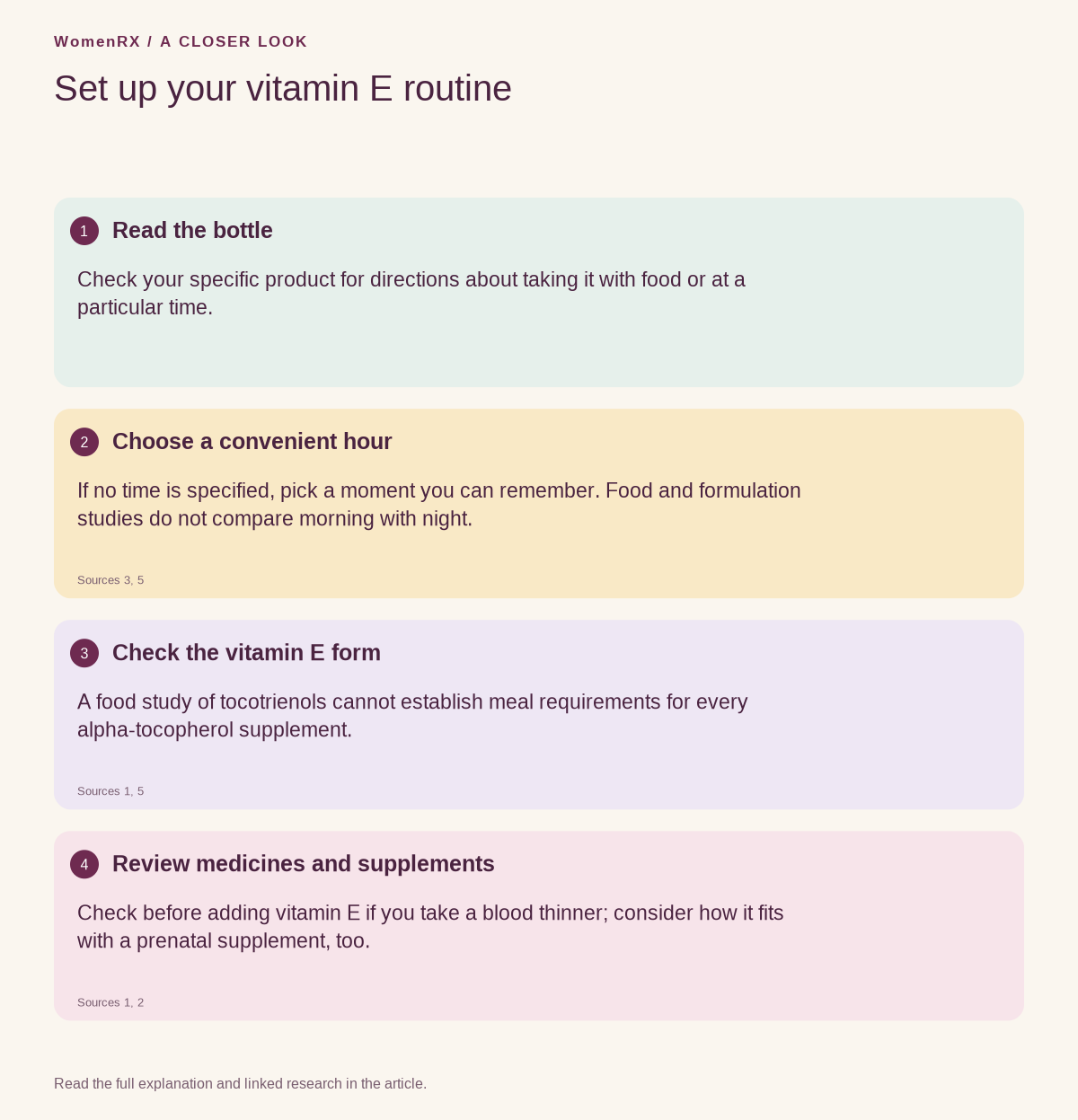
Set up your vitamin E routine
Read the bottle: Check your specific product for directions about taking it with food or at a particular time.
Choose a convenient hour: If no time is specified, pick a moment you can remember. Food and formulation studies do not compare morning with night.35
Check the vitamin E form: A food study of tocotrienols cannot establish meal requirements for every alpha-tocopherol supplement.15
Review medicines and supplements: Check before adding vitamin E if you take a blood thinner; consider how it fits with a prenatal supplement, too.12
Read the figure as text
Use these checks to separate product instructions from questions about timing and supplement suitability.- Read the bottle: Check your specific product for directions about taking it with food or at a particular time.
- Choose a convenient hour: If no time is specified, pick a moment you can remember. Food and formulation studies do not compare morning with night.35
- Check the vitamin E form: A food study of tocotrienols cannot establish meal requirements for every alpha-tocopherol supplement.15
- Review medicines and supplements: Check before adding vitamin E if you take a blood thinner; consider how it fits with a prenatal supplement, too.12
Sources you can check
- Vitamin E - Health Professional Fact SheetAccessed 2026-09-25Return to first citation
- Vitamin E: MedlinePlusAccessed 2026-09-25Return to first citation
- Can changes in hydrophobicity increase the bioavailability of alpha-tocopherol?Back EI, Frindt C, Oćenásková E, Nohr D, Stern M, Biesalski HK. · European journal of nutrition · 2006Return to first citation
- Effects of orlistat on fat-soluble vitamins in obese adolescents.McDuffie JR, Calis KA, Booth SL, Uwaifo GI, Yanovski JA. · Pharmacotherapy · 2002Return to first citation
- Bioavailability of tocotrienols: evidence in human studies.Fu JY, Che HL, Tan DM, Teng KT. · Nutrition & metabolism · 2014Return to first citation