Vitamin E Supplements: What Matters More Than Timing
A meal can help with vitamin E absorption, but your reason for taking a supplement, its dose, and your medicines matter more than the hour.
Most healthy people don’t need a vitamin E supplement. If you do need one, taking it with a meal containing some fat is a practical choice because fat is needed for absorption; the cited research doesn’t establish a morning-versus-evening advantage. Check the dose and your medicines first, especially if you take warfarin or aspirin. 124
First, ask what the supplement is for
Vitamin E is a nutrient you can get from nuts, seeds, vegetable oils, leafy greens, and fortified cereals. Most people get enough from food, and frank deficiency is rare in otherwise healthy people. A condition that interferes with fat absorption is a different situation: the digestive tract needs fat to absorb vitamin E, so some people with such conditions are more likely to become deficient. 12
That distinction is more useful than assuming a capsule offers extra protection. In the HOPE and HOPE-TOO trials, moderately high-dose vitamin E did not reduce serious cardiovascular events in men and women over 50 who had heart disease or diabetes. In a separate trial of healthy women aged 45 and older, 600 IU of natural vitamin E every other day for 10 years did not reduce the risk of developing cancer compared with placebo. Neither result is a reason to take vitamin E for general disease prevention. 1
If you need it, take it with food rather than watching the clock
Vitamin E is fat-soluble. If a supplement has been recommended for you, taking it with a meal that contains some fat is a practical way to support absorption. For example, a meal with nuts or vegetable oil fits that description. The absorption principle doesn’t establish that breakfast works better than dinner, or that taking a supplement with food improves a particular health outcome. 1
A trial involving people with pancreatic-insufficient cystic fibrosis illustrates the limit of the timing evidence. Participants took their study vitamins during meals, but the researchers compared supplement formulations, not meals against an empty stomach or morning against evening. Its findings shouldn’t be used to prescribe a clock time for everyone else. 3
Check the number on the label
Look at how much vitamin E a product provides per serving and whether you’d also get it from a multivitamin. Don’t use a supplement’s upper limit as a target or assume that anything below it is risk-free: analyses of randomized trials have raised safety concerns about large supplemental doses, including some below that limit. One analysis reported an increased risk of death at 400 IU per day; that finding doesn’t tell you your individual risk or establish a precise safe-or-unsafe cutoff. 1
There’s also a bleeding concern, especially when a supplement is combined with medicines that affect clotting. MedlinePlus warns that vitamin E supplements may be harmful for people taking blood thinners, and a clinical review specifically discusses high-dose vitamin E alongside warfarin or aspirin. If you take either, bring the product label and its dose to your pharmacist or prescriber before adding it. Don’t change a prescribed medicine to make room for a supplement. 24
Bleeding risk isn’t based only on a proposed interaction. Two trials reported increased hemorrhagic-stroke risk in men taking vitamin E: one followed Finnish male smokers taking 50 mg daily for an average of six years; the other followed male physicians taking 400 IU of synthetic vitamin E every other day for eight years. These are not estimates of a woman’s personal risk, but they make “more is better” a poor assumption. 1
Pregnancy calls for a separate decision
If you’re pregnant or planning to become pregnant, don’t treat the heart and cancer trials above as evidence that extra vitamin E helps fertility or pregnancy outcomes. A review of treatments for recurrent miscarriage included some studies in which vitamin E was part of a combination of supportive supplements and medicines; it did not isolate vitamin E’s effect. That leaves the benefit of adding vitamin E for that purpose unanswered by those studies. Check what’s already in any prenatal vitamin and discuss the specific reason and amount before adding a separate product. 5
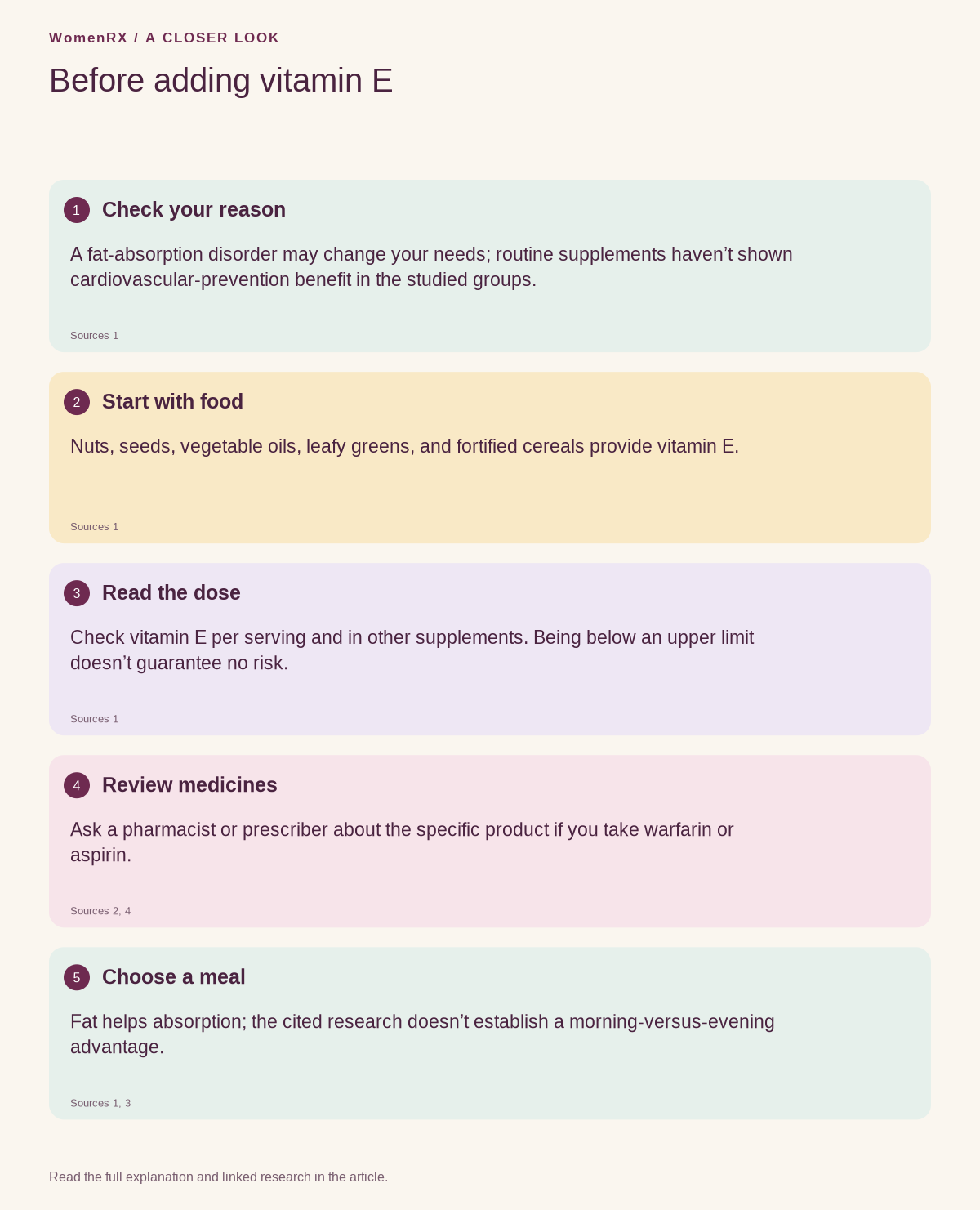
Before adding vitamin E
Check your reason: A fat-absorption disorder may change your needs; routine supplements haven’t shown cardiovascular-prevention benefit in the studied groups.1
Start with food: Nuts, seeds, vegetable oils, leafy greens, and fortified cereals provide vitamin E.1
Read the dose: Check vitamin E per serving and in other supplements. Being below an upper limit doesn’t guarantee no risk.1
Review medicines: Ask a pharmacist or prescriber about the specific product if you take warfarin or aspirin.24
Choose a meal: Fat helps absorption; the cited research doesn’t establish a morning-versus-evening advantage.13
Read the figure as text
Five checks help separate a nutritional need from an unnecessary or potentially risky extra dose.- Check your reason: A fat-absorption disorder may change your needs; routine supplements haven’t shown cardiovascular-prevention benefit in the studied groups.1
- Start with food: Nuts, seeds, vegetable oils, leafy greens, and fortified cereals provide vitamin E.1
- Read the dose: Check vitamin E per serving and in other supplements. Being below an upper limit doesn’t guarantee no risk.1
- Review medicines: Ask a pharmacist or prescriber about the specific product if you take warfarin or aspirin.24
- Choose a meal: Fat helps absorption; the cited research doesn’t establish a morning-versus-evening advantage.13
More questions, answered
Does taking vitamin E with food make a supplement more effective?
Fat is needed to absorb vitamin E, so a meal containing some fat is a practical choice. That absorption point isn’t proof that meal timing improves the health outcome you’re taking it for. 13
Sources you can check
- Vitamin E - Health Professional Fact SheetAccessed 2026-09-25Return to first citation
- Vitamin E: MedlinePlusAccessed 2026-09-25Return to first citation
- Fat-Soluble Vitamin Supplementation Using Liposomes, Cyclodextrins, or Medium-Chain Triglycerides in Cystic Fibrosis: A Randomized Controlled Trial.Nowak JK, Sobkowiak P, Drzymała-Czyż S, Krzyżanowska-Jankowska P, Sapiejka E, Skorupa W, Pogorzelski A, Nowicka A, Wojsyk-Banaszak I, Kurek S, Zielińska-Psuja B, Lisowska A, Walkow... · Nutrients · 2021Return to first citation
- Vitamin E (α-Tocopherol): Emerging Clinical Role and Adverse Risks of Supplementation in Adults.Kaye AD, Thomassen AS, Mashaw SA, MacDonald EM, Waguespack A, Hickey L, Singh A, Gungor D, Kallurkar A, Kaye AM, Shekoohi S, Varrassi G. · Cureus · 2025Return to first citation
- Chinese herbal medicines for unexplained recurrent miscarriage.Li L, Dou L, Leung PC, Chung TK, Wang CC. · The Cochrane database of systematic reviews · 2016Return to first citation