What Vitamin E Supplements Can, and Can’t, Do
Vitamin E matters for health, but taking extra usually isn’t a proven way to prevent heart disease.
Vitamin E is an essential nutrient, and most people get enough from food. Supplements can be useful when a medical condition interferes with absorption or causes a deficiency, but trials haven’t shown that routine supplementation prevents cardiovascular disease. High-dose products can raise bleeding concerns, especially if you take blood thinners, so check the dose and your medications before starting one. 23
Vitamin E has a real job in the body: it acts as an antioxidant and supports immune and metabolic processes. But a nutrient’s biological role doesn’t mean a supplement prevents disease. For most people, the practical question is whether there’s a reason to supplement, such as difficulty absorbing fat or a diagnosed deficiency, rather than whether vitamin E sounds generally protective. 23
Food adequacy is different from treating a deficiency
Most people get enough vitamin E from food. Nuts, seeds, vegetable oils, and leafy greens are useful sources. The adult recommended intake is 15 mg of alpha-tocopherol daily; the recommendation is also 15 mg during pregnancy and 19 mg while breastfeeding. Those are intake targets, not evidence that taking a separate supplement above that amount improves health. 23
Deficiency is rare in healthy people, even when their diets are low in vitamin E. It’s more likely when the body can’t absorb fat normally, as can happen with conditions such as Crohn’s disease, cystic fibrosis, or problems with bile reaching the digestive tract. In those situations, supplementation may be part of treating a specific deficiency, with the form and amount depending on the medical problem. This is different from taking a high-dose product for general prevention. 2
Heart-disease prevention: antioxidant promise, disappointing trial results
Vitamin E’s antioxidant properties helped motivate research into heart protection. But randomized trials are more useful than the theory for answering whether supplements actually prevent heart problems, and the overall results have not supported routine use for that purpose. 2
In the HOPE trial, people over 50 at high cardiovascular risk took 400 IU of natural vitamin E daily or a placebo for 4.5 years. Supplement users did not have fewer cardiovascular events or hospitalizations for heart failure or chest pain. A follow-up found no significant protection against heart attacks, strokes, or cardiovascular deaths after seven years. The study included men and women, but it doesn’t establish benefit for women specifically. 2
A large trial in healthy women aged 45 and older offers a women-specific comparison. Women assigned to 600 IU of natural vitamin E every other day for an average of 10 years had no significant difference in overall cardiovascular events or all-cause mortality compared with women assigned to placebo. The trial did report 24% fewer cardiovascular deaths in the supplement group, but that single result did not change the overall finding: routine supplementation wasn’t shown to prevent cardiovascular disease. 2
So if your goal is heart protection, vitamin E is not a proven substitute for strategies with established roles in cardiovascular prevention. The trial findings don’t rule out every possible benefit for every subgroup, but they don’t support starting a supplement for general heart-disease prevention. 12
Pregnancy and life stages
The recommended intake is 15 mg during pregnancy and 19 mg while breastfeeding. These figures describe nutrient needs; they don’t show that extra vitamin E supplements improve pregnancy or postpartum outcomes. The cardiovascular prevention trials described above do not establish a special benefit for pregnancy, postpartum, cycling years, or menopause. If you’re pregnant or breastfeeding, check whether a product overlaps with nutrients in other supplements you already take rather than assuming more is better. 2
Check the dose and medication picture
High-dose vitamin E supplements raise bleeding concerns. High doses disrupted blood coagulation in animal studies, and two human trials found a higher risk of hemorrhagic stroke in male participants taking vitamin E. Those results don’t tell us the exact risk for every woman or every product, but they’re a reason not to treat a high-dose supplement as harmless. 2
Before taking a product, check:
- The amount: Compare the label with your total intake from other supplements. Vitamin E-only products often provide substantially more than the recommended daily amount. 2
- The form and units: Labels may list milligrams or, on some older labels, international units. Don’t assume different forms and units are interchangeable. 2
- Your medicines: MedlinePlus warns that vitamin E supplements may be harmful with blood thinners and other medicines. Ask a pharmacist or prescriber to check your specific medication list; the warning doesn’t identify every possible interaction. 3
- The reason for taking it: A diagnosed deficiency or an absorption disorder is a different situation from using vitamin E to prevent heart disease. 2
The useful takeaway is simple: get vitamin E through food when you can, and treat supplementation as a response to a specific need, not as a general antioxidant insurance policy. If a clinician has recommended it for a deficiency or a condition that affects absorption, make sure the product and dose fit that reason and your medications. 23
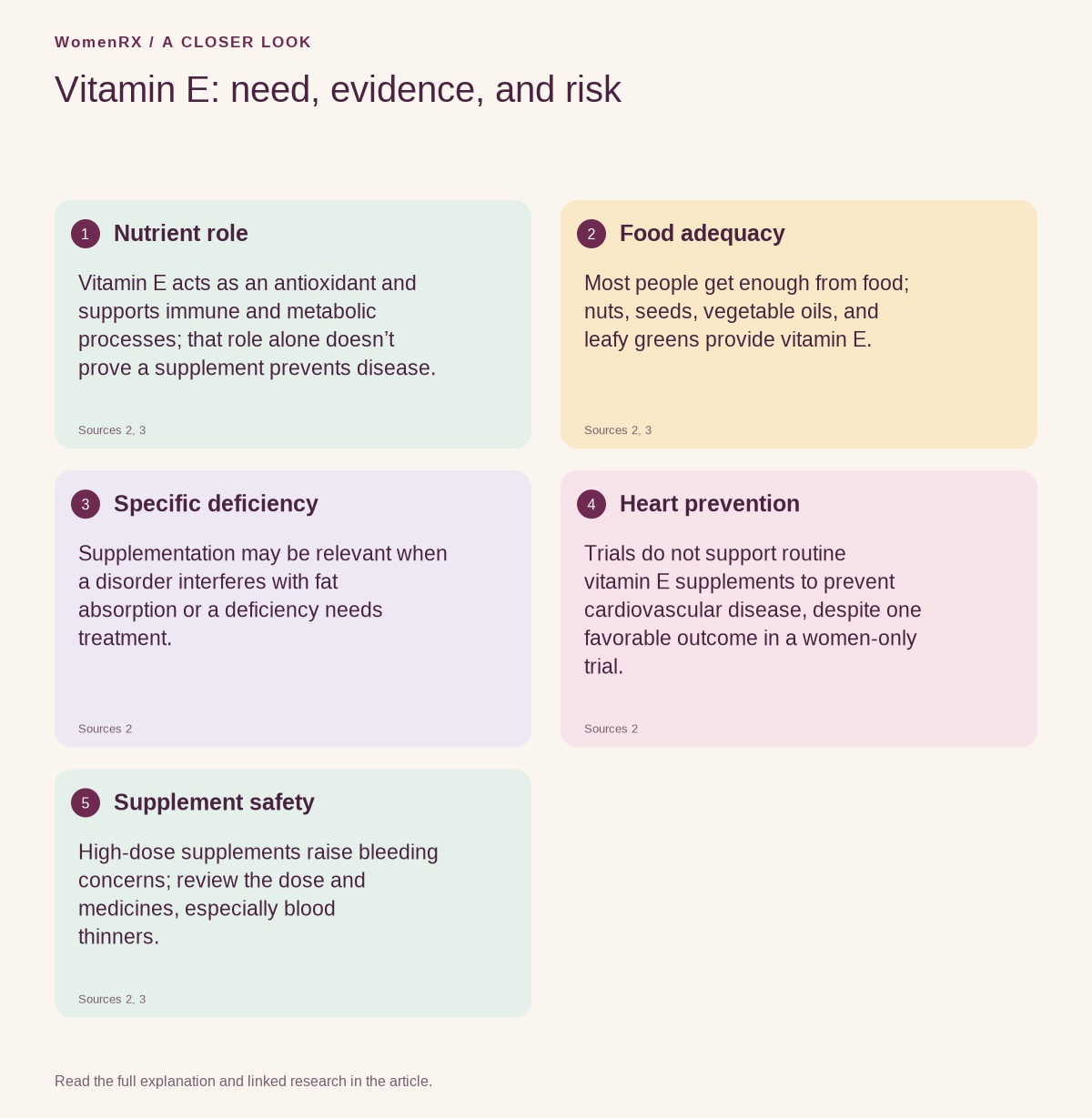
Vitamin E: need, evidence, and risk
Nutrient role: Vitamin E acts as an antioxidant and supports immune and metabolic processes; that role alone doesn’t prove a supplement prevents disease.23
Food adequacy: Most people get enough from food; nuts, seeds, vegetable oils, and leafy greens provide vitamin E.23
Specific deficiency: Supplementation may be relevant when a disorder interferes with fat absorption or a deficiency needs treatment.2
Heart prevention: Trials do not support routine vitamin E supplements to prevent cardiovascular disease, despite one favorable outcome in a women-only trial.2
Supplement safety: High-dose supplements raise bleeding concerns; review the dose and medicines, especially blood thinners.23
Read the figure as text
This evidence map separates the nutrient’s established role from situations where supplements may be relevant and outcomes where routine use has not shown benefit.- Nutrient role: Vitamin E acts as an antioxidant and supports immune and metabolic processes; that role alone doesn’t prove a supplement prevents disease.23
- Food adequacy: Most people get enough from food; nuts, seeds, vegetable oils, and leafy greens provide vitamin E.23
- Specific deficiency: Supplementation may be relevant when a disorder interferes with fat absorption or a deficiency needs treatment.2
- Heart prevention: Trials do not support routine vitamin E supplements to prevent cardiovascular disease, despite one favorable outcome in a women-only trial.2
- Supplement safety: High-dose supplements raise bleeding concerns; review the dose and medicines, especially blood thinners.23
More questions, answered
Can vitamin E from food cause the same bleeding concern?
The NIH Office of Dietary Supplements reports no adverse effects from vitamin E in foods; the bleeding concerns are about high-dose supplements. 2
Does a higher dose mean better protection?
No. In cardiovascular trials, doses well above the recommended intake did not reduce overall cardiovascular events. A larger dose should not be taken as evidence of a larger benefit. 2
Sources you can check
- Cardiovascular disease - NHSAccessed 2026-09-25Return to first citation
- Vitamin E - Health Professional Fact SheetAccessed 2026-09-25Return to first citation
- Vitamin E: MedlinePlusAccessed 2026-09-25Return to first citation