Vitamin E Supplements: What Benefits Have Trials Found?
Vitamin E can correct a true deficiency, but trials of routine supplementation have measured very different outcomes, often without finding a clear health benefit.
There’s no single timeline for vitamin E to “work.” Treating a diagnosed deficiency is different from taking it for hot flashes, pregnancy outcomes, or long-term health. Menopause studies haven’t established a reliable benefit from oral vitamin E alone; pregnancy trials found higher maternal vitamin E levels without a consistent benefit for the birth outcomes assessed. Large prevention trials measured outcomes over years, not weeks. 1347
If you’re wondering how long vitamin E takes to work, start with what you want it to do. A blood level, a hot flash, and the chance of a heart attack are different outcomes. A study that measures one can’t tell you when to expect another.
Deficiency is a different reason to take it
Vitamin E is a nutrient your body needs. A true deficiency is rare in otherwise healthy people, even when their dietary intake is low. It’s more likely when the body has trouble absorbing fat, as can happen with conditions such as Crohn’s disease or cystic fibrosis. Deficiency can affect nerves, muscles, vision, and immune function. In those circumstances, supplemental vitamin E may be part of treating a specific medical problem, sometimes in a form designed for people who have difficulty absorbing fat. 12
That doesn’t mean a high-dose supplement will produce a noticeable benefit if you aren’t deficient. Many vitamin-E-only supplements contain substantially more than the 15 mg daily recommended intake for adults, including during pregnancy. Foods such as sunflower seeds, almonds, and vegetable oils also provide vitamin E. The amount needed to meet a nutrient requirement is not the same question as the amount researchers have tested for a disease or symptom. 1
For menopausal symptoms, the outcome and the form matter
Hot flashes are a practical test of a supplement claim: did women have fewer or less intense episodes than women taking a comparison treatment? A review of studies in postmenopausal women found that vitamin E had been investigated for hot flashes, but concluded that better-quality evidence is needed before its benefit can be settled. Another review reported a reduction in hot-flash intensity with vitamin E combined with omega-3, while either ingredient alone did not show a significant effect in the analysis it described. A combination result can’t tell you that an oral vitamin E capsule works by itself, or give you a dependable week when relief should begin. 34
Vaginal symptoms are a separate question. A review of four small randomized trials tested vaginal vitamin E suppositories, not oral supplements, in healthy postmenopausal women. One eight-week trial found better patient-reported symptoms than placebo; another eight-week trial favored vaginal hyaluronic acid over vitamin E. Two 12-week trials found no detected difference between vaginal vitamin E and vaginal estrogen, but their small size does not establish that the treatments work equally well. These results don’t show that swallowing vitamin E will relieve vaginal dryness. 6
If hot flashes or vaginal discomfort are disrupting your life, the distinction is useful: choose a conversation about the symptom and treatments studied for it, rather than assuming any product labeled vitamin E has the same evidence. 46
Pregnancy trials found a blood-level change, not a clear birth benefit
In a review of six randomized trials involving 3,823 pregnant women, supplementation increased maternal blood levels of alpha-tocopherol, the form of vitamin E used to meet human requirements. The review found no significant effect on gestational age at birth or birth weight. Some trials included vitamin E alongside other micronutrients, and the blood-level results varied substantially across studies. Maternal levels were measured at baseline and postpartum, so these findings don’t establish a particular week when an individual should expect a change. 17
A higher vitamin level is evidence that supplementation affected a measurement. It is not, by itself, evidence that taking extra vitamin E improves a pregnancy outcome. 7
A quick measurement isn’t always a meaningful result
For example, a small trial in 90 women with polycystic ovary syndrome (PCOS) who were receiving a specific fertility-drug regimen measured follicles and uterine lining thickness on cycle days 7 and 12. The group also given vitamin E had favorable changes in those intermediate measurements, but the difference in pregnancy rates was not statistically significant. That is a result about adding vitamin E to that regimen, not evidence that vitamin E alone improves fertility within two weeks. 8
Likewise, a review of supplement trials in postmenopausal women reported a favorable result for vitamin E on CTX, a blood marker of bone breakdown. That marker is not a fracture or a measure of how you feel. The result alone doesn’t establish that vitamin E prevents osteoporosis or broken bones. 5
For disease prevention, trials ran for years
The Women’s Health Study assigned nearly 40,000 initially healthy women aged 45 or older to vitamin E or placebo and followed them for an average of 10 years. It found no significant difference in overall cardiovascular events, all-cause mortality, or the risk of developing any cancer. It did find some favorable cardiovascular results, including for women aged 65 or older, but those findings sit alongside the lack of benefit on the trial’s overall cardiovascular outcome. They aren’t a reason to expect routine supplementation to protect every woman’s heart. 1
Other large trials in adults at high cardiovascular risk also failed to show an overall preventive benefit. Their results can’t be turned into a promise about healthy younger women, but they do challenge the idea that antioxidant activity automatically translates into disease prevention. A separate vitamin-E-containing combination has slowed progression of age-related macular degeneration in people at high risk; because that formula also contained other ingredients, its result is not evidence that vitamin E alone prevents eye disease. 1
Weigh the proposed benefit against the supplement itself
Food sources of vitamin E and high-dose supplements aren’t interchangeable for safety. High supplemental intakes can interfere with clotting, and large doses taken with blood thinners or antiplatelet medicines, including warfarin, can increase bleeding risk. Trials in men have also reported more hemorrhagic strokes with supplemental vitamin E. Those findings do not give a precise risk for every woman or every dose, but they matter when the benefit you’re hoping for is unproven. If you take a medicine that affects bleeding, check the proposed supplement with the clinician managing that medicine before adding it. 1
The most useful question, then, isn’t simply how long should I try it? It’s what result am I expecting to change? Deficiency treatment addresses a known nutritional problem. For hot flashes, vaginal symptoms, pregnancy outcomes, fertility, and disease prevention, the studies ask different questions and offer different levels of confidence. A short trial of a capsule can’t stand in for evidence of a benefit that the relevant studies haven’t established. 14678
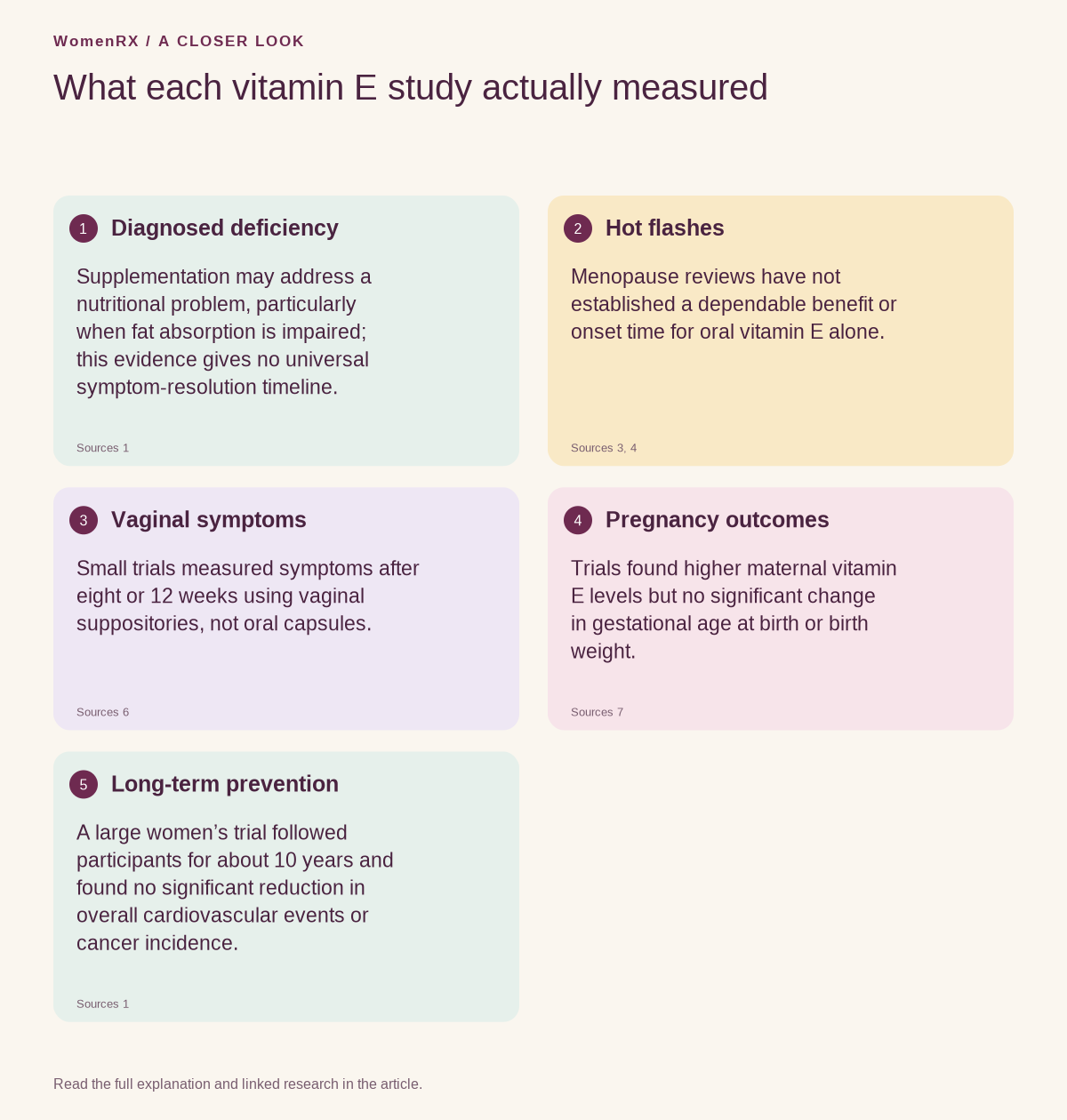
What each vitamin E study actually measured
Diagnosed deficiency: Supplementation may address a nutritional problem, particularly when fat absorption is impaired; this evidence gives no universal symptom-resolution timeline.1
Hot flashes: Menopause reviews have not established a dependable benefit or onset time for oral vitamin E alone.34
Vaginal symptoms: Small trials measured symptoms after eight or 12 weeks using vaginal suppositories, not oral capsules.6
Pregnancy outcomes: Trials found higher maternal vitamin E levels but no significant change in gestational age at birth or birth weight.7
Long-term prevention: A large women’s trial followed participants for about 10 years and found no significant reduction in overall cardiovascular events or cancer incidence.1
Read the figure as text
The time on a study calendar only answers the question that study tested.- Diagnosed deficiency: Supplementation may address a nutritional problem, particularly when fat absorption is impaired; this evidence gives no universal symptom-resolution timeline.1
- Hot flashes: Menopause reviews have not established a dependable benefit or onset time for oral vitamin E alone.34
- Vaginal symptoms: Small trials measured symptoms after eight or 12 weeks using vaginal suppositories, not oral capsules.6
- Pregnancy outcomes: Trials found higher maternal vitamin E levels but no significant change in gestational age at birth or birth weight.7
- Long-term prevention: A large women’s trial followed participants for about 10 years and found no significant reduction in overall cardiovascular events or cancer incidence.1
More questions, answered
Does a higher vitamin E blood level mean the supplement is helping?
It shows a change in vitamin E status, not necessarily a change in how you feel or in a health outcome. Pregnancy trials, for example, found higher maternal alpha-tocopherol levels without a consistent benefit for the birth outcomes assessed. 7
Are vaginal vitamin E and oral supplements supported by the same studies?
No. The small trials reporting results for postmenopausal vaginal symptoms tested vitamin E suppositories placed in the vagina. Their eight- and 12-week findings can’t be applied to oral capsules. 6
Sources you can check
- Vitamin E - Health Professional Fact SheetAccessed 2026-09-25Return to first citation
- Vitamin E: MedlinePlusAccessed 2026-09-25Return to first citation
- Natural strategies to optimize estrogen levels in aging women: mini review.Bolgova O, Shypilova I, Mavrych V. · Frontiers in aging · 2025Return to first citation
- The Effect of Vitamin E Supplementation in Postmenopausal Women-A Systematic Review.Feduniw S, Korczyńska L, Górski K, Zgliczyńska M, Bączkowska M, Byrczak M, Kociuba J, Ali M, Ciebiera M. · Nutrients · 2022Return to first citation
- Effects of dietary supplements on bone turnover markers in women after menopause: a network meta-analysis.Wei Y, Lei C, Zhong Y, Shen H. · PeerJ · 2025Return to first citation
- Vaginal Vitamin E for Treatment of Genitourinary Syndrome of Menopause: A Systematic Review of Randomized Controlled Trials.Porterfield L, Wur N, Delgado ZS, Syed F, Song A, Weller SC. · Journal of menopausal medicine · 2022Return to first citation
- Efficacy of Vitamin E Supplementation During Pregnancy on the Vitamin E Nutritional Status of the Mother-Child Dyad: A Systematic Review and Meta-Analysis of Randomized Controlled Trial.Carneiro BR, de Araújo AC, Sisinano YM, de Oliveira AF, de Rezende AA, da Silva Ribeiro KD. · Food science & nutrition · 2026Return to first citation
- Comparing Ovulation Outcomes of Letrozole-Tamoxifen-Estradiolwith and without Vitamin E in Infertile Women with PolycysticOvary Syndrome: A Double-Blind, Randomized Clinical Trial.Rasekh Jahromi A, Sharifi N, Karimi Javad M, Rahmanian V. · International journal of fertility & sterility · 2026Return to first citation