Vitamin E Supplements and Bleeding: What to Check
Food sources and concentrated vitamin E capsules aren’t interchangeable, especially when you take medicine that affects clotting or have a procedure coming up.
Vitamin E in food is different from a high-dose capsule. Before adding a supplement, check how much vitamin E is already in your multivitamin and other products, and review the total with a pharmacist or prescriber if you take a blood thinner or another medicine that affects clotting. Tell your procedure team what you take and ask whether they want you to make a change. 1 2
Start with the label, not the bottle name
“Vitamin E” can mean the amount in a meal, a multivitamin, or a concentrated standalone supplement. Those aren’t equivalent. For adults, the recommended dietary allowance is 15 mg of alpha-tocopherol a day; it’s also 15 mg during pregnancy and 19 mg while breastfeeding. These are daily intake recommendations, not instructions to take a supplement. 1
Many vitamin-E-only supplements provide at least 67 mg, substantially more than the adult RDA. A multivitamin or another combination product may add more. Check the Supplement Facts panels and add the listed vitamin E amounts so you can see the total from supplements and fortified products. The adult upper limit is 1,000 mg a day from these sources, but that’s a safety ceiling, not a target or assurance that a high dose is useful or right for you. 1
Vitamin E in foods such as nuts, seeds, vegetable oils, and leafy greens is a separate consideration. The NIH reference reports no adverse effects from vitamin E consumed in food; that shouldn’t be taken as proof that concentrated capsules have the same risk profile. 1
If a medicine affects clotting
Laboratory and animal findings raise a possible bleeding-related concern, but they don’t establish that the same effects occur in people: high-dose alpha-tocopherol has caused hemorrhage and disrupted coagulation in animals, and in-vitro findings suggest it can inhibit platelet aggregation. In human studies, the clearest bleeding-related signals summarized by NIH were increased hemorrhagic-stroke risk in male participants. 1
MedlinePlus cautions that vitamin E supplements may be harmful for people taking blood thinners and other medicines. The practical question is not only “Do I take a blood thinner?” but also “How much vitamin E am I getting across all my products, and does it matter alongside my medicines?” Ask a pharmacist or prescriber to review the actual labels and medication list before you start or continue a high-dose product. 2
The human evidence doesn’t mean every supplement dose causes bleeding. In two trials cited by the NIH, increased hemorrhagic stroke risk appeared in male participants: Finnish male smokers taking 50 mg daily for an average of six years, and male physicians taking 400 IU of synthetic vitamin E every other day for eight years. These findings raise a safety concern, but they don’t establish the size of the risk for women or for every dose and medicine combination. 1
Before a procedure, disclose it rather than guessing
One small study offers some context but not a universal rule. Forty healthy volunteers completed a study in which they took 800 IU of synthetic vitamin E daily for 14 days; researchers found no significant changes in the measured platelet aggregation, coagulation, or simulated bleeding-time results. Participants had avoided antiplatelet agents before the study, so it doesn’t answer what happens for someone taking clotting-related medicine or facing a particular operation. 3
Tell the team planning your procedure that you take vitamin E, including the amount and whether it’s part of a multivitamin or combination supplement. Ask whether they want you to change anything and when. Don’t assume the small volunteer study proves that continuing is safe for your situation, or that everyone must stop on the same schedule.
Pregnancy, breastfeeding, and the final decision
The recommended intake stays at 15 mg a day during pregnancy and rises to 19 mg while breastfeeding. These figures don’t by themselves show that an extra vitamin E capsule improves fertility or pregnancy outcomes. If you use a prenatal or multivitamin, check its label before adding standalone vitamin E so you can avoid an unnecessary overlap. 1
A useful review is brief: note the vitamin E amount on each product, include any medicines that affect clotting, and mention any upcoming procedure. If a clinician recommended vitamin E for a specific reason, include that reason in the review rather than stopping or adding it based on the label alone.
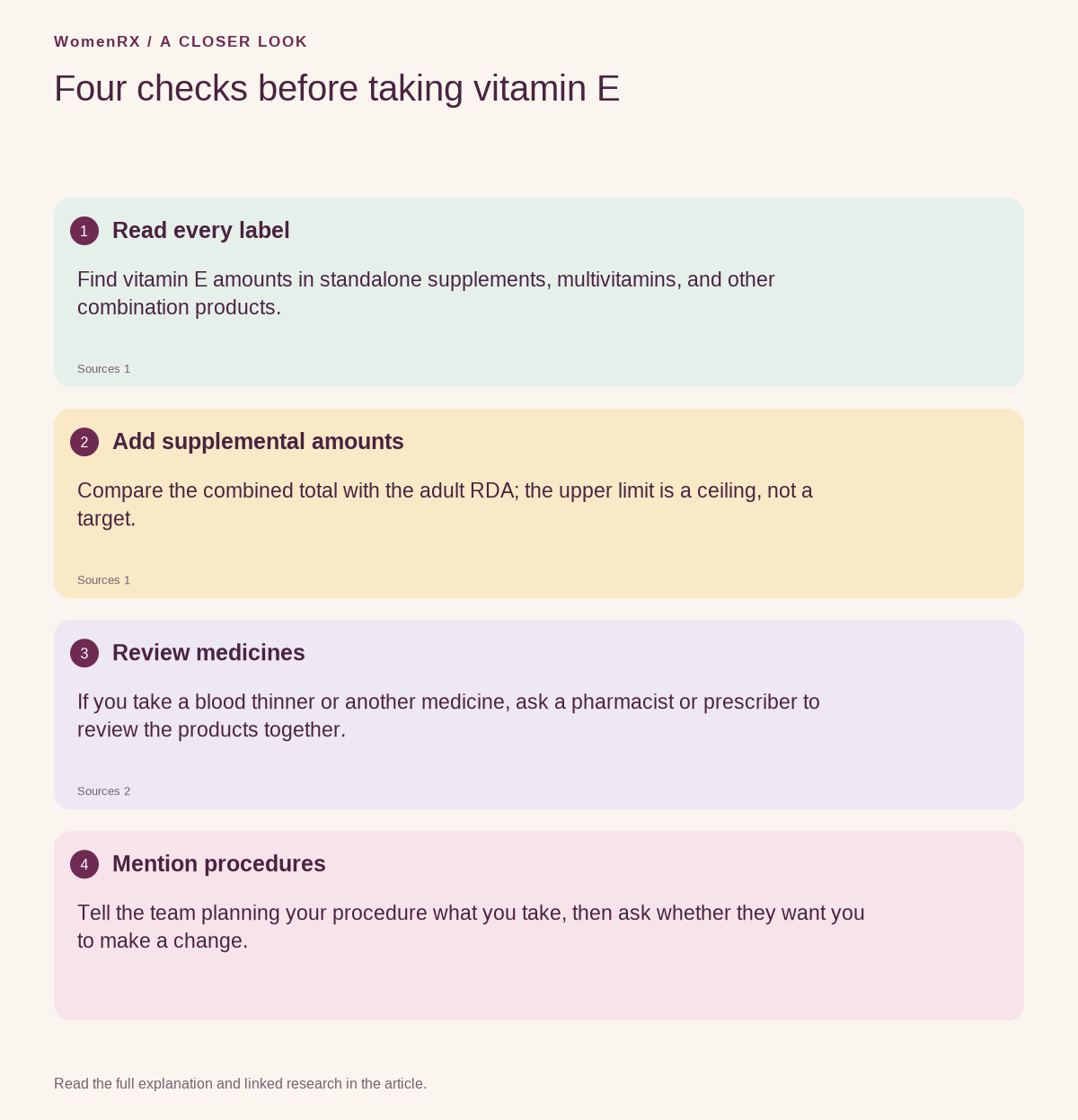
Four checks before taking vitamin E
Read every label: Find vitamin E amounts in standalone supplements, multivitamins, and other combination products.1
Add supplemental amounts: Compare the combined total with the adult RDA; the upper limit is a ceiling, not a target.1
Review medicines: If you take a blood thinner or another medicine, ask a pharmacist or prescriber to review the products together.2
Mention procedures: Tell the team planning your procedure what you take, then ask whether they want you to make a change.
Read the figure as text
Use these checks to separate food intake from supplemental amounts and flag situations where a product review matters.- Read every label: Find vitamin E amounts in standalone supplements, multivitamins, and other combination products.1
- Add supplemental amounts: Compare the combined total with the adult RDA; the upper limit is a ceiling, not a target.1
- Review medicines: If you take a blood thinner or another medicine, ask a pharmacist or prescriber to review the products together.2
- Mention procedures: Tell the team planning your procedure what you take, then ask whether they want you to make a change.
More questions, answered
Does the upper limit mean a high-dose supplement is safe for me?
No. The adult upper limit of 1,000 mg per day is a ceiling for intake from supplements and fortified foods, not a recommended dose. NIH notes that long-term intake above the limit increases the risk of adverse effects, and bleeding-related concerns have also been raised at doses below it. 1
Should I count vitamin E in my multivitamin?
Yes. Check the vitamin E amount on your multivitamin and any other supplements or fortified products, then consider the combined amount. Standalone vitamin E products can provide substantially more than the adult RDA. 1
Sources you can check
- Vitamin E - Health Professional Fact SheetAccessed 2026-09-25Return to first citation
- Vitamin E: MedlinePlusAccessed 2026-09-25Return to first citation
- Short-term, moderate dosage Vitamin E supplementation may have no effect on platelet aggregation, coagulation profile, and bleeding time in healthy individuals.Dereska NH, McLemore EC, Tessier DJ, Bash DS, Brophy CM. · The Journal of surgical research · 2006Return to first citation