Vitamin E Supplements: Read the Dose Before You Buy
Your vitamin E requirement is not the same as a supplement dose, and a high-dose capsule isn’t automatically a better choice.
For people aged 14 and older, the recommended vitamin E intake is 15 mg a day, rising to 19 mg while breastfeeding; these are total-intake targets, not instructions to take that much as a supplement. Many vitamin E-only products contain far more. Check the amount and form on the label, add up other supplements, and ask a pharmacist or clinician about high doses, especially if you take a blood thinner or are pregnant or breastfeeding. 12
Vitamin E is essential, but that doesn’t mean everyone needs a separate pill. For most people, food provides it; supplements are worth considering when there’s a specific reason, not simply because a product promises antioxidant benefits. The useful first step is to separate three numbers that are easy to confuse: the recommended intake, the amount in a bottle, and the upper limit.
Three numbers that mean different things
For people aged 14 and older, the recommended dietary allowance (RDA) is 15 mg of alpha-tocopherol per day. It refers to total intake from food and supplements, not a recommended supplement serving. During pregnancy the RDA remains 15 mg; during breastfeeding it is 19 mg. 1
The upper limit (UL) is different: it’s the maximum daily amount of supplemental alpha-tocopherol unlikely to cause harm, not a target or a suggested dose. For adults 19 and older, that limit is 1,000 mg per day. Vitamin E from food counts toward the RDA, but the UL applies to supplemental alpha-tocopherol, not vitamin E naturally present in food. The figure should not be read as proof that taking anything below it is risk-free. The Office of Dietary Supplements notes that evidence on very high intakes is limited, and research has raised safety concerns at doses lower than the UL. 1
Why might a supplement label show an amount far above 15 mg? Many vitamin E-only supplements provide 67 mg or more, substantially above the RDA. The amount in a capsule also isn’t a direct measure of whether you need one or whether it will help with a particular health goal. 1
Read the unit and the form
Current U.S. Supplement Facts labels list vitamin E in milligrams (mg). Some older labels use International Units (IU), so check which unit you’re reading before comparing products. IU-to-mg conversion depends on the form: 1 IU of natural vitamin E is 0.67 mg, while 1 IU of synthetic vitamin E is 0.45 mg. 1
The form may be listed as d-alpha-tocopherol (natural) or dl-alpha-tocopherol (synthetic). The same weight in milligrams of the synthetic form is not equivalent to the same weight of the natural form in the body. If the label is confusing, take a photo of it and ask a pharmacist to help compare it with your other supplements. 1
Start with the reason, not the promise
Nuts, seeds, vegetable oils, and leafy greens provide vitamin E. For example, an ounce of almonds provides 6.8 mg, and an ounce of dry-roasted sunflower seeds provides 7.4 mg. 1 If your goal is simply to meet your nutritional needs, looking at your usual diet may be more useful than adding a high-dose capsule.
There are situations where extra vitamin E may be needed. MedlinePlus notes that people with certain conditions, including liver disease, cystic fibrosis, or Crohn’s disease, may need more. That’s a reason to get individualized guidance about the amount and form, rather than choosing a dose based on a general supplement label. 2
For broad disease prevention, the evidence doesn’t support assuming that more vitamin E helps. In a large trial of women aged 45 and older, vitamin E supplements did not significantly change overall cardiovascular events or all-cause mortality. The NIH Office of Dietary Supplements concludes that trials generally have not shown routine supplementation to prevent cardiovascular disease. 1
Pregnancy and breastfeeding call for a closer look
The pregnancy RDA is 15 mg a day, while the breastfeeding RDA is 19 mg. Those figures describe total intake, not an amount to add on top of a prenatal or other supplement. Check the vitamin E listed on each product so you can see the combined amount, then discuss any extra supplement with your prenatal care team. 1
A systematic review of six randomized trials in pregnant women found that supplementation increased maternal vitamin E levels but did not significantly affect gestational age at birth or birth weight. The studies were heterogeneous, so those results don’t establish a reason for routine extra vitamin E in pregnancy. 3
Do a safety check before taking it
High-dose vitamin E supplements can affect blood clotting. MedlinePlus warns that supplements may be harmful for people taking blood thinners, and research has linked supplementation to increased risk of hemorrhagic stroke in some study populations. These findings don’t tell us the risk for every individual, but they make it sensible to check before starting a high-dose product, especially if you take a medicine that affects clotting. 12
Before buying or adding a product, check the amount per serving, whether the label uses mg or IU, the form of vitamin E, and the total across your supplements. Then ask: What is the reason I’m taking this? Is this amount meant to correct a documented need, or is it far above the daily requirement? Could it interact with a medicine I take? If you’re pregnant or breastfeeding, include your prenatal or postpartum supplements in that check.
Food sources haven’t been found to cause the same adverse effects described for excessive supplemental vitamin E. The practical distinction is not “vitamin E is unsafe,” but that a concentrated supplement can deliver much more than you need, with risks that deserve a closer look. 1
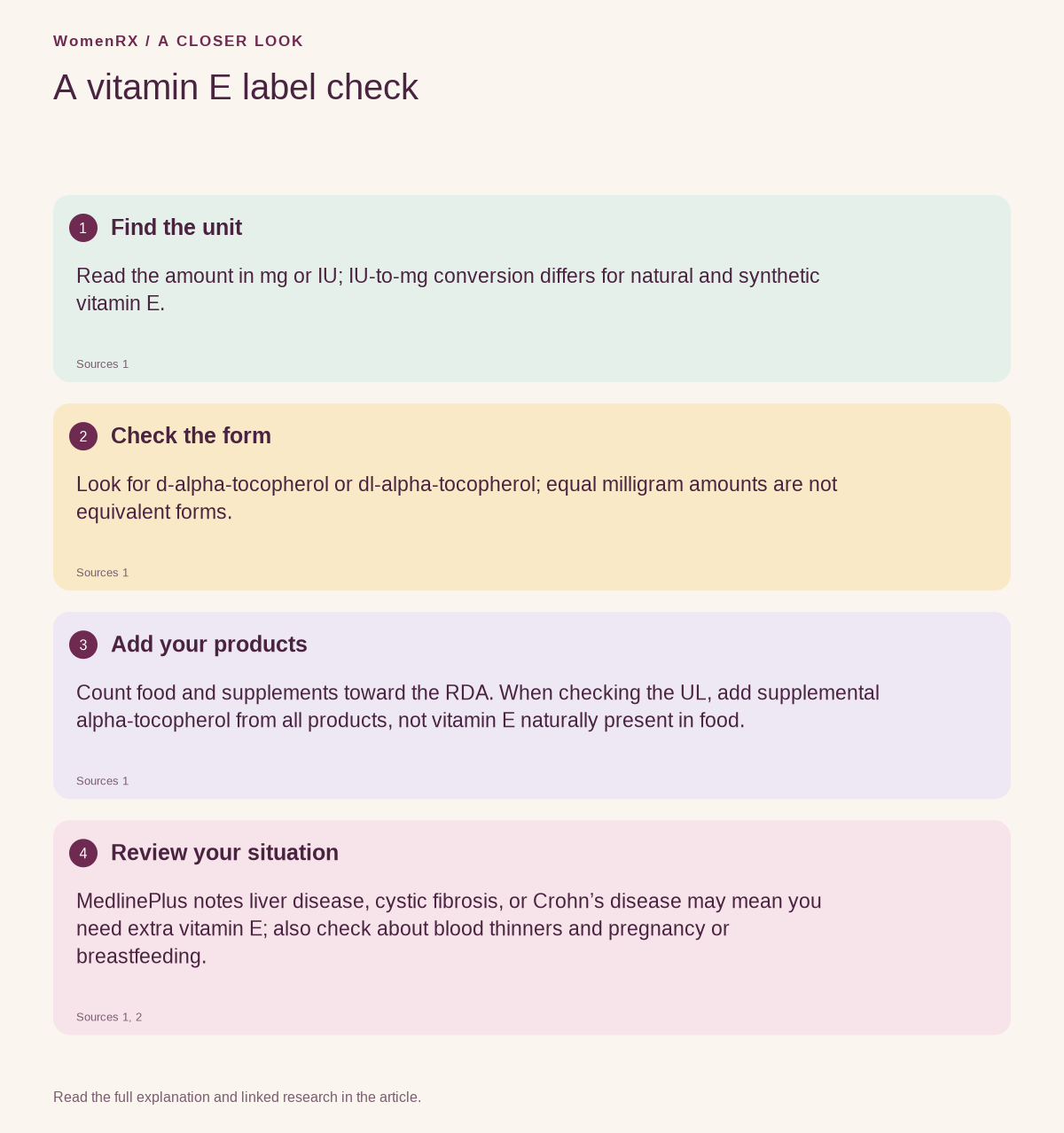
A vitamin E label check
Find the unit: Read the amount in mg or IU; IU-to-mg conversion differs for natural and synthetic vitamin E.1
Check the form: Look for d-alpha-tocopherol or dl-alpha-tocopherol; equal milligram amounts are not equivalent forms.1
Add your products: Count food and supplements toward the RDA. When checking the UL, add supplemental alpha-tocopherol from all products, not vitamin E naturally present in food.1
Review your situation: MedlinePlus notes liver disease, cystic fibrosis, or Crohn’s disease may mean you need extra vitamin E; also check about blood thinners and pregnancy or breastfeeding.12
Read the figure as text
Use these checks to understand what a bottle says and whether you need a closer look before taking it.- Find the unit: Read the amount in mg or IU; IU-to-mg conversion differs for natural and synthetic vitamin E.1
- Check the form: Look for d-alpha-tocopherol or dl-alpha-tocopherol; equal milligram amounts are not equivalent forms.1
- Add your products: Count food and supplements toward the RDA. When checking the UL, add supplemental alpha-tocopherol from all products, not vitamin E naturally present in food.1
- Review your situation: MedlinePlus notes liver disease, cystic fibrosis, or Crohn’s disease may mean you need extra vitamin E; also check about blood thinners and pregnancy or breastfeeding.12
More questions, answered
Does 100% Daily Value mean I need a supplement?
No. The Daily Value is a label reference for comparing products, while the RDA is a recommended total daily intake for a life stage. Getting vitamin E from food counts toward your intake too. 1
Should I take vitamin E with a blood thinner?
Check with your prescriber or pharmacist before starting a vitamin E supplement. MedlinePlus warns that supplements may be harmful with blood thinners, and high supplemental intakes can affect clotting. 12
Sources you can check
- Vitamin E - Health Professional Fact SheetAccessed 2026-09-25Return to first citation
- Vitamin E: MedlinePlusAccessed 2026-09-25Return to first citation
- Efficacy of Vitamin E Supplementation During Pregnancy on the Vitamin E Nutritional Status of the Mother-Child Dyad: A Systematic Review and Meta-Analysis of Randomized Controlled Trial.Carneiro BR, de Araújo AC, Sisinano YM, de Oliveira AF, de Rezende AA, da Silva Ribeiro KD. · Food science & nutrition · 2026Return to first citation