Resveratrol Supplements: How to Read the Dose and Risks
A dose used in one study is a research detail, not a proven target for your health goal or a guarantee of long-term safety.
A review of trials in older adults says the optimal resveratrol dose still needs study. An uncontrolled knee osteoarthritis study used 500 mg daily for 90 days, but can’t establish a dose for other goals. Compare the product’s ingredient and amount with research on your goal, and review medication and pregnancy-related questions before starting. 3 4
Start with the goal, not the bottle
Resveratrol products are easier to assess when you begin with the reason you’re considering one. Evidence about one outcome doesn’t establish a benefit for another. A systematic review of trials in older adults found mixed results across health conditions: some outcomes appeared to improve in certain groups, while resveratrol wasn’t more effective than placebo in studies of older adults with diabetes or peripheral artery disease. The review also said that the best dose, long-term effects, and medication interactions still need study. 3
That means a product labeled “resveratrol” isn’t automatically a match for your goal. Ask what outcome the research measured, who took part, and whether the product’s form and dose resemble what was studied. If the evidence concerns a different group or condition, treat it as background, not proof that the product will help you.
What a studied dose can, and can’t, tell you
A pilot study in people with mild-to-moderate knee osteoarthritis used a specially prepared capsule containing 500 mg of resveratrol once daily for 90 days. The study described the ingredient as trans-resveratrol natural pure powder of at least 98% purity, sourced from Polygonum cuspidatum. It was open-label and had no control group, so it can describe what those participants took, but it can’t reliably establish that resveratrol caused the reported changes or that the dose is right for someone else. 4
When comparing that study with a label, check the serving size and the amount of resveratrol per serving. Note the named form or ingredient, too. Matching the ingredient name alone doesn’t establish that a retail product is equivalent to the study preparation. The study’s dose is a comparison point, not a recommendation, and it doesn’t show that taking that amount for longer is safe. 4
Read the label as a set of details
Before deciding whether a product resembles research, write down:
- The amount per serving and how many capsules make a serving.
- The specific resveratrol ingredient or form named on the label.
- Any other active ingredients in the product.
- The health outcome you want to address, and whether the research actually studied it.
If you can’t tell how much resveratrol you’d get from the serving you plan to take, or the product’s ingredients don’t line up clearly with the study you’re using for comparison, the dose match is uncertain. There’s no need to treat a larger number on the label as a better choice.
Make medication and life-stage questions specific
The review of older-adult trials identifies potential medication interactions as an area needing further study; it doesn’t establish a definitive interaction list. Bring the full product label and a list of your medicines and supplements to a pharmacist or prescriber, and ask about your particular combination rather than relying on a generic interaction list. 3
If you’re pregnant, check before adding a supplement: MedlinePlus advises pregnant people to discuss herbs and supplements with a healthcare provider before taking them. 2 If you’re breastfeeding, don’t assume findings from adult trials establish safety for a nursing baby; ask about resveratrol specifically. The adult trial review doesn’t resolve this question. 1 3
A practical bottom line: if the product’s goal, ingredient, dose, and safety context don’t line up clearly, pause rather than treating a study dose as a personal target.
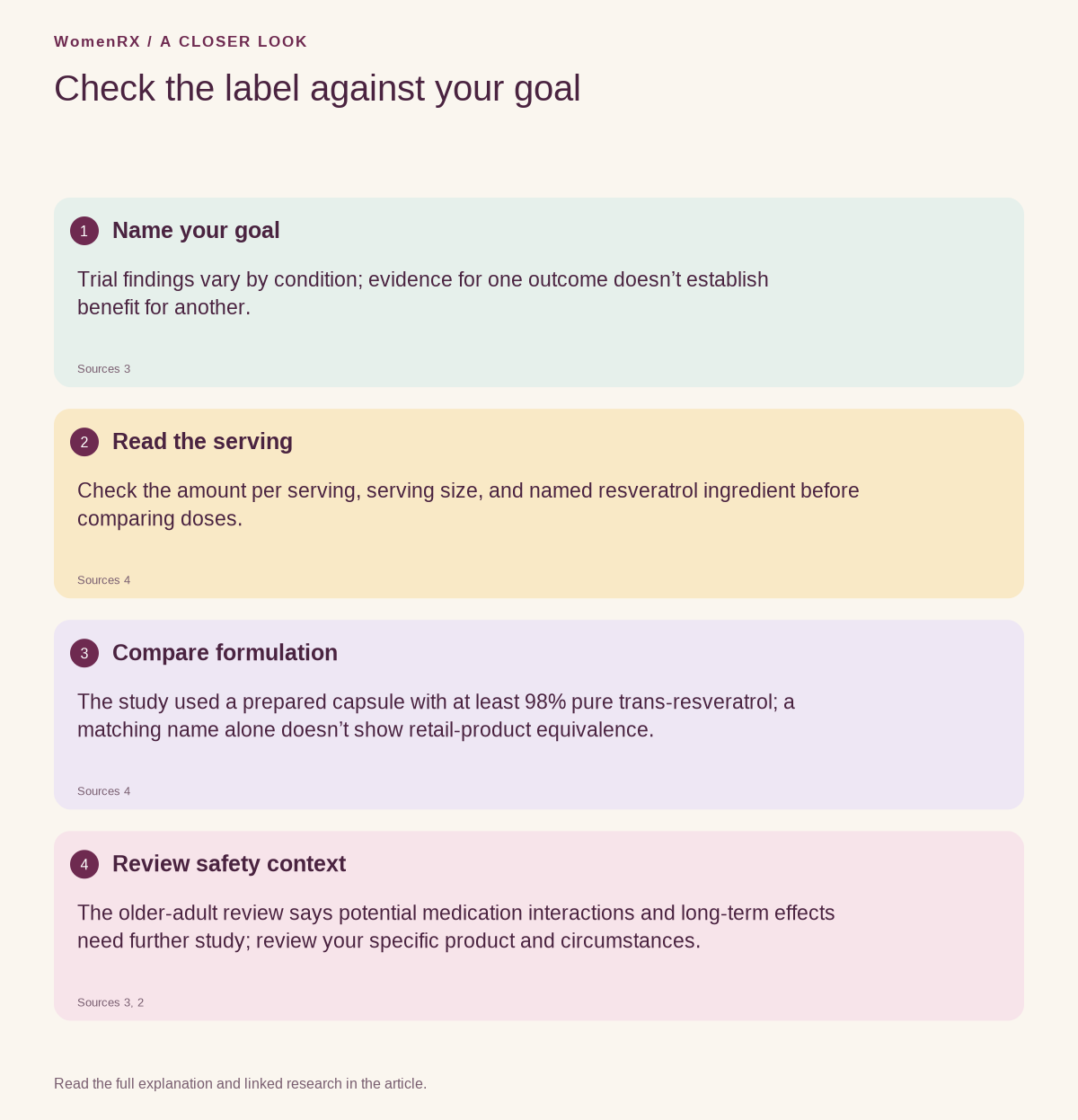
Check the label against your goal
Name your goal: Trial findings vary by condition; evidence for one outcome doesn’t establish benefit for another.3
Read the serving: Check the amount per serving, serving size, and named resveratrol ingredient before comparing doses.4
Compare formulation: The study used a prepared capsule with at least 98% pure trans-resveratrol; a matching name alone doesn’t show retail-product equivalence.4
Review safety context: The older-adult review says potential medication interactions and long-term effects need further study; review your specific product and circumstances.32
Read the figure as text
Use these distinctions to see whether a product resembles research and what remains uncertain before you decide.- Name your goal: Trial findings vary by condition; evidence for one outcome doesn’t establish benefit for another.3
- Read the serving: Check the amount per serving, serving size, and named resveratrol ingredient before comparing doses.4
- Compare formulation: The study used a prepared capsule with at least 98% pure trans-resveratrol; a matching name alone doesn’t show retail-product equivalence.4
- Review safety context: The older-adult review says potential medication interactions and long-term effects need further study; review your specific product and circumstances.32
More questions, answered
Does a dose used in a study mean the product is safe long term?
No. A study’s dose and duration describe what researchers tested in that particular group. The review of older-adult trials says long-term effects and optimal dosage still need investigation. 3
Can I use resveratrol with my current medicines?
The review of older-adult trials identifies potential medication interactions as an area needing further study; it doesn’t establish a definitive interaction list. Have a pharmacist or prescriber review the specific product alongside your medicines and supplements. 3
Sources you can check
- Breastfeeding | Benefits of Breastfeeding | MedlinePlusAccessed 2026-09-25Return to first citation
- Pregnancy and Medicines | MedlinePlusAccessed 2026-09-25Return to first citation
- Effects and safety of resveratrol supplementation in older adults: A comprehensive systematic review.Yadegar S, Mohammadi F, Yadegar A, Mohammadi Naeini A, Ayati A, Milan N, Tayebi A, Seyedi SA, Nabipoorashrafi SA, Rabizadeh S, Esteghamati A, Nakhjavani M. · Phytotherapy research : PTR · 2024Return to first citation
- Effect of Resveratrol on Serum Levels of Type II Collagen and Aggrecan in Patients with Knee Osteoarthritis: A Pilot Clinical Study.Marouf BH. · BioMed research international · 2021Return to first citation