Holy Basil Supplements: How to Read the Dose and Risks
A holy basil dose only makes sense alongside the plant part, preparation, and product details behind it.
There’s no single holy basil dose that can be treated as established for every supplement. Human studies have used different forms, including leaf powder and extracts, and the research review says dose and form still need clarification. Treat a study dose as information about that specific preparation, not as a recommendation for your product. Pregnancy, breastfeeding, fertility questions, and medicines that affect blood sugar or blood pressure deserve a separate review. 2
Why the number on the front isn’t enough
A label might show milligrams per capsule, but that number alone doesn’t tell you whether the product matches a preparation studied in people. Holy basil, also called tulsi, has been taken as leaf powder, fresh juice, aqueous preparations, and extracts. Those forms aren’t interchangeable by weight. The human research review specifically called for more work to clarify dose and dose form. 2
For example, the review describes a four-week study of 300 mg per day of an ethanolic tulsi preparation in healthy adults, and a separate 12-week study using 2 g per day of leaf powder in 90 male adults with diabetes or metabolic syndrome. These were different preparations and study settings. Neither amount establishes a general dose for other products or proves that taking the same number of milligrams from a different extract will have the same effect. 2
The review identified 24 human studies, but only eight included a placebo group. Most studied people with particular health conditions, and just three reported effects in healthy participants. Those details matter: findings from a limited study group or one product don’t automatically answer what’s appropriate for you. 2
Read the product details, not just the serving size
Before choosing or continuing a supplement, check the full label for:
- Plant identity: Look for Ocimum tenuiflorum or Ocimum sanctum. The review describes Ocimum gratissimum as a distinct species, even though tulsi has sometimes been used as a broad term for different plants. 2
- Plant part and form: Is it leaf powder, a leaf extract, or another preparation? A dose in grams of leaf powder can’t be directly compared with milligrams of an extract.
- Extract information: Note any extraction method or standardization details shown. If the label doesn’t explain what the extract represents, the dose is harder to compare with a study.
- Amount per serving: Check how much is in one serving and how many servings the label describes per day. Don’t adopt a study’s amount as a personal target.
- Other ingredients: A blend makes it harder to tell which ingredient is responsible for an effect or a side effect. Bring the full ingredient list if you want a medicine or condition review.
These checks help you describe what’s in the bottle. They don’t verify product quality or establish that the supplement is effective.
When medicine review is especially useful
Some human studies reported changes in blood sugar or blood pressure, but the review does not establish that holy basil interacts with particular medicines. If you take medication for blood sugar or blood pressure, ask a pharmacist or clinician to review the exact product before adding it. That’s a sensible precaution based on the outcomes studied, not proof of a specific interaction. 2
The review reported no significant adverse events in the included studies. That’s reassuring as far as it goes, but it doesn’t prove long-term safety: the studies used varied preparations and reported safety unevenly. Don’t read “no significant adverse events reported” as a guarantee that a supplement is safe for every person or alongside every medicine. 2
Pregnancy, breastfeeding, and fertility
The human review doesn’t establish whether holy basil is safe during pregnancy or breastfeeding, or what it might mean for fertility. If you’re pregnant, breastfeeding, or trying to conceive, don’t use a dose from an unrelated study as a safety guide. Bring the product label to a clinician or pharmacist and ask about your specific situation. 2
A study of holy basil extracts in rats with experimentally induced PCOS cannot answer whether a supplement is safe or useful for people with PCOS or fertility concerns. Animal findings are not a human dose or treatment recommendation. 1
A practical next step
Take a photo of the front and back labels, including the ingredient panel and serving directions. If you use prescription medicines or have a health condition that could be affected by blood sugar or blood pressure changes, share those details with a pharmacist or clinician. If the plant form or extract details are unclear, say so; the missing label information itself makes comparison with research difficult.
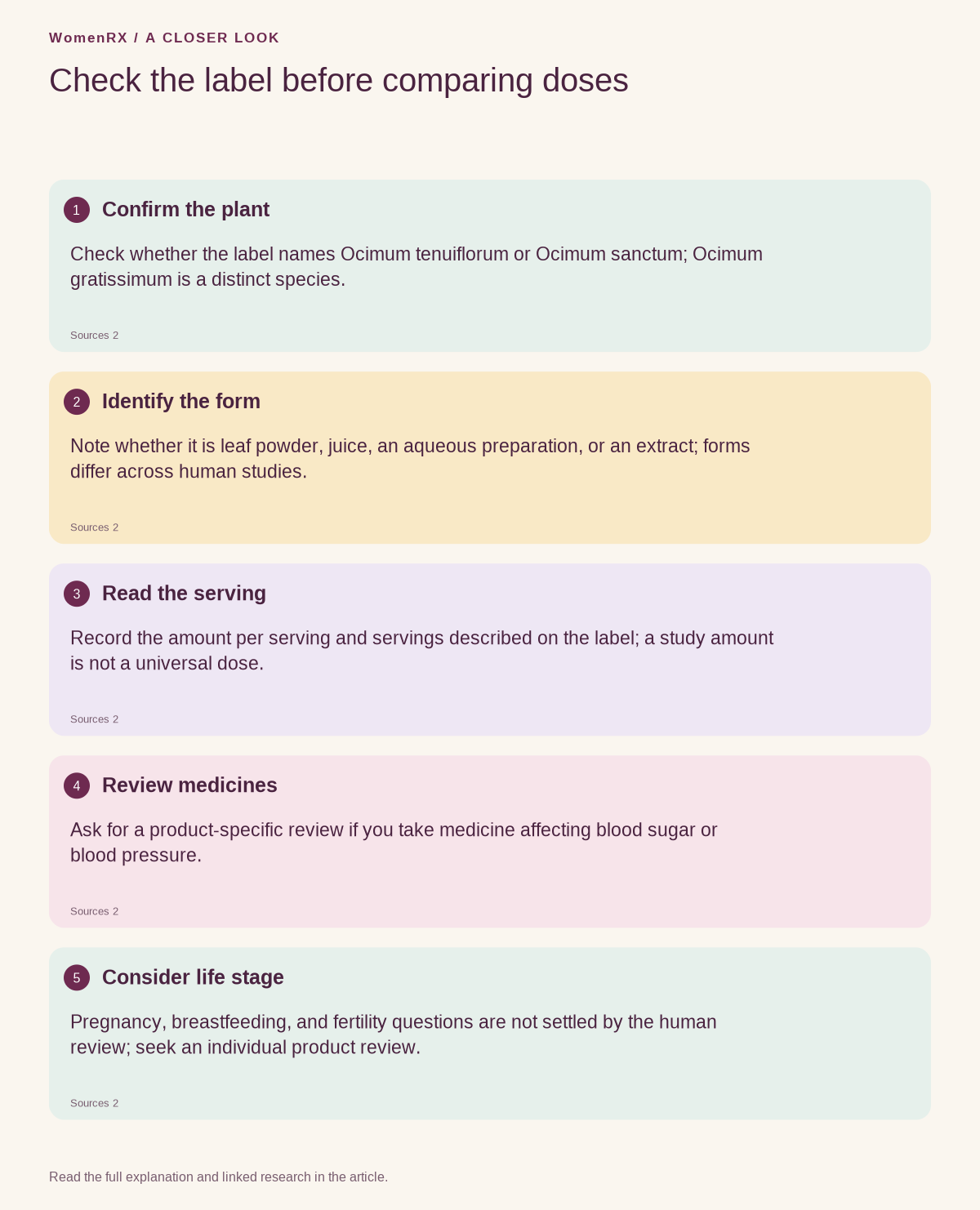
Check the label before comparing doses
Confirm the plant: Check whether the label names Ocimum tenuiflorum or Ocimum sanctum; Ocimum gratissimum is a distinct species.2
Identify the form: Note whether it is leaf powder, juice, an aqueous preparation, or an extract; forms differ across human studies.2
Read the serving: Record the amount per serving and servings described on the label; a study amount is not a universal dose.2
Review medicines: Ask for a product-specific review if you take medicine affecting blood sugar or blood pressure.2
Consider life stage: Pregnancy, breastfeeding, and fertility questions are not settled by the human review; seek an individual product review.2
Read the figure as text
These label and context checks help explain why a dose from one holy basil preparation may not transfer to another.- Confirm the plant: Check whether the label names Ocimum tenuiflorum or Ocimum sanctum; Ocimum gratissimum is a distinct species.2
- Identify the form: Note whether it is leaf powder, juice, an aqueous preparation, or an extract; forms differ across human studies.2
- Read the serving: Record the amount per serving and servings described on the label; a study amount is not a universal dose.2
- Review medicines: Ask for a product-specific review if you take medicine affecting blood sugar or blood pressure.2
- Consider life stage: Pregnancy, breastfeeding, and fertility questions are not settled by the human review; seek an individual product review.2
More questions, answered
Does a traditional use establish a safe supplement dose?
No. The human research review found varied preparations and called for more work to clarify dose and dose form. A history of use doesn’t establish that a particular product or amount is safe or effective for you. 2
Does the research show a specific holy basil medicine interaction?
The review does not establish a specific interaction. Because some studies reported changes in blood sugar or blood pressure, people taking medicines that affect those measures should have the exact product reviewed rather than assuming there is no concern. 2
Sources you can check
- Ocimum tenuiflorum L. extracts attenuate polycystic ovarian syndrome in letrozole treated female Wistar rats through modulation of iNOS, COX-2, IL-1β and TNF-α.Rashid S, Khan WY, Hafiz S, Mushtaq Z, Rafiq M, Rasheed S, Ganie SA, Amin S. · Journal of molecular histology · 2026Return to first citation
- The Clinical Efficacy and Safety of Tulsi in Humans: A Systematic Review of the Literature.Jamshidi N, Cohen MM. · Evidence-based complementary and alternative medicine : eCAM · 2017Return to first citation