Holy Basil Supplements: Evidence, Dose, and Safety
Holy basil products aren’t interchangeable, and this research doesn’t establish a dose or benefit that applies to every product or to women specifically.
Check that the label names Ocimum tenuiflorum or Ocimum sanctum, then look for the plant part and preparation instead of relying on a “stress support” claim. 2 Research doesn’t establish a universal dose or women-specific benefit. 3 4 A 2010 review advised avoiding holy basil during pregnancy and breastfeeding because safety hadn’t been investigated at that time. 2 If you’re trying to conceive or take medicines or supplements, ask a pharmacist or clinician to review the exact product before use.
Start with the plant and preparation
“Basil” can mean different plants. Holy basil, also called tulsi, is identified as Ocimum tenuiflorum or Ocimum sanctum. Other plants in the Ocimum genus are not the same species, so check the botanical name instead of relying on “basil” alone. 2 6
Next, see whether the label describes leaves, leaf powder, an extract, tea, or an essential oil. Traditional use includes forms such as tea, dried powder, and fresh leaf, but evidence from one preparation doesn’t automatically apply to another. A study of a particular leaf extract, for example, can’t establish that a tea or essential oil has the same effect. 2 4 5
Look for the plant part and extract information on the label. If it’s missing, it’s harder to compare the product with the preparations described in research. A large list of possible uses or a “standardized” claim, on its own, doesn’t show that the product has been shown to help your particular goal.
Match the evidence to your reason for considering it
For stress or anxiety, a 2026 review reports randomized trials of holy basil leaf extract and summarizes possible benefits. It also reports a study range of 300-600 mg a day for 60 days. That’s a description of what the review says was studied, not a recommended dose: the summary doesn’t provide enough trial detail to judge how well those products compare with what’s on a store shelf or what benefit a particular person might expect. 4
If stress is keeping you from your usual daily activities, seek help rather than relying on a supplement. MedlinePlus advises getting help right away if stress is causing thoughts of suicide. 1
There’s also a useful reminder that research findings are goal-specific. A 2026 systematic review of trials on cognition found an improvement in reaction time on one executive-function task with O. tenuiflorum. The review called for longer, more methodologically robust trials. That result doesn’t establish that holy basil improves stress, mood, or everyday memory. 3
These findings don’t establish a benefit specific to women. Don’t interpret a general adult finding as proof of a particular effect during menstrual cycles, perimenopause, or menopause. For any goal, ask whether the research studied the same preparation and outcome you care about, rather than treating “holy basil” as one uniform intervention.
Treat dose as product-specific, not universal
The dose range reported in a review is not a starting instruction. Products can differ in plant part and preparation, and the evidence does not establish that doses are interchangeable across products. If a label promises a specific effect at a “clinically proven” dose, check whether it identifies a human study using that same preparation for that same outcome. If you can’t verify that match, treat the claim as unconfirmed rather than filling in the gaps yourself.
Make pregnancy and fertility part of the decision
A 2010 review said safety during pregnancy and breastfeeding had not been investigated at that time and recommended avoiding holy basil during those life stages until more is known. If you’re trying to conceive, ask about it before using a supplement: two animal studies raised the possibility that large amounts could affect fertility, but that does not establish the same effect in people. 2
If you take medicines or other supplements, ask a pharmacist or clinician to review the exact holy basil product alongside them before you start.
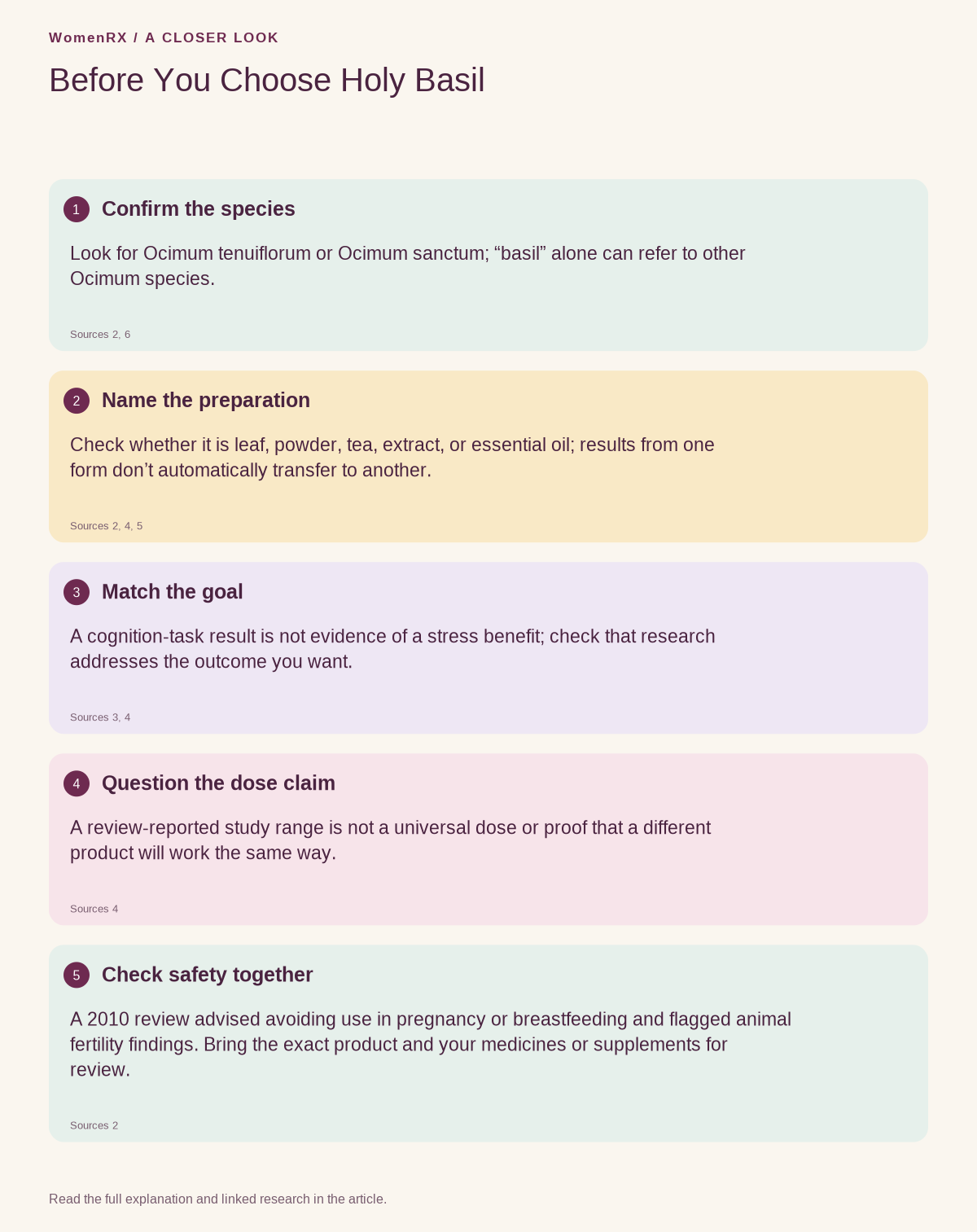
Before You Choose Holy Basil
Confirm the species: Look for Ocimum tenuiflorum or Ocimum sanctum; “basil” alone can refer to other Ocimum species.26
Name the preparation: Check whether it is leaf, powder, tea, extract, or essential oil; results from one form don’t automatically transfer to another.245
Match the goal: A cognition-task result is not evidence of a stress benefit; check that research addresses the outcome you want.34
Question the dose claim: A review-reported study range is not a universal dose or proof that a different product will work the same way.4
Check safety together: A 2010 review advised avoiding use in pregnancy or breastfeeding and flagged animal fertility findings. Bring the exact product and your medicines or supplements for review.2
Read the figure as text
Use these checks to compare a product’s identity and preparation with the evidence and to spot situations where a safety conversation matters.- Confirm the species: Look for Ocimum tenuiflorum or Ocimum sanctum; “basil” alone can refer to other Ocimum species.26
- Name the preparation: Check whether it is leaf, powder, tea, extract, or essential oil; results from one form don’t automatically transfer to another.245
- Match the goal: A cognition-task result is not evidence of a stress benefit; check that research addresses the outcome you want.34
- Question the dose claim: A review-reported study range is not a universal dose or proof that a different product will work the same way.4
- Check safety together: A 2010 review advised avoiding use in pregnancy or breastfeeding and flagged animal fertility findings. Bring the exact product and your medicines or supplements for review.2
More questions, answered
Is holy basil the same as sweet basil?
Not necessarily. Holy basil is identified as Ocimum tenuiflorum or Ocimum sanctum; the Ocimum genus also includes other species. Check the botanical name on the product label. 2 6
Is there a proven holy basil dose for stress?
A review reports studies using 300-600 mg a day of leaf extract for 60 days, but that doesn’t establish a universal or product-independent dose. The reported range is not a personal dosing recommendation. 4
Sources you can check
- Stress: MedlinePlusAccessed 2026-09-25Return to first citation
- Ocimum sanctum Linn. A reservoir plant for therapeutic applications: An overview.Pattanayak P, Behera P, Das D, Panda SK. · Pharmacognosy reviews · 2010Return to first citation
- The efficacy of nutritional phytochemical compounds in improving cognition.Marsh A, Quelch D, Mackonochie M, Hejmadi M, Rolfe V. · The international journal of neuropsychopharmacology · 2026Return to first citation
- System-Level, Molecular and Cellular Mechanisms of Selected Plant Adaptogens-A Review.Such S, Puchalski C, Kogut Ł, Zaguła G. · Nutrients · 2026Return to first citation
- An In Vitro Anti-Cancer Activity of Ocimum tenuiflorum Essential Oil by Inducing Apoptosis in Human Gastric Cancer Cell Line.Boonyanugomol W, Rukseree K, Prapatpong P, Reamtong O, Baik SC, Jung M, Shin MK, Kang HL, Lee WK. · Medicina (Kaunas, Lithuania) · 2021Return to first citation
- Ethnobotany, Phytochemistry, and Pharmacological Activities of Ocimum Species in Low- and Middle-Income Countries: A Systematic Review.Maluwa C, Zinan'dala B, Chuljerm H, Parklak W, Kulprachakarn K. · International journal of molecular sciences · 2026Return to first citation