Holy Basil: What We Know About Dose and Safety
A short tea trial offers one example of human use, but it doesn’t establish a general supplement dose or answer whether holy basil is safe to combine with medicines.
There isn’t a reliable general daily dose of holy basil established by the human findings discussed here. One small trial tested tea made with 2 grams of dried leaves per serving, after each meal for four days, in people receiving radioactive iodine treatment. That regimen isn’t a dose recommendation for stress supplements or capsules. The trial also doesn’t establish long-term, pregnancy, breastfeeding, or medicine-combination safety. 2
The dose in this human trial is tied to a specific situation
A randomized trial enrolled 44 people with differentiated thyroid cancer who were receiving radioactive iodine treatment after thyroid removal. Half drank 180 mL of tea made from 2 grams of dried holy basil leaves after each meal for four days; the comparison group drank the same amount of water. The holy basil group had a more favorable change in anxiety scores during that treatment period. 2
That is a description of what one study tested, not a recommended daily dose. The participants were dealing with anxiety during a particular cancer treatment, and the preparation was leaf tea. The study doesn’t show that the same amount, a longer course, or a capsule or extract will help with everyday stress. It also doesn’t establish what dose, if any, is appropriate for you. 2
Stress and blood sugar claims need different evidence
The tea trial measured anxiety in people receiving radioactive iodine, not general stress in women using an over-the-counter supplement. It therefore can’t establish a broad stress-relief effect. 2
Holy basil is also promoted for blood sugar. A computational study modeled how plant compounds might bind to a proposed diabetes-related target. That kind of computer analysis can suggest questions for future research, but it doesn’t show that taking holy basil improves blood sugar in people or can replace diabetes care. 1
What the trial can’t tell you about safety
Four days of use in a small, specific group can’t answer whether holy basil is safe over weeks or months. The trial also doesn’t establish safety during pregnancy or breastfeeding. That’s a gap in what this study reports, not proof that no other research exists. 2
The trial wasn’t designed to establish whether holy basil interacts with medicines, so it doesn’t provide a verified list of interactions. If you’re considering a product while taking prescriptions or other supplements, show a pharmacist the full label and ask about that exact product and your medication list. Don’t assume that a tea trial answers the same question for a concentrated capsule.
Check what’s actually in the product
Start with the plant name, plant part, preparation, amount per serving, and other listed ingredients. The human trial used dried holy basil leaves in tea. A product with a different preparation isn’t automatically equivalent, even if its front label says “holy basil.” 2
Ask the seller for clear product-specific information rather than relying on a stress or blood sugar promise. The trial doesn’t validate commercial products or establish a product-quality standard. If you’re pregnant, trying to become pregnant, or breastfeeding, don’t take this short trial as reassurance about safety; discuss the specific product with your pregnancy or postpartum care clinician. 2
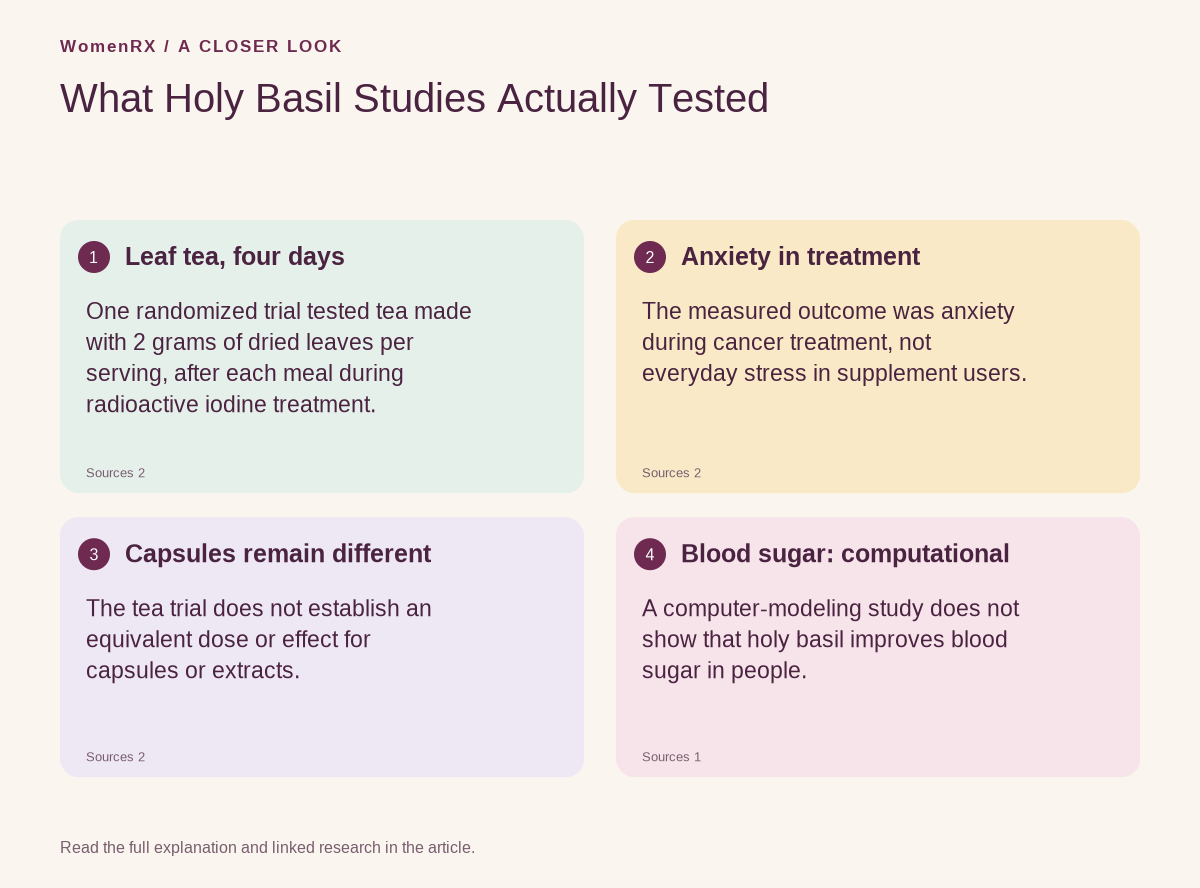
What Holy Basil Studies Actually Tested
Leaf tea, four days: One randomized trial tested tea made with 2 grams of dried leaves per serving, after each meal during radioactive iodine treatment.2
Anxiety in treatment: The measured outcome was anxiety during cancer treatment, not everyday stress in supplement users.2
Capsules remain different: The tea trial does not establish an equivalent dose or effect for capsules or extracts.2
Blood sugar: computational: A computer-modeling study does not show that holy basil improves blood sugar in people.1
Read the figure as text
Separate the specific human tea trial from claims that require different kinds of evidence.- Leaf tea, four days: One randomized trial tested tea made with 2 grams of dried leaves per serving, after each meal during radioactive iodine treatment.2
- Anxiety in treatment: The measured outcome was anxiety during cancer treatment, not everyday stress in supplement users.2
- Capsules remain different: The tea trial does not establish an equivalent dose or effect for capsules or extracts.2
- Blood sugar: computational: A computer-modeling study does not show that holy basil improves blood sugar in people.1
More questions, answered
Does the tea-trial amount apply to holy basil capsules?
No. The trial tested tea made with 2 grams of dried leaves per serving, taken after each meal for four days, not capsules or extracts. That regimen isn’t a capsule dose recommendation; the trial doesn’t establish that different preparations provide the same exposure or effects. 2
Does holy basil have a proven interaction with my medicine?
The trial doesn’t establish medicine interactions, so it can’t confirm whether a particular product is safe with your prescriptions. Bring the full product label and your medication list to a pharmacist to ask about that combination.
Sources you can check
- Exploring Holy Basil's Bioactive Compounds for T2DM Treatment: Docking and Molecular Dynamics Simulations with Human Omentin-1.Ibrahim MJ, Nangia A, Das S, Verma T, Rajeswari VD, Venkatraman G, Gnanasambandan R. · Cell biochemistry and biophysics · 2025Return to first citation
- Benefits of basil tea for patients with differentiated thyroid cancer during radioiodine therapy: A randomized controlled trial.Nomura K, Nakayama M, Okizaki A. · Heliyon · 2023Return to first citation