What We Know About Long-Term Holy Basil Use
Human studies offer some short-term reassurance, but they don’t establish that taking holy basil for months or years is safe.
Small human studies and a systematic review reported few significant adverse effects, but the evidence doesn’t establish safety with ongoing use. The reported trials include a standardized extract taken for six weeks and a leaf extract studied for 30 days. Those findings don’t automatically apply to tea, powder, or another product. Pregnancy and breastfeeding raise separate concerns because reproductive safety is inadequately studied. 2 4
Short studies aren’t a long-term safety record
The clearest human safety signal is reassuring but limited: studies reviewed so far generally reported few serious problems. A systematic review identified 24 human studies and found that none reported significant adverse events. That doesn’t show that long-term use is safe, though. The review’s summary doesn’t establish how long participants used tulsi across those studies or what might happen with continued use over months or years. 4
A more specific example helps show the limits. In one randomized, placebo-controlled study, 158 people with at least three stress symptoms took a standardized whole-plant extract for six weeks. The review reported no adverse events in the extract group. A different study gave 44 healthy men a leaf extract for 30 days to study cognitive outcomes. Neither study answers what happens with years of use, and their results describe particular extracts and study participants, not every holy basil product or every person. 2
Animal testing adds a different kind of information, not a substitute for long-term human follow-up. One study found no genotoxic effects in its tests and reported no acute oral toxicity at the tested levels in rats. An acute toxicity test assesses a different question from repeated use over time in people. 1
The label matters as much as the herb name
Holy basil is also called tulsi. Ocimum tenuiflorum is the preferred botanical name; some research uses the synonym Ocimum sanctum. That naming difference doesn’t necessarily mean a product is different, but the plant name alone doesn’t tell you whether a product matches one studied in people. 2
The human studies used specific preparations: one a standardized extract made from the whole plant, another an extract from leaves. Holy basil is also used as fresh leaves, dried powder, and tea. Evidence about one extract can’t be assumed to establish the safety of those other forms, or of a different extract with different specifications. 2 3
If you’re considering continued use, check the label for the botanical name, plant part, and whether it describes a tea, powder, or extract. If the label names a standardized extract, note the product’s extract details rather than relying on “holy basil” alone. This won’t prove that the product is safe long-term; it helps you avoid treating different preparations as if they were interchangeable.
Pregnancy and breastfeeding need a separate answer
The safety question is more cautious during pregnancy and breastfeeding. A review says holy basil extracts are not recommended during either period and describes reproductive and developmental toxicity as a concern flagged in a safety assessment. It also says the studies on reproduction and fertility are inadequate. That is a reason for caution, not proof that holy basil causes harm in pregnant or breastfeeding people. 2
This evidence also doesn’t settle effects on fertility or other aspects of reproductive health. Don’t use general short-term results in adults as proof of reproductive safety. If pregnancy is possible, planned, or underway, or you’re breastfeeding, the product and your circumstances matter; bring the label to a pharmacist or clinician before continuing it.
What about medicine interactions?
The clinical safety summaries here don’t establish specific interactions with prescription medicines or over-the-counter drugs. That means interaction risk is unresolved, not that interactions have been ruled out. If you take regular medication, show a pharmacist or clinician the exact product label and ask about that product rather than relying on a general answer about the herb.
The practical bottom line: short-term reports offer some reassurance for the particular preparations studied, but they don’t provide a dependable basis for calling indefinite use safe. Product identity, duration, pregnancy or breastfeeding, and medicines can all change how useful that reassurance is.
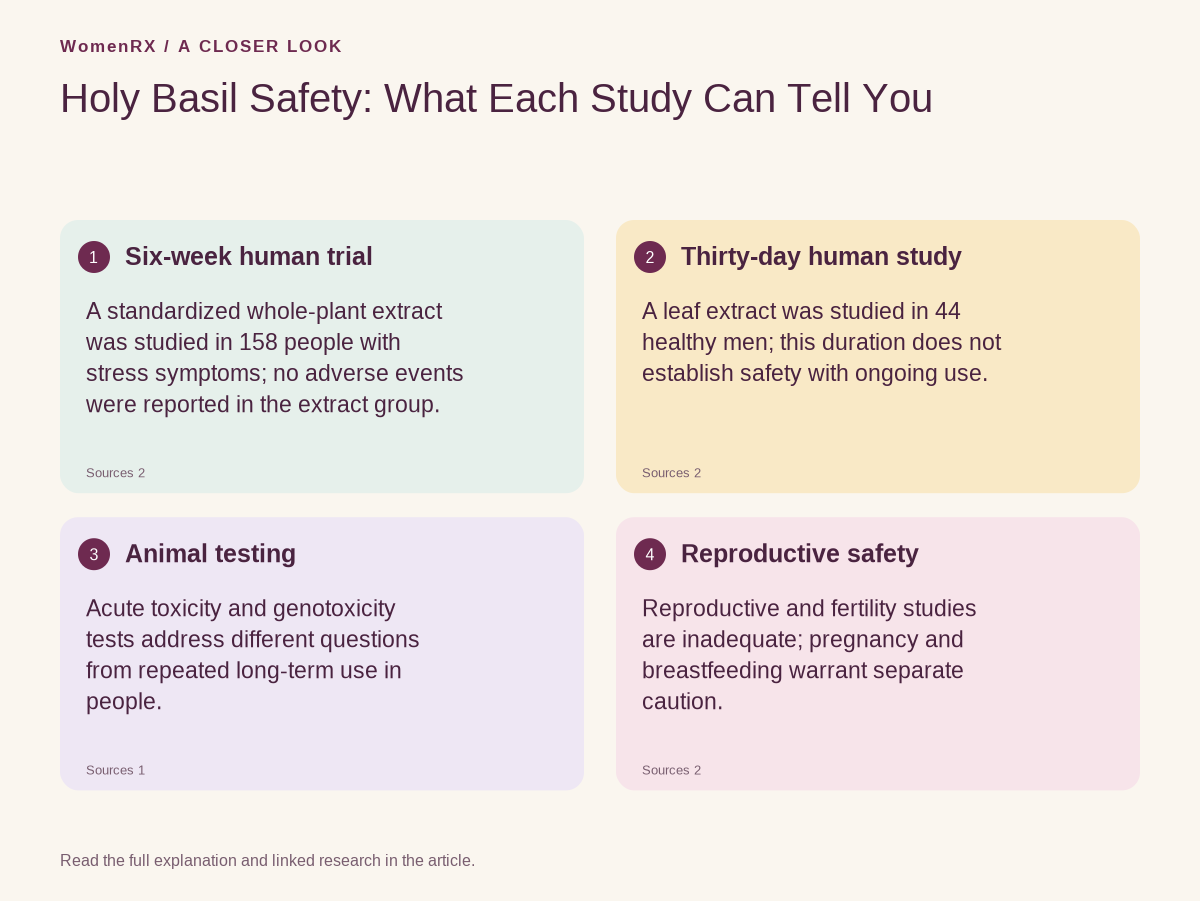
Holy Basil Safety: What Each Study Can Tell You
Six-week human trial: A standardized whole-plant extract was studied in 158 people with stress symptoms; no adverse events were reported in the extract group.2
Thirty-day human study: A leaf extract was studied in 44 healthy men; this duration does not establish safety with ongoing use.2
Animal testing: Acute toxicity and genotoxicity tests address different questions from repeated long-term use in people.1
Reproductive safety: Reproductive and fertility studies are inadequate; pregnancy and breastfeeding warrant separate caution.2
Read the figure as text
Different evidence answers different safety questions. Short human trials, animal tests, and reproductive-safety assessments should not be treated as proof of long-term safety.- Six-week human trial: A standardized whole-plant extract was studied in 158 people with stress symptoms; no adverse events were reported in the extract group.2
- Thirty-day human study: A leaf extract was studied in 44 healthy men; this duration does not establish safety with ongoing use.2
- Animal testing: Acute toxicity and genotoxicity tests address different questions from repeated long-term use in people.1
- Reproductive safety: Reproductive and fertility studies are inadequate; pregnancy and breastfeeding warrant separate caution.2
More questions, answered
Does holy basil tea have the same safety evidence as capsules?
Not necessarily. Human studies described in reviews used specific extracts, while traditional use also includes tea, fresh leaves, and dried powder. Evidence for one preparation doesn’t establish the safety of another. 2 3
Does a lack of reported interactions mean holy basil won’t interact with my medicine?
No. The clinical safety summaries described here don’t establish particular medicine interactions, so they can’t rule them out. Share the exact product label with a pharmacist or clinician if you take regular medication.
Sources you can check
- Assessment of genotoxicity and acute oral toxicity of a standardized Ocimum tenuiflorum extract (HolixerTM).Murugan SK, Bethapudi B, Mundkinajeddu D, D'Souza P. · Drug and chemical toxicology · 2025Return to first citation
- The Safety and Efficacy of Botanicals with Nootropic Effects.Roe AL, Venkataraman A. · Current neuropharmacology · 2021Return to first citation
- Harnessing the Antibacterial, Anti-Diabetic and Anti-Carcinogenic Properties of Ocimum sanctum Linn (Tulsi).Arya R, Faruquee HM, Shakya H, Rahman SA, Begum MM, Biswas SK, Apu MAI, Islam MA, Sheikh MMI, Kim JJ. · Plants (Basel, Switzerland) · 2024Return to first citation
- The Clinical Efficacy and Safety of Tulsi in Humans: A Systematic Review of the Literature.Jamshidi N, Cohen MM. · Evidence-based complementary and alternative medicine : eCAM · 2017Return to first citation