Holy Basil Supplements: What Human Evidence Can Tell You
One small trial found improvement with a particular holy basil extract, but that doesn't establish benefits or safety for every product or person.
One placebo-controlled human trial suggests a specific holy basil extract may reduce self-rated general stress symptoms. A sleep-problems symptom improved too, but that doesn't establish a treatment for insomnia or a benefit from every tulsi product. The six-week trial reported no adverse events, yet excluded pregnant and breastfeeding participants and people taking medicines. Its cited results don't establish a women-specific effect or medication safety. 2
Start with the plant and the product
Holy basil, also called tulsi, is identified in the human study as Ocimum tenuiflorum, with Ocimum sanctum given as a synonym. That name is more useful than a label that says only “basil.” The study tested a particular extract, OciBest, not culinary basil, basil essential oil, or every supplement containing tulsi. Results from one preparation shouldn't be assumed to apply to a different product or blend. 2
What the stress trial found
A 2012 randomized, double-blind, placebo-controlled study in India assigned 150 adults with stress-related symptoms to OciBest extract or placebo for six weeks. The extract group had 71 participants and the placebo group had 79. Participants took 1,200 mg of actives per day and rated their symptoms at the start and during the study. At six weeks, the researchers reported greater improvement than with placebo in total symptom scores and in some individual symptoms, including exhaustion and a self-rated sleep-problems symptom. 2
That is a positive result, but a narrow one. The outcome was a self-rated general stress symptom score, not proof that holy basil treats an anxiety disorder, insomnia, or another medical condition. The study tested one extract over six weeks; it can't tell you whether a different product works, whether an effect lasts, or when an individual might notice a change. The cited overall results don't establish a women-specific effect. 2
A 2022 systematic review looked at randomized human trials of plants and plant nutrients affecting hormones involved in the stress response. It included holy basil among many different substances, but found that overall effects on these hormones were unclear; the most consistent finding was for ashwagandha, not holy basil. That review doesn't establish a holy-basil-specific cortisol benefit. 3
Traditional use can explain why people are interested in tulsi, but it isn't the same as clinical evidence for a particular goal. The trial offers an initial signal for one extract and self-rated stress symptoms, not a general promise of stress relief. 2
What the safety information does and doesn't cover
No adverse events were reported during the six-week OciBest trial. That is useful information about the participants and product studied, but it doesn't prove that holy basil is safe for everyone or with long-term use. The researchers excluded people taking other conventional or herbal medicines, as well as people with certain significant health conditions. So the trial doesn't answer whether the extract is suitable alongside your medicines or in those circumstances. 2
Pregnancy and breastfeeding were also exclusion criteria. The trial therefore provides no safety reassurance for either stage. A lack of reported harm in this study cannot be used to establish safety during pregnancy or breastfeeding. 2
The study doesn't establish which medicines, if any, interact with holy basil. That means it would be misleading to present a list of confirmed interactions based on this trial. Before considering a supplement, check the exact product label and ingredient list with a pharmacist or clinician who can review your medicines, other supplements, and relevant health conditions. This is especially pertinent if you're pregnant, breastfeeding, or planning a pregnancy, since those situations weren't studied. 2
A practical label-and-safety check
Before you decide, look for the botanical name (Ocimum tenuiflorum or O. sanctum), the specific extract or plant preparation, and any additional ingredients. Then compare the product with the one actually studied: OciBest extract. A matching plant name alone doesn't show that two preparations are equivalent. 2
Be clear about your goal, too. The human trial assessed general stress symptoms; it doesn't answer whether holy basil helps with a different concern. If stress is disrupting sleep, focus, or daily activities, don't let an uncertain supplement result stand in for addressing those effects. The practical takeaway is modest: there is one controlled human study worth knowing about, but the evidence and safety information are too limited to treat holy basil as a proven, universally suitable option. 12
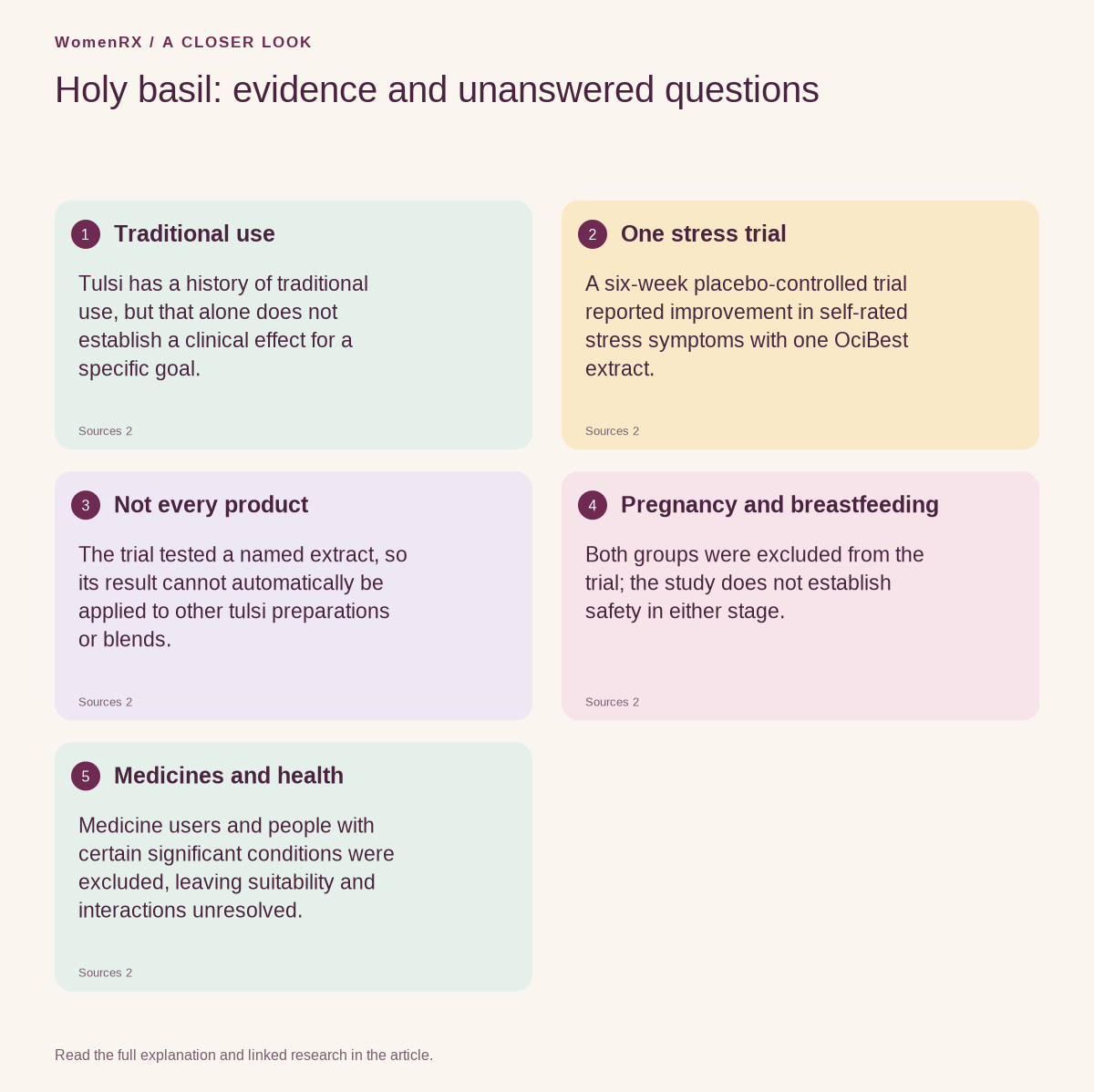
Holy basil: evidence and unanswered questions
Traditional use: Tulsi has a history of traditional use, but that alone does not establish a clinical effect for a specific goal.2
One stress trial: A six-week placebo-controlled trial reported improvement in self-rated stress symptoms with one OciBest extract.2
Not every product: The trial tested a named extract, so its result cannot automatically be applied to other tulsi preparations or blends.2
Pregnancy and breastfeeding: Both groups were excluded from the trial; the study does not establish safety in either stage.2
Medicines and health: Medicine users and people with certain significant conditions were excluded, leaving suitability and interactions unresolved.2
Read the figure as text
Separate traditional use from the specific human finding and the safety questions that trial could not answer.- Traditional use: Tulsi has a history of traditional use, but that alone does not establish a clinical effect for a specific goal.2
- One stress trial: A six-week placebo-controlled trial reported improvement in self-rated stress symptoms with one OciBest extract.2
- Not every product: The trial tested a named extract, so its result cannot automatically be applied to other tulsi preparations or blends.2
- Pregnancy and breastfeeding: Both groups were excluded from the trial; the study does not establish safety in either stage.2
- Medicines and health: Medicine users and people with certain significant conditions were excluded, leaving suitability and interactions unresolved.2
More questions, answered
How soon might holy basil work for stress?
The trial measured symptoms at weeks 2, 4, and 6, and reported improvement after six weeks. It doesn't establish when an individual might notice a benefit or predict how another product will perform. 2
Does holy basil interact with medications?
The human trial doesn't establish specific medication interactions. It excluded people taking conventional or herbal medicines, so it cannot show whether the tested extract was suitable alongside them. Check the exact product and ingredients with a pharmacist or clinician who can review your medication list. 2
Sources you can check
- Stress: MedlinePlusAccessed 2026-09-25Return to first citation
- Efficacy of an Extract of Ocimum tenuiflorum (OciBest) in the Management of General Stress: A Double-Blind, Placebo-Controlled Study.Saxena RC, Singh R, Kumar P, Negi MP, Saxena VS, Geetharani P, Allan JJ, Venkateshwarlu K. · Evidence-based complementary and alternative medicine : eCAM · 2012Return to first citation
- Modulation of the hypothalamic-pituitary-adrenal (HPA) axis by plants and phytonutrients: a systematic review of human trials.Lopresti AL, Smith SJ, Drummond PD. · Nutritional neuroscience · 2022Return to first citation