Ashwagandha for Anxiety: What the Research Can Tell You
A few small trials have measured anxiety directly, but their results don’t yet show that ashwagandha is a reliable stand-alone treatment or works specifically for women.
Some randomized trials report lower anxiety scores with particular ashwagandha extracts, including one small study in people with diagnosed generalized anxiety disorder who were already taking SSRIs. But studies are short, use different products, and don’t establish a women-specific benefit. Ashwagandha may also cause side effects, affect thyroid function, and interact with some medicines; pregnancy safety remains uncertain. 1 6
Ashwagandha may reduce anxiety symptoms for some people, but the evidence is still preliminary. A key distinction: feeling less stressed isn’t the same as treating an anxiety disorder. The studies include both kinds of outcomes, and the strongest case for an anxiety benefit comes from a small number of short trials using specific extracts, not from evidence about every supplement on the shelf. 1 6 7
Anxiety scores and stress measures aren’t interchangeable
Stress is often tied to a situation or demand. An anxiety disorder can involve fear or worry that persists, becomes hard to control, and interferes with daily life. 2 That distinction matters because some ashwagandha research measures perceived stress or cortisol, while other trials measure symptoms on anxiety scales. A change in a stress score alone doesn’t establish that a treatment helps an anxiety disorder. 1 5
There is some direct, if limited, anxiety evidence. In one randomized, double-blind trial, 40 people with diagnosed generalized anxiety disorder received an ashwagandha root extract or placebo for six weeks. Everyone was also taking an SSRI. Anxiety scores fell by 14 points in the extract group and 8 points in the placebo group. That result suggests possible added benefit alongside prescribed treatment, not proof that ashwagandha works on its own or can replace medication. 6
Another placebo-controlled trial followed 70 people with mild-to-moderate anxiety and depression for 90 days. The tested root extract, which also contained piperine, was associated with greater improvement on an anxiety scale than placebo. Because anxiety and depression were both part of the study, and the formulation was specific, this result doesn’t tell us how a different product would perform or whether the same effect applies to anxiety alone. 7
A 2021 review summarized seven trials involving 491 adults in India. Participants had either self-reported high stress and anxiety or a diagnosed anxiety disorder, and studies lasted six to eight weeks. That mix makes it harder to tell how much the overall results reflect anxiety-specific improvement rather than changes in stress. The trials also weren’t long enough to answer questions about lasting benefit. 1
What the studies say about women
The trial descriptions don’t report how many participants were women or whether outcomes differed by sex. So, while women may have been included, these results don’t establish a benefit specific to women. A study in pregnant women measured stress, sleep, and blood-related outcomes, not treatment of an anxiety disorder. 4 6 7
Pregnancy deserves a separate conversation. The NIH Office of Dietary Supplements notes that some experts advise against ashwagandha during pregnancy. A small, open-label study in 70 pregnant women reported no adverse events over 12 weeks, but it examined a different set of outcomes and wasn’t designed to settle pregnancy safety or anxiety treatment. Overall, pregnancy evidence remains limited. 1 3 4
Before trying it, check the safety questions
Short-term trials suggest ashwagandha is often tolerated, but mild effects can include nausea, loose stools, or drowsiness. There have also been reports of effects on liver function. The NIH Office of Dietary Supplements says ashwagandha may affect thyroid function, can interact with some medicines, and has not been studied well for long-term safety. 1
Before adding it, bring the exact product label to a clinician or pharmacist and ask:
- Could it interact with any of my prescription medicines or other supplements?
- Does my thyroid or liver history change the safety picture?
- If I’m pregnant, might become pregnant, or am planning a pregnancy, should I avoid it?
- If I’m already receiving anxiety treatment, how would we tell whether this product is helping or causing a problem?
These are worth checking because trial results apply to the particular extract tested, not automatically to all products labeled ashwagandha. The trials used different formulations, and one included piperine. 6 7
Don’t let a supplement postpone useful care
If anxiety is persistent, getting worse, or interfering with work, sleep, or relationships, it’s reasonable to seek help rather than waiting to see whether a supplement is enough. Psychotherapy, including cognitive behavioral therapy, medication, or both are established treatment options; support groups and stress-management approaches may also help. Which option fits depends on the person and the type of anxiety. 2
If you’re considering ashwagandha, think of the current evidence as a reason to ask a focused question, not as a reason to stop or delay care that’s already helping. The most encouraging trials tested a particular extract alongside, or against, a placebo. They don’t show that an over-the-counter product can replace prescribed treatment. 6 2
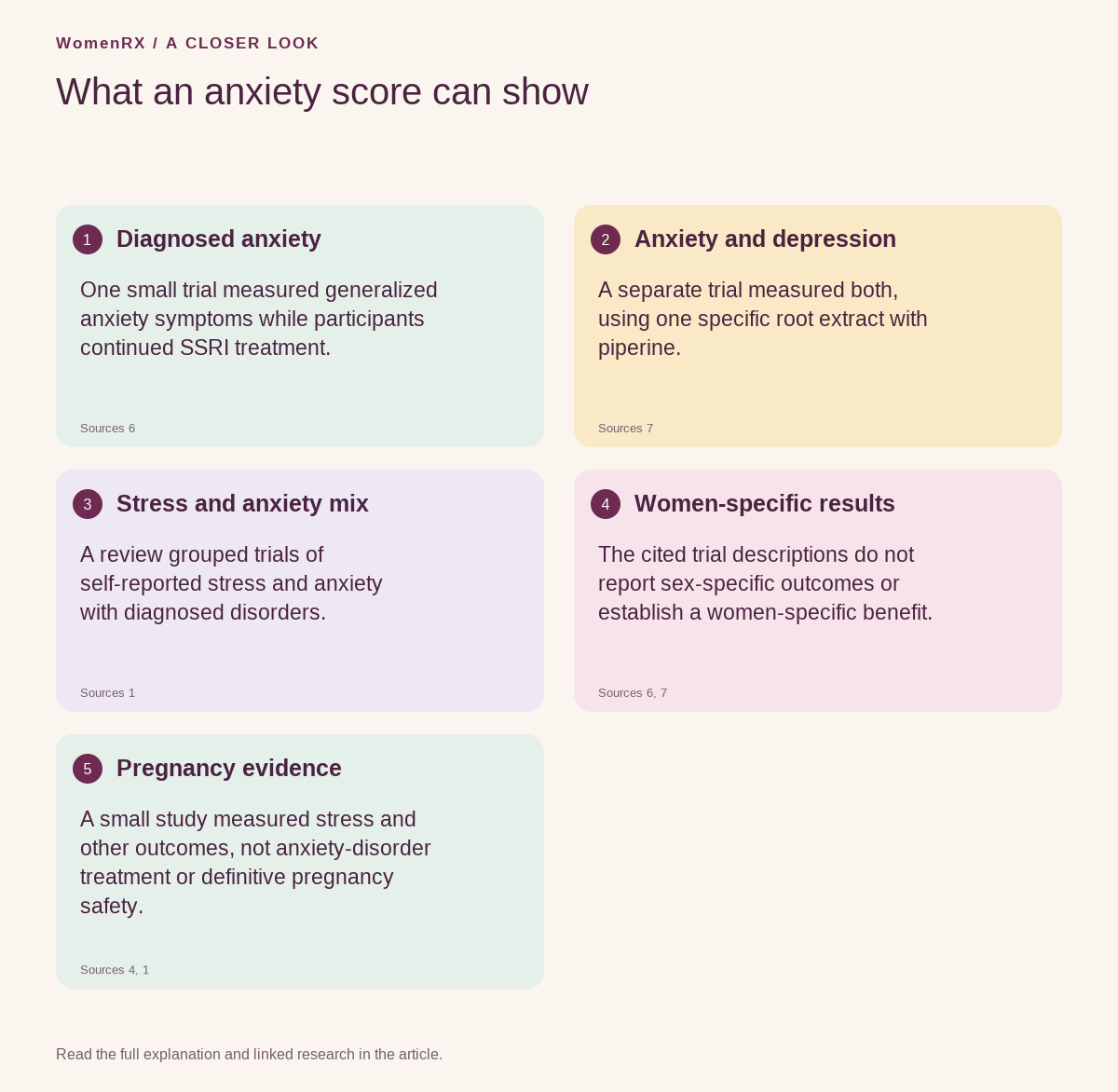
What an anxiety score can show
Diagnosed anxiety: One small trial measured generalized anxiety symptoms while participants continued SSRI treatment.6
Anxiety and depression: A separate trial measured both, using one specific root extract with piperine.7
Stress and anxiety mix: A review grouped trials of self-reported stress and anxiety with diagnosed disorders.1
Women-specific results: The cited trial descriptions do not report sex-specific outcomes or establish a women-specific benefit.67
Pregnancy evidence: A small study measured stress and other outcomes, not anxiety-disorder treatment or definitive pregnancy safety.41
Read the figure as text
These study categories help distinguish direct anxiety outcomes from broader stress findings and show what the evidence does not yet establish.- Diagnosed anxiety: One small trial measured generalized anxiety symptoms while participants continued SSRI treatment.6
- Anxiety and depression: A separate trial measured both, using one specific root extract with piperine.7
- Stress and anxiety mix: A review grouped trials of self-reported stress and anxiety with diagnosed disorders.1
- Women-specific results: The cited trial descriptions do not report sex-specific outcomes or establish a women-specific benefit.67
- Pregnancy evidence: A small study measured stress and other outcomes, not anxiety-disorder treatment or definitive pregnancy safety.41
More questions, answered
Can ashwagandha replace anxiety medication?
The trial in people with diagnosed generalized anxiety disorder tested ashwagandha alongside SSRIs, not as a replacement for them. It doesn’t show that stopping prescribed treatment is safe or that the supplement works on its own. 6
Does it help stress as well as anxiety?
Some studies measured perceived stress, while others measured anxiety symptoms. Those findings aren’t interchangeable: a lower stress score doesn’t by itself show improvement in an anxiety disorder. 1 2
Sources you can check
- Ashwagandha: Is it helpful for stress, anxiety, or sleep? - Health Professional Fact SheetAccessed 2026-09-25Return to first citation
- Anxiety: MedlinePlusAccessed 2026-09-25Return to first citation
- A Systematic and Ethnobotanical Review of Ashwagandha's ( Withania Somnifera ) Teratogenic and Abortifacient Potentials.Tallon MJ, Koturbash I, Blum JL. · Phytotherapy research : PTR · 2026Return to first citation
- Efficacy and safety of Ashwagandha (Withania somnifera) root extract in pregnant women: a prospective, randomized, comparative, open-label, 12-week study.Ajgaonkar A, Tayade H, Nayak A. · Frontiers in global women's health · 2026Return to first citation
- Safety and efficacy of ashwagen (a standardized withania somnifera extract) in stress and anxiety with hypertension and associated cardiometabolic risk factors: a randomized, placebo-controlled trial.Pattojoshi A, Kumar Patra S, Idrees SA, Behera S, Dalua SS, Tiwari P, Valavan R. · Stress (Amsterdam, Netherlands) · 2026Return to first citation
- Assessment of the Efficacy of Withania somnifera Root Extract in Patients with Generalized Anxiety Disorder: A Randomized Double-blind Placebo- Controlled Trial.Fuladi S, Emami SA, Mohammadpour AH, Karimani A, Manteghi AA, Sahebkar A. · Current reviews in clinical and experimental pharmacology · 2021Return to first citation
- A Standardized Withania somnifera (Linn.) Root Extract with Piperine Alleviates the Symptoms of Anxiety and Depression by Increasing Serotonin Levels: A Double-Blind, Randomized, Placebo-Controlled Study.Majeed M, Nagabhushanam K, Murali A, Vishwanathan DT, Mamidala RV, Mundkur L. · Journal of integrative and complementary medicine · 2024Return to first citation