L-Theanine or Ashwagandha for Anxiety: What the Evidence Says
Studies report possible benefits from both supplements, but no reliable comparison establishes which works better for anxiety.
Current studies don’t establish whether L-theanine or ashwagandha works better for anxiety. Ashwagandha trials report improvements in anxiety or stress, while L-theanine findings are mixed and often concern stress in specific situations rather than ongoing anxiety. Ashwagandha has reported liver and thyroid concerns; pregnancy and breastfeeding precautions reflect uncertainty about safety. The cited L-theanine reviews don’t establish safety in those stages. 1 3 4 5
The comparison isn’t a contest between matched trials
If you’re weighing these supplements, the key difference is the kind of evidence behind them. Studies of ashwagandha have measured anxiety or stress against a placebo. L-theanine research is more mixed: some studies look at short-term stress during challenging situations, while evidence for anxiety symptoms is inconsistent. Those separate findings can’t tell us which supplement is better. 1 3 4
A network meta-analysis that included trials of both found a statistically significant anxiety-score difference between ashwagandha and placebo, but not between L-theanine and placebo. That result does not establish that ashwagandha works better than L-theanine: the ashwagandha trials were small, and a network analysis compares findings across trials rather than directly testing the two supplements against each other. 5
Ashwagandha: reported improvements, varied products
A 2021 review summarized seven randomized trials involving 491 adults in India who had self-reported high stress or anxiety, or a diagnosed anxiety disorder. Participants took ashwagandha or placebo for six to eight weeks. The trials reported reductions in anxiety and stress on rating scales, but they used different preparations, doses, and plant parts. That variation makes it hard to know whether results for one extract apply to another product. 1
Some studies enrolled men and women, but the published summary doesn’t report whether outcomes differed by sex. So this evidence doesn’t show that ashwagandha works better, worse, or differently for women. 1
Short trials aren’t the same as evidence for long-term use. Ashwagandha was generally tolerated for up to about three months in the studies summarized by NIH’s Office of Dietary Supplements, but longer-term safety is not established. Reported side effects include stomach upset, loose stools, nausea, and drowsiness. There are also reports of liver injury, and evidence suggests ashwagandha may affect thyroid function. It can interact with some medicines, including sedatives, thyroid hormone medicines, immunosuppressants, antihypertensives, and diabetes medicines. 1
For pregnancy, the NIH Office of Dietary Supplements notes that some experts advise against ashwagandha because of a proposed risk of spontaneous abortion, while also noting that an American Herbal Pharmacopoeia report has been disputed and that it does not establish that ashwagandha root causes abortion. ODS says ashwagandha may not be safe during pregnancy or breastfeeding. France’s food-safety agency, ANSES, recommends against use in both groups. These cautions reflect uncertainty, not proof that every product will cause harm. 1
L-theanine: a different and less settled anxiety picture
L-theanine has been studied for stress and anxiety, but the outcomes don’t line up into a clear treatment effect for anxiety disorders. A 2026 systematic review and meta-analysis of 31 randomized trials, involving 1,168 people across healthy and clinical populations, found anxiety effects to be inconsistent and not statistically significant overall, apart from one study in psychotic anxiety. A separate review of nine placebo-controlled trials suggested possible benefits for stress or anxiety in people facing stressful situations, but noted that evidence was insufficient for chronic conditions. 3 4
That distinction matters in everyday life: feeling tense before a stressful event is not necessarily the same as persistent worry that interferes with work, relationships, sleep, or other daily activities. The available findings don’t establish L-theanine as a treatment for ongoing anxiety. 2 4
The reviews discussed don’t report anxiety outcomes separately for women and men. They therefore don’t show whether L-theanine’s effect on anxiety differs by sex; that doesn’t mean none of the underlying trials examined the question. 3 4
The reviews describe L-theanine as generally well tolerated in trials, and the meta-analysis reported no serious adverse events. But those findings don’t establish safety in pregnancy or while breastfeeding. That uncertainty is different from evidence that L-theanine is either safe or harmful in those stages. 3 4
Weigh the possible benefit alongside the risks
For an everyday decision, look at what was actually studied. Results for one ashwagandha preparation may not apply to another, and L-theanine findings from stressful situations don’t promise relief from persistent anxiety. 1 4
The choice also isn’t just about a possible benefit. Ashwagandha has reported liver and thyroid concerns and potential medication interactions. Its pregnancy and breastfeeding cautions are separate: safety in those stages is uncertain, and ANSES recommends against use in both. L-theanine’s trial safety reports are generally reassuring, but the cited reviews don’t establish longer-term safety or safety during pregnancy and breastfeeding. 1 3 4
If anxiety keeps returning or is getting in the way of daily life, supplements shouldn’t be the only plan. Anxiety disorders can be treated with psychotherapy, medicines, or both; treatment can be matched to the kind of anxiety you’re experiencing. 2
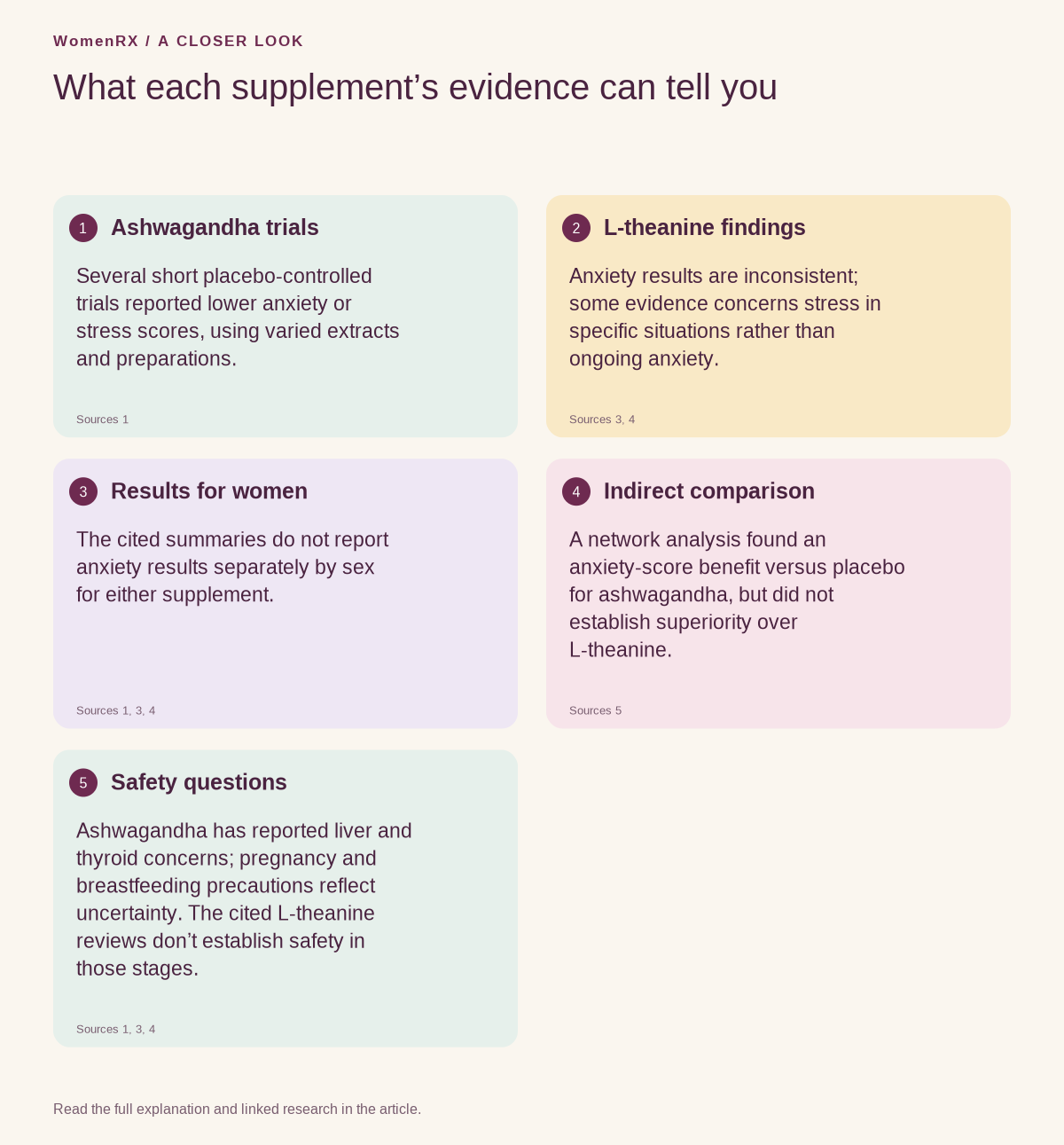
What each supplement’s evidence can tell you
Ashwagandha trials: Several short placebo-controlled trials reported lower anxiety or stress scores, using varied extracts and preparations.1
L-theanine findings: Anxiety results are inconsistent; some evidence concerns stress in specific situations rather than ongoing anxiety.34
Results for women: The cited summaries do not report anxiety results separately by sex for either supplement.134
Indirect comparison: A network analysis found an anxiety-score benefit versus placebo for ashwagandha, but did not establish superiority over L-theanine.5
Safety questions: Ashwagandha has reported liver and thyroid concerns; pregnancy and breastfeeding precautions reflect uncertainty. The cited L-theanine reviews don’t establish safety in those stages.134
Read the figure as text
These studies address overlapping but not identical questions; a comparison of their evidence types is more useful than a simple winner ranking.- Ashwagandha trials: Several short placebo-controlled trials reported lower anxiety or stress scores, using varied extracts and preparations.1
- L-theanine findings: Anxiety results are inconsistent; some evidence concerns stress in specific situations rather than ongoing anxiety.34
- Results for women: The cited summaries do not report anxiety results separately by sex for either supplement.134
- Indirect comparison: A network analysis found an anxiety-score benefit versus placebo for ashwagandha, but did not establish superiority over L-theanine.5
- Safety questions: Ashwagandha has reported liver and thyroid concerns; pregnancy and breastfeeding precautions reflect uncertainty. The cited L-theanine reviews don’t establish safety in those stages.134
More questions, answered
Can I assume any ashwagandha product matches the studies?
No. Trials used different extracts, plant parts, and preparations, so a finding for one product may not apply to another. 1
What if I’m pregnant or breastfeeding?
The NIH Office of Dietary Supplements notes that some experts advise against ashwagandha during pregnancy because of a proposed risk, and says it may not be safe during pregnancy or breastfeeding. ANSES recommends against use in both groups. The proposed pregnancy risk is uncertain; the cited L-theanine reviews don’t establish safety in either stage. 1 3 4
Sources you can check
- Ashwagandha: Is it helpful for stress, anxiety, or sleep? - Health Professional Fact SheetAccessed 2026-09-25Return to first citation
- Anxiety: MedlinePlusAccessed 2026-09-25Return to first citation
- Cognitive and affective effects of L-Theanine: a systematic review and meta-analysis of 31 randomized trials.Gerolymos C, Saddier E, Boyer L, Fond G. · Molecular psychiatry · 2026Return to first citation
- Effects of L-theanine on cognition, mood and sleep: evidence from human trials.Cotter J, Kilpatrick HE. · Frontiers in nutrition · 2026Return to first citation
- Medicinal herbs for the treatment of anxiety: A systematic review and network meta-analysis.Zhang W, Yan Y, Wu Y, Yang H, Zhu P, Yan F, Zhao R, Tian P, Wang T, Fan Q, Su Z. · Pharmacological research · 2022Return to first citation